Mississippi Science E.4.10.2
The Standard
- E.4.10
- Students will demonstrate an understanding of the various sources of energy used for human needs along with their effectiveness and possible impacts.
Use technology or informational text to investigate, evaluate, and communicate various forms of clean energy generation.
2026 Mississippi College- and Career-Readiness Standards for Science · Earth’s Resources
Teacher's field guide
What This Standard Means
What Students Need to Do
- Students use a short article or video to find out how sunlight, wind, and moving water can generate electricity. They compare where each source works well and what limits it, then share a choice backed by facts.
What Mastery Looks Like
- A student can explain what powers solar panels, wind turbines, and hydroelectric dams. Given a location, they can recommend a source, cite a fact from a text or video, and name one drawback.
Common Misconceptions
- Students may think solar panels work at night or that wind turbines make wind. Some think clean energy has no effect on land, rivers, or wildlife.
How to Assess It
- Give students short fact cards about solar and wind power. Ask: Which would you choose for a windy town, and what fact and drawback support your choice?
Lesson moves
Ways to Teach It
Build paper pinwheels, test them with a desk fan at two speeds, and record what happens when the fan stops.
Read a one-page fact sheet on solar, wind, and water power, then write which fits a windy town and cite two facts.
Match picture cards of panels, turbines, and dams to sunlight, wind, and moving water, then explain each match to a partner.
Find a nearby river on a map, then discuss how a hydroelectric dam might affect people and fish.
Free download
Printable E.4.10.2 Worksheet
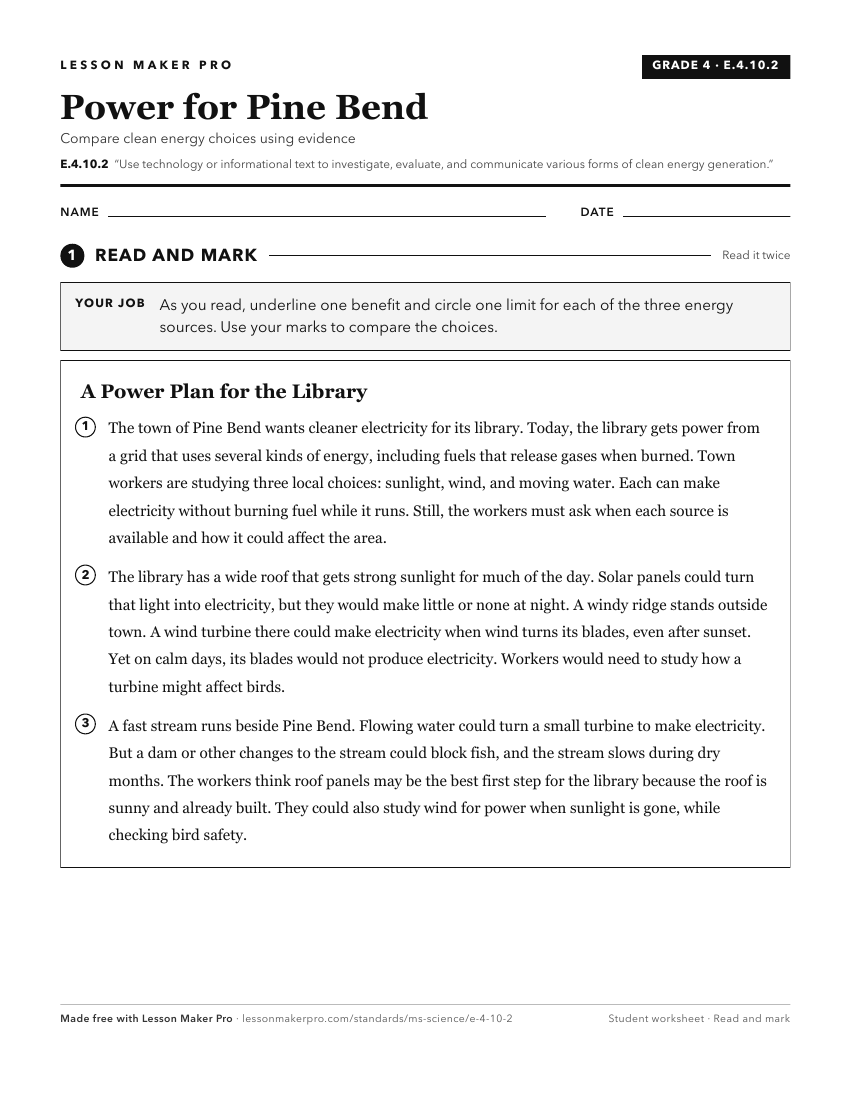
A ready-to-print activity worksheet aligned to E.4.10.2, with an answer key for the teacher on its own page. No account needed.
PDF, US Letter, prints cleanly in black and white.
Download the worksheetKeep exploring
Related Standards
- P.4.6A.5
Use informational text and technology resources to communicate technological breakthroughs made by historical figures in electricity (e.g. Alessandro Volta, Mic...
- PHS.7.1
Using digital resources, explore forms of energy (e.g., potential, kinetic, mechanical, chemical, electrical, thermal, radiant, and nuclear).
- E.1.10.1
Obtain and evaluate informational texts and other media to generate and answer questions about water sources and human uses of clean water.
- ENV.2.2
Investigate and research the pros and cons of using traditional sources of energy (e.g., fossil fuels) and alternative sources of energy (e.g., water, wind, geo...
Turn this exact standard into a lesson
Grade, subject, topic, and the complete standard are prefilled. Create one free, no account needed.
Also for this standard:Make a WorksheetMake a QuizMake a Sub Lesson