Mississippi Science PHY.3.9
The Standard
- PHY.3
- Students will develop an understanding of concepts related to work and energy.
Explore the kinetic theory in terms of kinetic energy of ideal gases using digital resources.
2026 Mississippi College- and Career-Readiness Standards for Science · Work and Energy
Teacher's field guide
What This Standard Means
What Students Need to Do
- Students use a gas simulation to change temperature and watch particles move. They connect higher temperature in Kelvin with greater average kinetic energy.
What Mastery Looks Like
- A student can predict that doubling the Kelvin temperature doubles the average kinetic energy. They can explain why particles in the same gas still move at different speeds.
Common Misconceptions
- Students may think doubling a temperature in Celsius doubles average kinetic energy. Some think every particle moves at the same speed, or that adding particles raises the average energy per particle.
How to Assess It
- Exit ticket: A gas warms from 300 K to 600 K. What happens to its average kinetic energy, and what would you expect to see in a particle simulation?
Lesson moves
Ways to Teach It
Use the PhET Gas Properties simulation to heat a gas while keeping volume and particle count fixed, then compare particle motion before and after.
Ask: Two gas samples have the same temperature but different particle counts. Do their particles have the same average kinetic energy? Explain.
Give pairs cards marked 150 K, 300 K, and 600 K; have them rank average kinetic energy and check their choices in the simulation.
Use a weather app's morning and afternoon temperatures to predict tire pressure changes, then test the prediction with a fixed-volume gas simulation.
Free download
Printable PHY.3.9 Worksheet
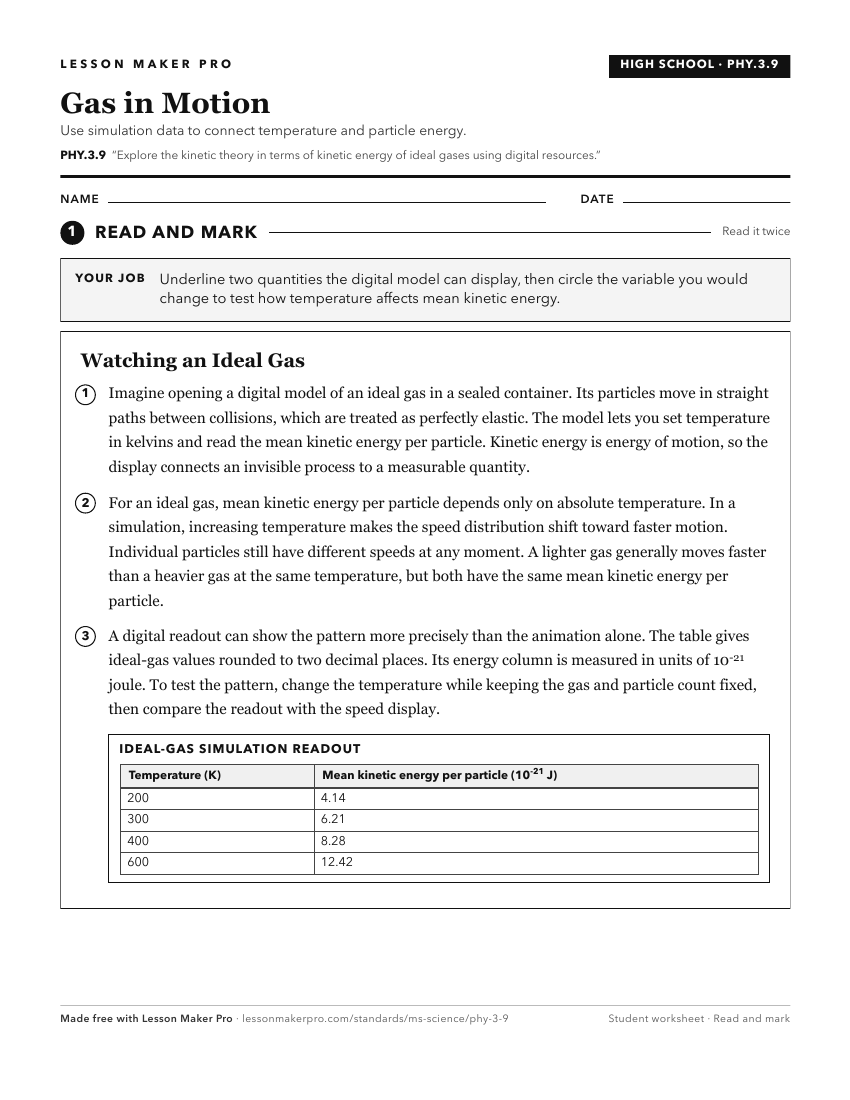
A ready-to-print activity worksheet aligned to PHY.3.9, with an answer key for the teacher on its own page. No account needed.
PDF, US Letter, prints cleanly in black and white.
Download the worksheetKeep exploring
Related Standards
- PHS.7.1
Using digital resources, explore forms of energy (e.g., potential, kinetic, mechanical, chemical, electrical, thermal, radiant, and nuclear).
- PHY.3.3
Through real-world applications, draw conclusions about mechanical potential energy and kinetic energy using online simulations and/or laboratory experiences.
- CHE.7.1
Analyze the behavior of ideal and real gases in terms of pressure, volume, temperature, and number of particles.
- P.6.6.7
Determine the relationships between the concepts of potential, kinetic, and thermal energy.
Turn this exact standard into a lesson
Grade, subject, topic, and the complete standard are prefilled. Create one free, no account needed.
Also for this standard:Make a WorksheetMake a QuizMake a Sub Lesson