Mississippi Science CHE.7.1
The Standard
- CHE.7
- Students will demonstrate an understanding of the structure and behavior of gases.
Analyze the behavior of ideal and real gases in terms of pressure, volume, temperature, and number of particles.
2026 Mississippi College- and Career-Readiness Standards for Science · Gas Laws
Teacher's field guide
What This Standard Means
What Students Need to Do
- Students predict how pressure and volume change when temperature or the number of particles changes. They use the ideal gas model, then explain why real gases can behave differently at high pressure or low temperature.
What Mastery Looks Like
- A student can use PV = nRT to predict a change, converting Celsius to kelvin first. They can explain how particle size and attraction cause real gases to differ from the prediction.
Common Misconceptions
- Students may use Celsius instead of kelvin in calculations. They may think adding gas always raises pressure, even when a flexible container expands. Some assume real gas particles take up no space.
How to Assess It
- Exit ticket: A sealed, rigid flask warms from 300 K to 600 K. Ask students to predict the pressure change, name what stays fixed, and give one reason a real gas might differ at high pressure.
Lesson moves
Ways to Teach It
Cap a plastic syringe filled to 20 mL with air, push the plunger to 10 mL, and describe how the resistance changes.
Ask why a real gas at high pressure might stray from PV = nRT, and have students discuss particle size and attraction.
Run a card sort: students match temperature or particle-count changes to pressure or volume changes, naming two variables held fixed.
Show tire-pressure readings from a cold morning and warm afternoon; students explain the difference assuming tire volume and air amount stay fixed.
Free download
Printable CHE.7.1 Worksheet
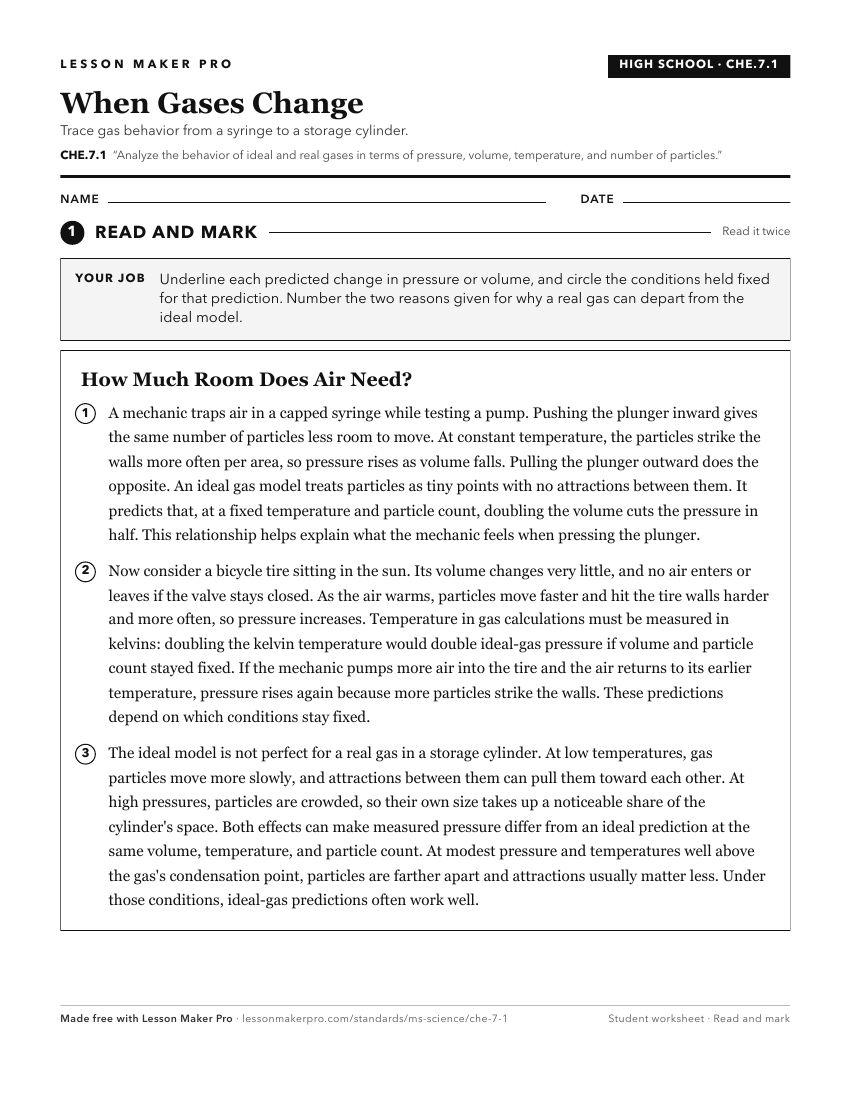
A ready-to-print activity worksheet aligned to CHE.7.1, with an answer key for the teacher on its own page. No account needed.
PDF, US Letter, prints cleanly in black and white.
Download the worksheetKeep exploring
Related Standards
- CHE.7.4
Use mathematical computations to describe relationships comparing pressure, temperature, volume, and number of particles, including Boyle’s law, Charles’s law, ...
- P.5.5A.2
Collect, analyze, and interpret data from measurements of the physical properties of solids, liquids, and gases (e.g., volume, shape, movement, and spacing of p...
- CHE.7.6
Use the ideal gas law to support the prediction of volume, mass, and number of particles produced in chemical reactions (i.e., gas stoichiometry).
- P.7.5B.2
Use evidence from multiple scientific investigations to communicate the relationships between pressure, volume, density, and temperature of a gas.
Turn this exact standard into a lesson
Grade, subject, topic, and the complete standard are prefilled. Create one free, no account needed.
Also for this standard:Make a WorksheetMake a QuizMake a Sub Lesson