Mississippi Science P.7.5B.2
The Standard
- P.7.5B
- Students will demonstrate an understanding about the effects of temperature and pressure on physical state, molecular motion, and molecular interactions.
Use evidence from multiple scientific investigations to communicate the relationships between pressure, volume, density, and temperature of a gas.
2026 Mississippi College- and Career-Readiness Standards for Science · Organization of Matter and Chemical Interactions
Teacher's field guide
What This Standard Means
What Students Need to Do
- Students compare results from two or more gas tests. They describe how pressure, volume, temperature, and density change, and identify what stayed the same in each test.
What Mastery Looks Like
- Students use measurements from separate tests to show that pressure rises as volume falls at steady temperature, while volume rises as temperature rises at steady pressure. They calculate how density changes when the same mass of gas takes up more or less space.
Common Misconceptions
- Students may think warming a gas always raises both pressure and volume, even when one is held steady. Some think compressing a sealed syringe adds gas particles, rather than packing the same mass into less space.
How to Assess It
- Exit ticket: At steady temperature, pressure rises from 100 to 200 kPa as volume falls from 40 to 20 mL; at steady pressure, warming gas from 300 to 600 K raises its volume from 20 to 40 mL. Use both results to explain the pressure and temperature patterns, then state how density changes in each test if gas mass stays the same.
Lesson moves
Ways to Teach It
Compress a capped syringe at three marked volumes, then compare balloon sizes on bottles in warm and cool water.
Write two sentences using syringe resistance and balloon size as evidence for how pressure and temperature affect gas volume.
Hand out gas data cards listing mass, pressure, volume, and temperature; have pairs match cards to claims and name the controlled variable.
Show bike tire gauge readings of 35 psi indoors and 32 psi outdoors; ask why pressure fell when the tire cooled.
Free download
Printable P.7.5B.2 Worksheet
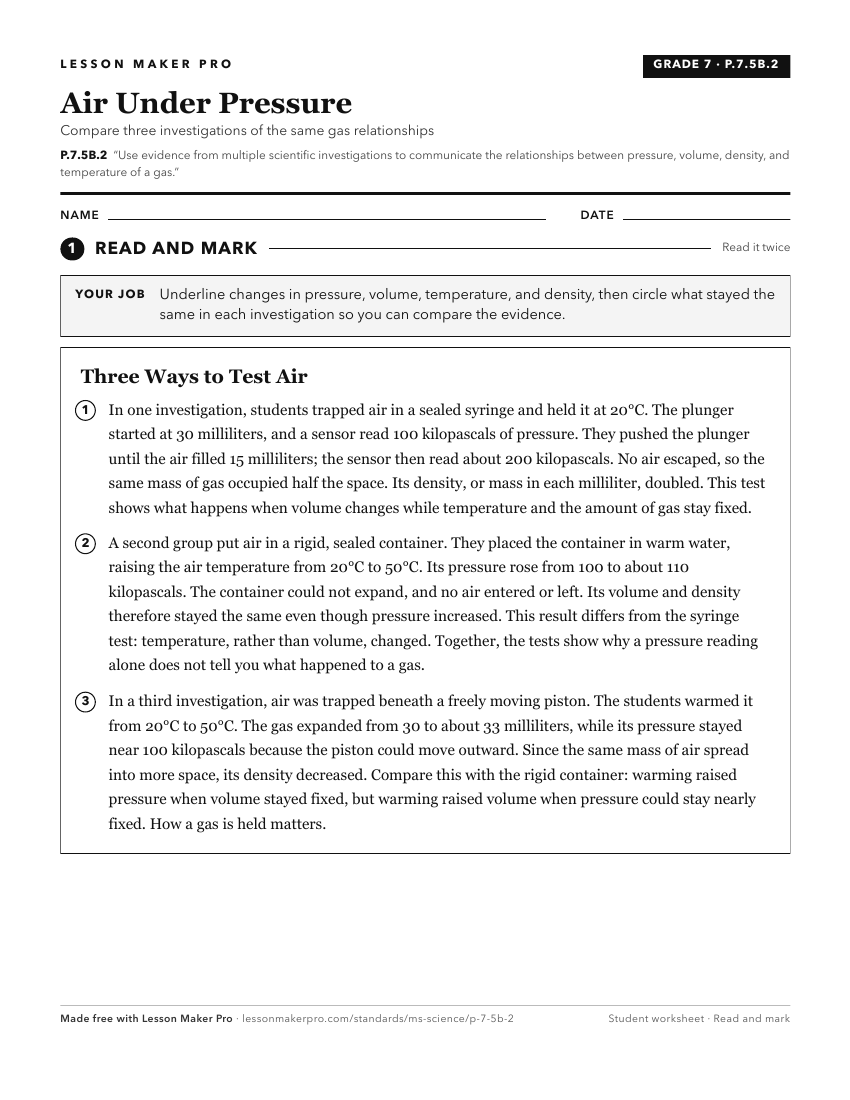
A ready-to-print activity worksheet aligned to P.7.5B.2, with an answer key for the teacher on its own page. No account needed.
PDF, US Letter, prints cleanly in black and white.
Download the worksheetKeep exploring
Related Standards
- CHE.7.4
Use mathematical computations to describe relationships comparing pressure, temperature, volume, and number of particles, including Boyle’s law, Charles’s law, ...
- CHE.7.7
Plan and conduct controlled scientific investigations to produce mathematical evidence that confirms that reactions involving gases conform to the law of conser...
- CHE.7.1
Analyze the behavior of ideal and real gases in terms of pressure, volume, temperature, and number of particles.
- P.7.5B.3
Ask questions to explain how density of matter (observable in various objects) is affected by a change in heat and/or pressure.
Turn this exact standard into a lesson
Grade, subject, topic, and the complete standard are prefilled. Create one free, no account needed.
Also for this standard:Make a WorksheetMake a QuizMake a Sub Lesson