Mississippi Science CHE.7.6
The Standard
- CHE.7
- Students will demonstrate an understanding of the structure and behavior of gases.
Use the ideal gas law to support the prediction of volume, mass, and number of particles produced in chemical reactions (i.e., gas stoichiometry).
2026 Mississippi College- and Career-Readiness Standards for Science · Gas Laws
Teacher's field guide
What This Standard Means
What Students Need to Do
- Students use a balanced reaction to find moles of gas produced from a given amount of reactant. They use pressure and temperature to predict the gas volume. They convert gas moles to mass or molecule count.
What Mastery Looks Like
- Given zinc and excess acid, a student can find the moles of hydrogen produced. They use kelvins and matching units to calculate its volume, then find its mass and molecule count.
Common Misconceptions
- Students may treat grams of reactant as moles of gas or ignore the coefficients in the equation. Some use Celsius in PV = nRT or choose a gas constant with the wrong pressure units. Others multiply gas volume by Avogadro’s number instead of converting moles to molecules.
How to Assess It
- Exit ticket: For Zn + 2HCl → ZnCl₂ + H₂, find the H₂ volume, mass, and molecule count from 0.10 mol Zn and excess HCl at 300 K and 1 atm. Show your steps using R = 0.0821 L·atm/(mol·K), H₂ = 2.0 g/mol, and 6.02 × 10²³ molecules/mol.
Lesson moves
Ways to Teach It
Connect a gas syringe to a flask, react measured baking soda with excess vinegar, and compare collected CO₂ with a calculated volume.
Write two sentences explaining why equal moles of H₂ and CO₂ occupy equal volumes at the same pressure and temperature but have different masses.
Give pairs reaction cards for zinc and acid, with zinc amounts; race to find hydrogen volume at 298 K and 1 atm.
Use a 60 L airbag at 1 atm and 300 K to calculate the moles and mass of N₂ needed.
Free download
Printable CHE.7.6 Worksheet
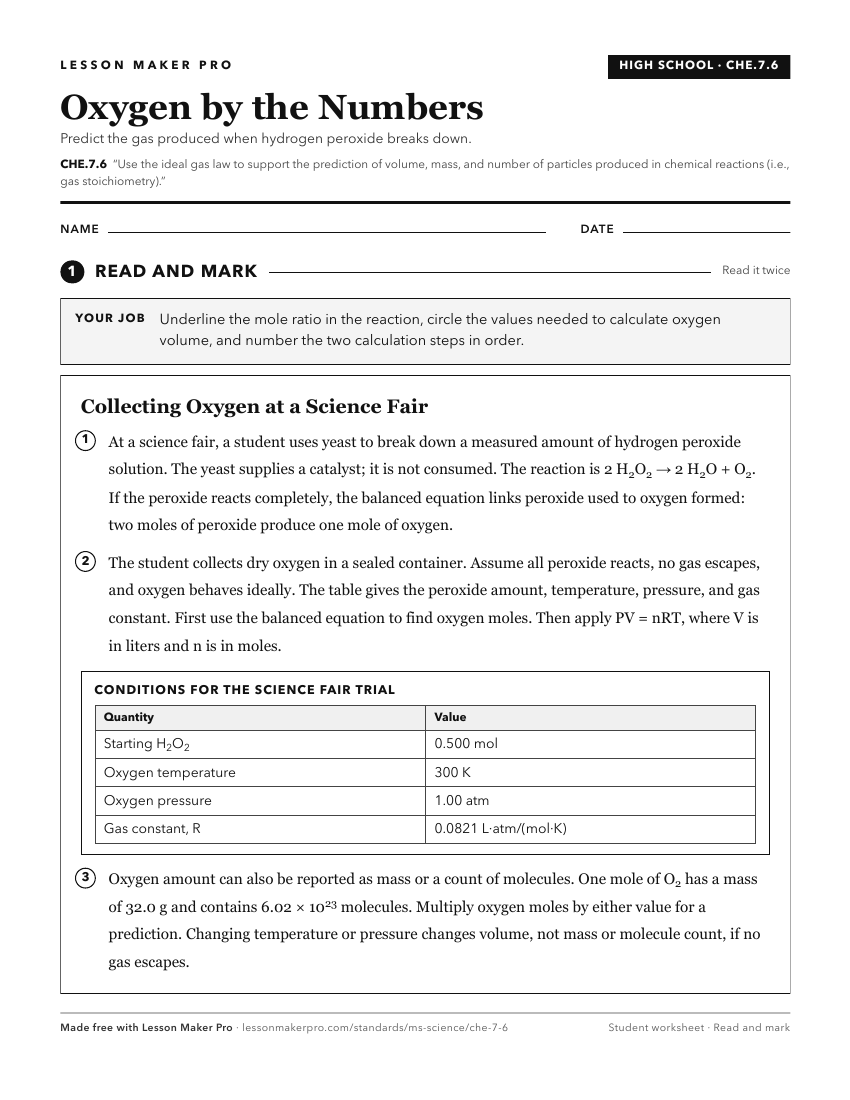
A ready-to-print activity worksheet aligned to CHE.7.6, with an answer key for the teacher on its own page. No account needed.
PDF, US Letter, prints cleanly in black and white.
Download the worksheetKeep exploring
Related Standards
- CHE.7.4
Use mathematical computations to describe relationships comparing pressure, temperature, volume, and number of particles, including Boyle’s law, Charles’s law, ...
- CHE.7.7
Plan and conduct controlled scientific investigations to produce mathematical evidence that confirms that reactions involving gases conform to the law of conser...
- CHE.7.1
Analyze the behavior of ideal and real gases in terms of pressure, volume, temperature, and number of particles.
- CHE.8.7
Use mathematical and computational analysis to predict the results of reactions using the concentration of solutions (i.e., solution stoichiometry).
Turn this exact standard into a lesson
Grade, subject, topic, and the complete standard are prefilled. Create one free, no account needed.
Also for this standard:Make a WorksheetMake a QuizMake a Sub Lesson