Mississippi Science CHE.8.7
The Standard
- CHE.8
- Students will demonstrate an understanding of the nature of properties of various types of chemical solutions.
Use mathematical and computational analysis to predict the results of reactions using the concentration of solutions (i.e., solution stoichiometry).
2026 Mississippi College- and Career-Readiness Standards for Science · Solutions
Teacher's field guide
What This Standard Means
What Students Need to Do
- Students use molarity and volume to find moles of dissolved reactants. They use a balanced equation to predict how much product forms and which reactant runs out.
What Mastery Looks Like
- Given two solutions, students calculate the moles of each reactant and identify the limiting reactant. They use that result to find the mass of product, with correct units.
Common Misconceptions
- Students may use milliliters instead of liters when calculating moles. They may pick the smaller volume as the limiting reactant without checking concentration or the mole ratio.
How to Assess It
- Exit ticket: For CaCl2 + Na2CO3 → CaCO3 + 2NaCl, mix 20.0 mL of 0.10 M CaCl2 and 30.0 mL of 0.10 M Na2CO3. Name the limiting reactant and predict the mass of CaCO3.
Lesson moves
Ways to Teach It
Mix 10 mL of 0.10 M calcium chloride with 20 mL of 0.10 M sodium carbonate; predict the calcium carbonate mass, then filter it.
Ask: Why can't you compare 10 mL and 20 mL alone to decide which reactant runs out first?
Deal pairs cards with AgNO3 and NaCl solution concentrations and volumes; race to calculate the AgCl mass using a balanced equation.
Model water softening: calculate how much 0.10 M sodium carbonate removes calcium from 500 mL of 0.010 M calcium chloride.
Free download
Printable CHE.8.7 Worksheet
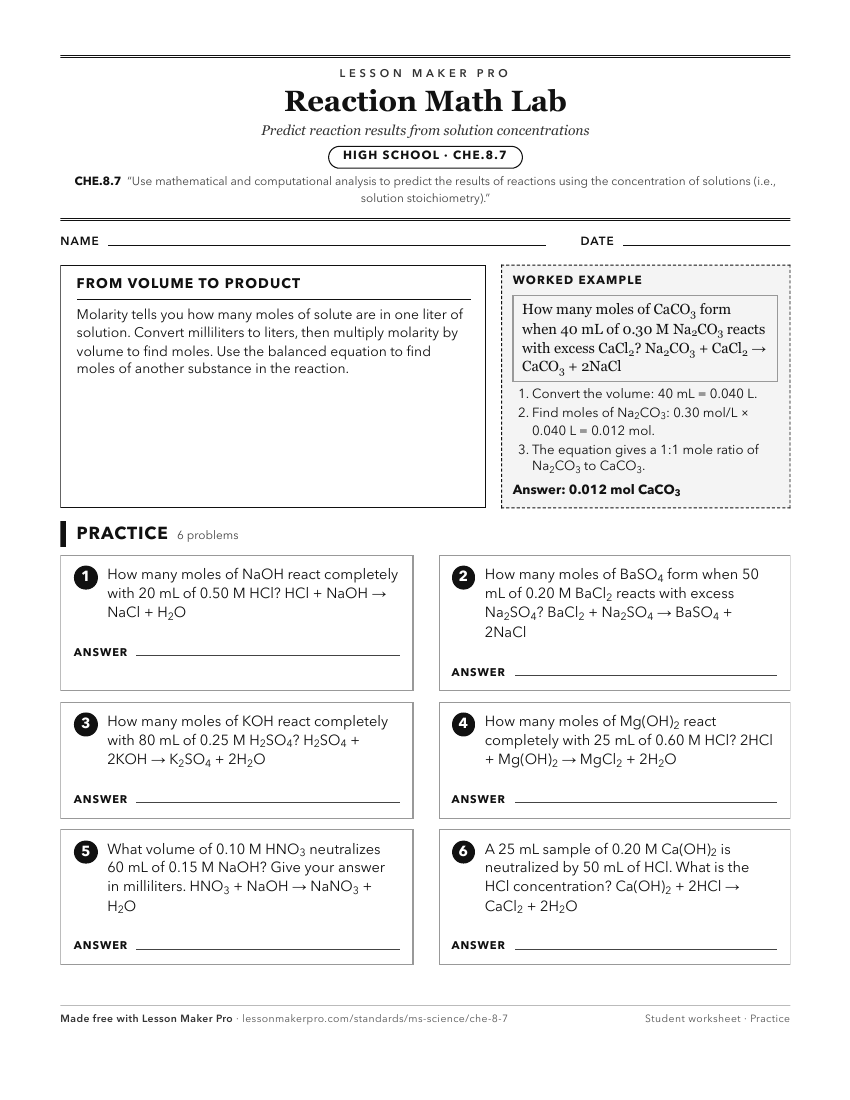
A ready-to-print activity worksheet aligned to CHE.8.7, with an answer key for the teacher on its own page. No account needed.
PDF, US Letter, prints cleanly in black and white.
Download the worksheetKeep exploring
Related Standards
- P.7.5D.1
Analyze evidence from scientific investigations to predict likely outcomes of chemical reactions.
- CHE.8.1
Use mathematical and computational analysis to quantitatively express the concentration of solutions using concepts such as molarity, percent by mass, and dilut...
- CHE.6.3
Use mathematics and computational analysis to represent the ratio of reactants and products in terms of masses, molecules, and moles (stoichiometry).
- CHE.11.3
Enrichment: Use mathematical and computational thinking to calculate an equilibrium constant expression for a reaction.
Turn this exact standard into a lesson
Grade, subject, topic, and the complete standard are prefilled. Create one free, no account needed.
Also for this standard:Make a WorksheetMake a QuizMake a Sub Lesson