Mississippi Science CHE.6.3
The Standard
- CHE.6
- Students will demonstrate an understanding of the types, causes, and effects of chemical reactions.
Use mathematics and computational analysis to represent the ratio of reactants and products in terms of masses, molecules, and moles (stoichiometry).
2026 Mississippi College- and Career-Readiness Standards for Science · Chemical Reactions
Teacher's field guide
What This Standard Means
What Students Need to Do
- Students balance an equation and use its coefficients to compare reactants and products in moles and molecules. They convert between grams, moles, and molecules to calculate how much reacts or forms.
What Mastery Looks Like
- Given a starting mass and a balanced equation, a student calculates the product's moles, mass, and molecule count. They show the mole ratio and use units to check each conversion.
Common Misconceptions
- Students may read a 2:1 mole ratio as a 2:1 gram ratio. They may change subscripts to balance an equation or multiply grams directly by Avogadro's number.
How to Assess It
- Exit ticket: For 2H2 + O2 → 2H2O, find the moles, grams, and molecules of water made from 4 g of H2 with excess O2. Use 2 g/mol for H2 and 18 g/mol for H2O.
Lesson moves
Ways to Teach It
Build six H2 molecules and three O2 molecules with colored beads, then rearrange the beads into H2O and count the products.
Ask students to explain why 2 mol of H2 reacts with 1 mol of O2, but 2 g of H2 does not react with 1 g of O2.
Enter 2, 4, and 6 g of hydrogen in a spreadsheet, then calculate water mass and molecule count with excess oxygen.
Read a fizzy tablet label and calculate the carbon dioxide molecules its listed sodium bicarbonate could produce with excess acid.
Free download
Printable CHE.6.3 Worksheet
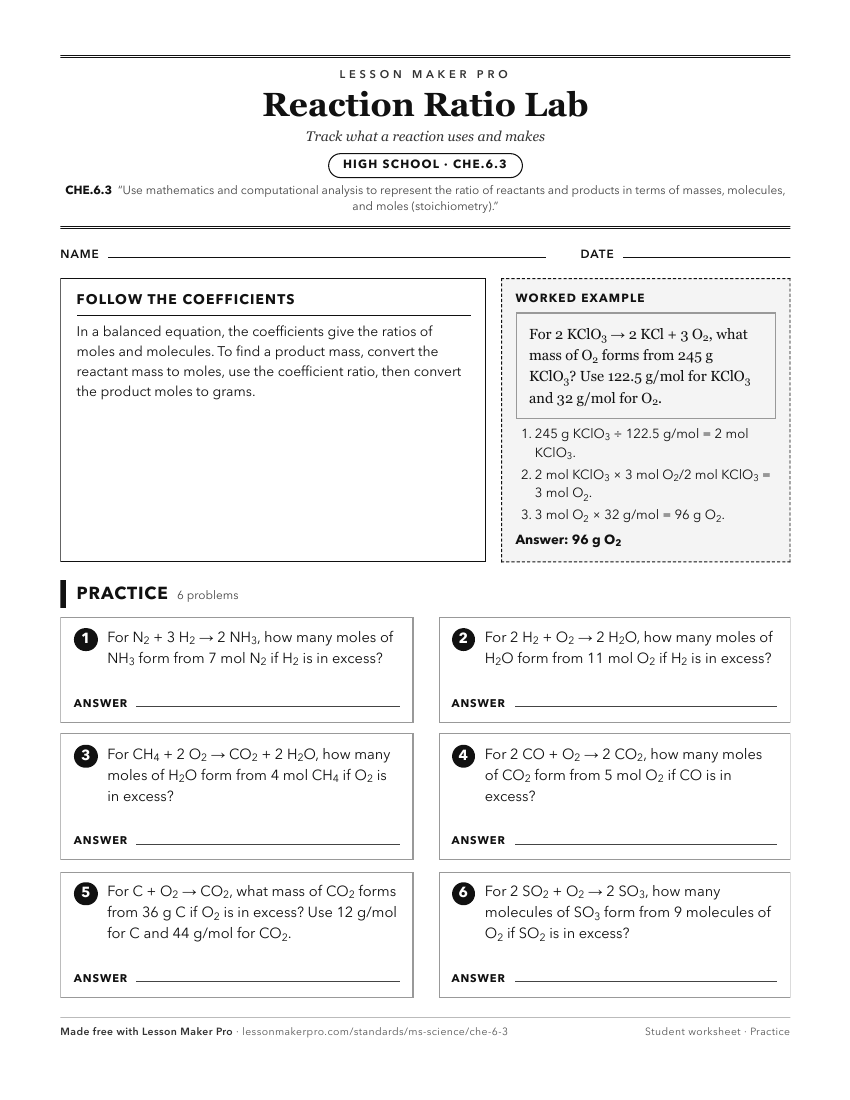
A ready-to-print activity worksheet aligned to CHE.6.3, with an answer key for the teacher on its own page. No account needed.
PDF, US Letter, prints cleanly in black and white.
Download the worksheetKeep exploring
Related Standards
- PHS.4.4
Use mathematical and computational analysis to examine evidence that mass is conserved in chemical reactions using simple stoichiometry problems (1:1 mole ratio...
- CHE.8.7
Use mathematical and computational analysis to predict the results of reactions using the concentration of solutions (i.e., solution stoichiometry).
- CHE.6.6
Use mathematics and computational analysis to support the concept of percent yield and limiting reagent.
- CHE.4.6
Use mathematical and computational analysis to determine the empirical formula and the percent composition of compounds.
Turn this exact standard into a lesson
Grade, subject, topic, and the complete standard are prefilled. Create one free, no account needed.
Also for this standard:Make a WorksheetMake a QuizMake a Sub Lesson