Mississippi Science P.7.5D.1
The Standard
- P.7.5D
- Students will demonstrate an understanding of chemical formulas and common chemical substances to predict the types of reactions and possible outcomes of the reactions.
Analyze evidence from scientific investigations to predict likely outcomes of chemical reactions.
2026 Mississippi College- and Career-Readiness Standards for Science · Organization of Matter and Chemical Interactions
Teacher's field guide
What This Standard Means
What Students Need to Do
- Students compare lab records for mixtures, noting what went in and what changed. They use those results to predict bubbles, temperature changes, or new solids in a later test.
What Mastery Looks Like
- Given a table of repeated tests, a student points to the trials that support a prediction and names the likely result. They explain when a changed ingredient or amount makes the prediction less certain.
Common Misconceptions
- Students may call dissolving a reaction because a solid disappears. They may treat any bubbles as proof that a new substance formed, even when the bubbles could be trapped air.
How to Assess It
- Give students this record: Vinegar and baking soda produced bubbles in two trials; water and baking soda did not. Ask, “What will you likely observe with fresh vinegar and baking soda? Which trials support your prediction?”
Lesson moves
Ways to Teach It
In two clear cups, mix baking soda with vinegar and with water, then record bubbles and temperature changes in a chart.
Display records for two mixtures that bubbled and one that only dissolved; ask, “Which results help predict gas in the next test?”
Deal pairs cards showing mixtures and results; have them match a new mixture to a past trial and explain their prediction.
Use a yeast, sugar, and warm water trial record to predict whether warm bread dough with yeast and sugar will rise.
Free download
Printable P.7.5D.1 Worksheet
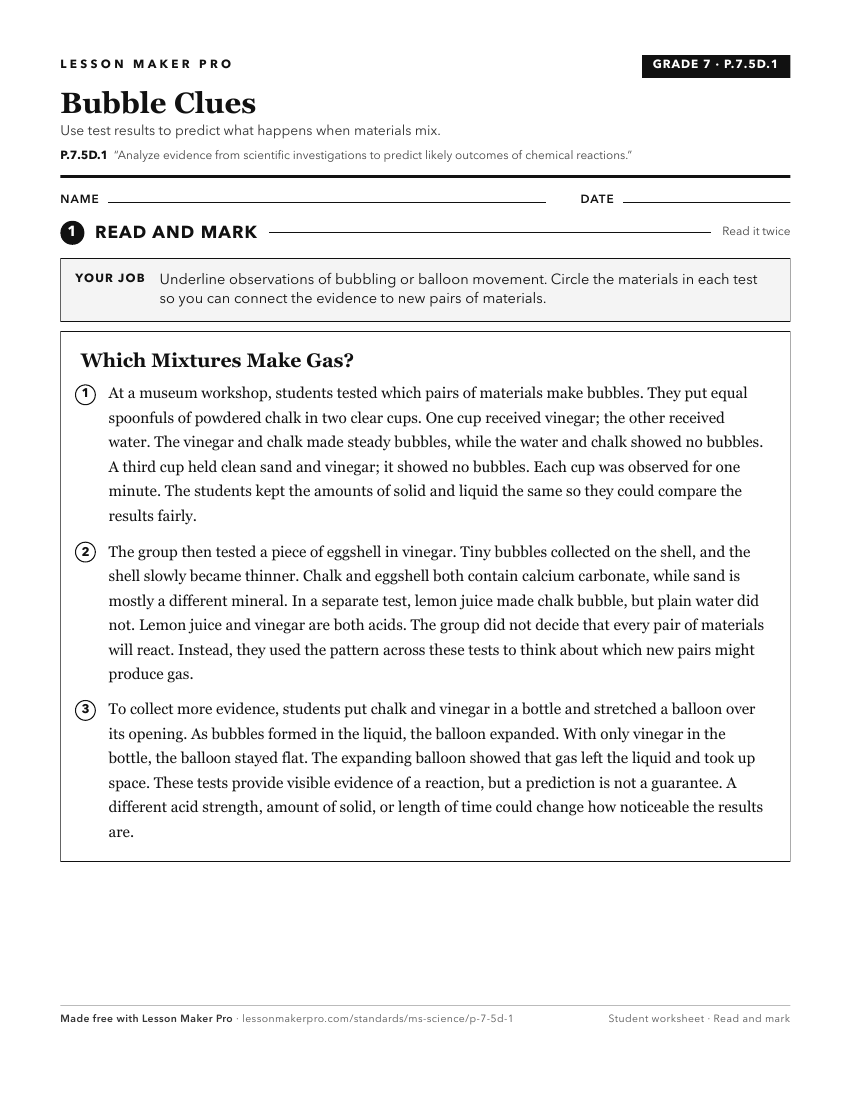
A ready-to-print activity worksheet aligned to P.7.5D.1, with an answer key for the teacher on its own page. No account needed.
PDF, US Letter, prints cleanly in black and white.
Download the worksheetKeep exploring
Related Standards
- CHE.6.7
Plan and conduct a controlled scientific investigation to produce mathematical evidence to predict and confirm the limiting reagent and percent yield in the rea...
- CHE.6.2
Plan, conduct, and communicate the results of investigations to demonstrate different types of simple chemical reactions.
- P.7.5D.2
Design and conduct scientific investigations to support evidence that chemical reactions (e.g., cooking, combustion, rusting, decomposition, photosynthesis, and...
- CHE.8.7
Use mathematical and computational analysis to predict the results of reactions using the concentration of solutions (i.e., solution stoichiometry).
Turn this exact standard into a lesson
Grade, subject, topic, and the complete standard are prefilled. Create one free, no account needed.
Also for this standard:Make a WorksheetMake a QuizMake a Sub Lesson