Mississippi Science CHE.6.2
The Standard
- CHE.6
- Students will demonstrate an understanding of the types, causes, and effects of chemical reactions.
Plan, conduct, and communicate the results of investigations to demonstrate different types of simple chemical reactions.
2026 Mississippi College- and Career-Readiness Standards for Science · Chemical Reactions
Teacher's field guide
What This Standard Means
What Students Need to Do
- Students plan and run small reactions, keeping quantities fixed and recording changes such as bubbles or a new solid. They use the starting and ending substances to identify each reaction type and explain what they observed.
What Mastery Looks Like
- A student writes clear steps another group could follow and records results in a data table. They classify each reaction from its reactants and products, then use their observations to support their conclusion.
Common Misconceptions
- Students may assume any bubbles mean a reaction is decomposition. They may treat a color change as proof of a reaction without checking what substances formed. Some describe what happened but leave out the reactants and products.
How to Assess It
- Give students these results: yeast added to hydrogen peroxide produced bubbles, and calcium chloride mixed with sodium carbonate produced a white solid. Provide the reaction equations and ask students to name each reaction type, cite an observation, and write one step for repeating either test.
Lesson moves
Ways to Teach It
In goggles, mix yeast with 3% hydrogen peroxide, then mix prepared calcium chloride and sodium carbonate solutions; record bubbles and solids.
Ask pairs: Which observation supports a new substance forming, and why do bubbles alone not identify the reaction type?
Give groups cards with reactant and product formulas; have them sort decomposition, synthesis, and double replacement examples and defend one choice.
Show a photo of mineral scale on a faucet; ask students how dissolved calcium and carbonate could produce the solid coating.
Free download
Printable CHE.6.2 Worksheet
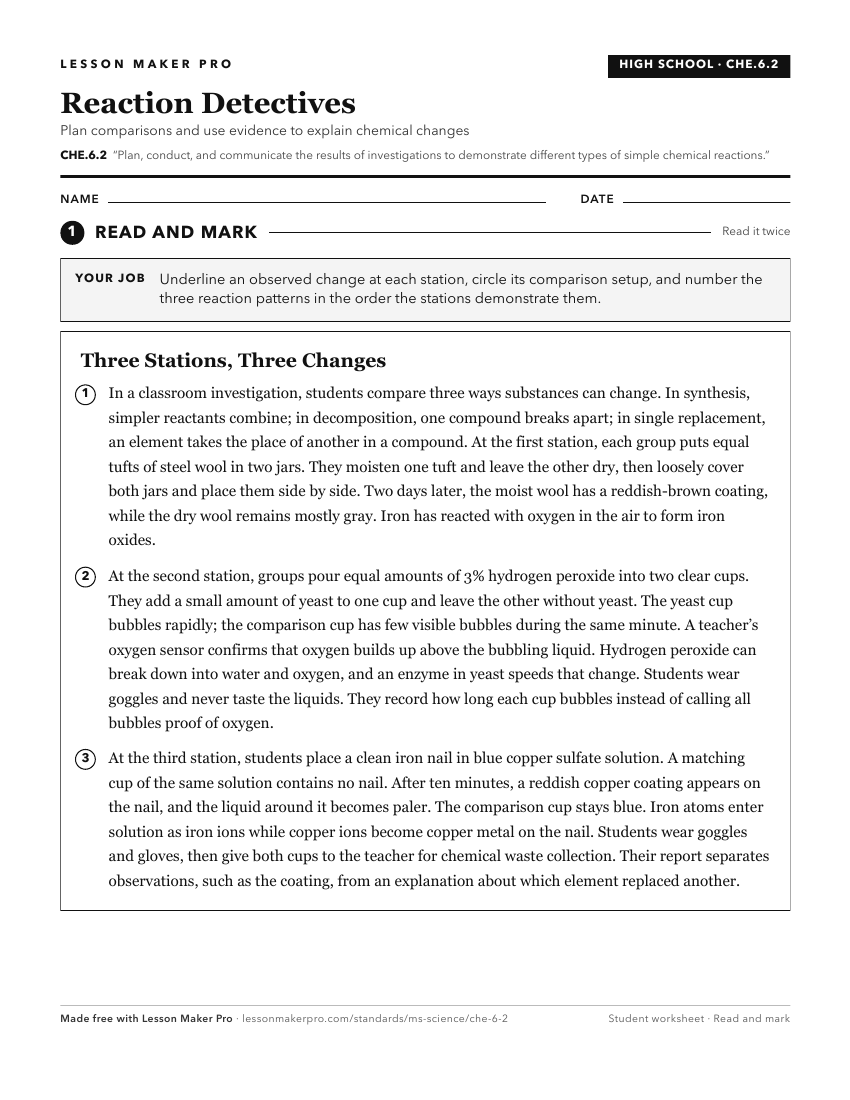
A ready-to-print activity worksheet aligned to CHE.6.2, with an answer key for the teacher on its own page. No account needed.
PDF, US Letter, prints cleanly in black and white.
Download the worksheetKeep exploring
Related Standards
- P.7.5D.1
Analyze evidence from scientific investigations to predict likely outcomes of chemical reactions.
- P.7.5D.2
Design and conduct scientific investigations to support evidence that chemical reactions (e.g., cooking, combustion, rusting, decomposition, photosynthesis, and...
- P.5.5C.1
Analyze and communicate the results of chemical changes that result in the formation of new materials (e.g., decaying, burning, rusting, or cooking).
- PHS.4.1
Design and conduct experiments to investigate physical and chemical changes of various household products (e.g., rusting, sour milk, crushing, grinding, tearing...
Turn this exact standard into a lesson
Grade, subject, topic, and the complete standard are prefilled. Create one free, no account needed.
Also for this standard:Make a WorksheetMake a QuizMake a Sub Lesson