Mississippi Science PHS.4.1
The Standard
- PHS.4
- Students will analyze changes in matter and the relationship of these changes to the law of conservation of matter and energy.
Design and conduct experiments to investigate physical and chemical changes of various household products (e.g., rusting, sour milk, crushing, grinding, tearing, boiling, and freezing) and reactions of common chemicals that produce color changes or gases.
2026 Mississippi College- and Career-Readiness Standards for Science · The Law of Conservation of Matter and Energy
Teacher's field guide
What This Standard Means
What Students Need to Do
- Students plan and run tests on household materials, such as melting ice and mixing vinegar with baking soda. They record changes in state, color, gas production, and mass. They use those observations to decide whether a change is physical or chemical.
What Mastery Looks Like
- Students keep amounts and containers the same when comparing tests. They explain why melting ice is physical and vinegar reacting with baking soda is chemical, using their observations. They account for the gas when explaining why a sealed bag keeps the same mass.
Common Misconceptions
- Students may call boiling water a chemical change because it makes bubbles, or call crushed chalk a new substance because it looks different. They may think gas that escapes has vanished, or that any color change proves a new substance formed.
How to Assess It
- Exit ticket: A sealed bag of vinegar and baking soda weighs 40 g before mixing and 40 g after it inflates. What shows a chemical change, why is the mass unchanged, and how is this different from melting ice?
Lesson moves
Ways to Teach It
Have pairs weigh sealed bags before and after changes, one holding melting ice, another with vinegar and baking soda mixed inside.
Ask students to explain why bubbles from boiling water differ from bubbles when vinegar meets baking soda.
Hand out cards labeled tearing paper, rusting iron, freezing juice, and mixing vinegar with baking soda; groups sort and defend each choice.
Show photos of a rusty bike chain and a frozen water bottle; students label each change and cite one clue.
Free download
Printable PHS.4.1 Worksheet
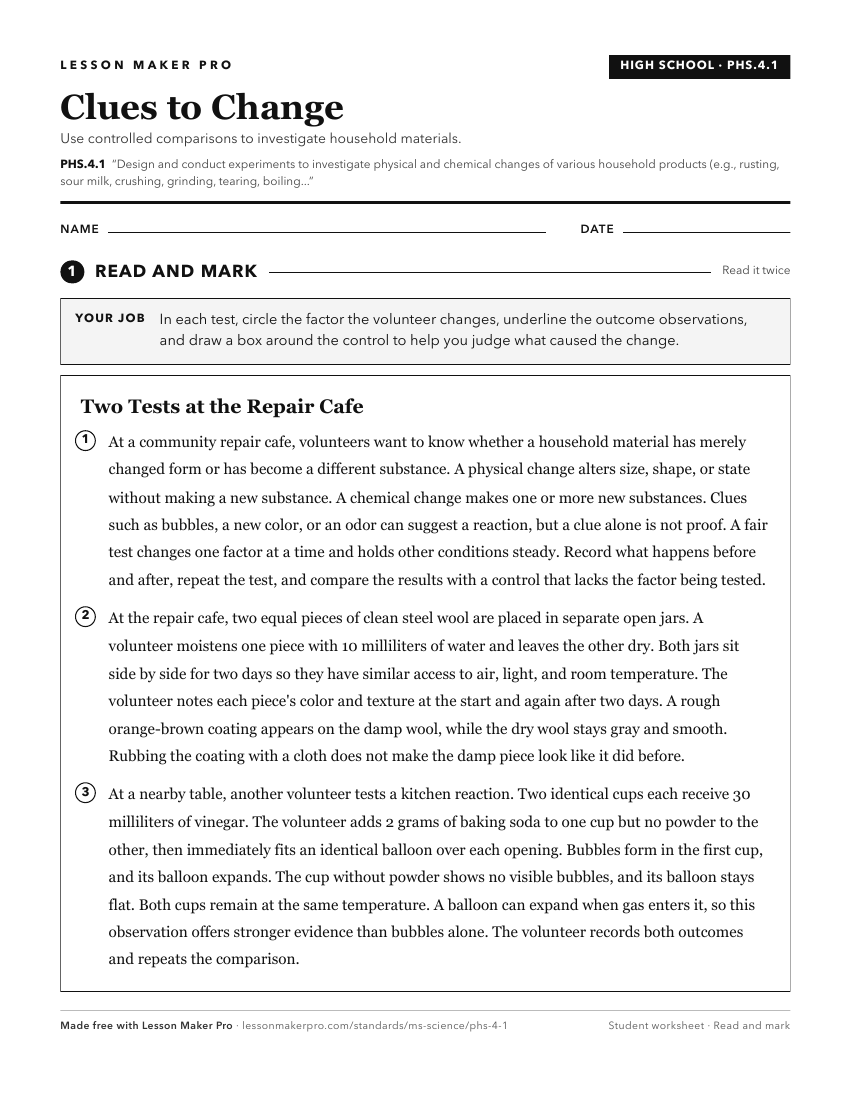
A ready-to-print activity worksheet aligned to PHS.4.1, with an answer key for the teacher on its own page. No account needed.
PDF, US Letter, prints cleanly in black and white.
Download the worksheetKeep exploring
Related Standards
- CHE.6.2
Plan, conduct, and communicate the results of investigations to demonstrate different types of simple chemical reactions.
- P.7.5D.2
Design and conduct scientific investigations to support evidence that chemical reactions (e.g., cooking, combustion, rusting, decomposition, photosynthesis, and...
- PHS.4.2
Design and conduct investigations to produce evidence that mass is conserved in chemical reactions (e.g., vinegar and baking soda in a Ziploc© bag).
- P.5.5C.1
Analyze and communicate the results of chemical changes that result in the formation of new materials (e.g., decaying, burning, rusting, or cooking).
Turn this exact standard into a lesson
Grade, subject, topic, and the complete standard are prefilled. Create one free, no account needed.
Also for this standard:Make a WorksheetMake a QuizMake a Sub Lesson