Mississippi Science P.5.5C.1
The Standard
- P.5.5C
- Students will demonstrate an understanding of the difference between physical and chemical changes.
Analyze and communicate the results of chemical changes that result in the formation of new materials (e.g., decaying, burning, rusting, or cooking).
2026 Mississippi College- and Career-Readiness Standards for Science · Organization of Matter and Chemical Interactions
Teacher's field guide
What This Standard Means
What Students Need to Do
- Students compare materials before and after cooking, rusting, burning, or decaying. They record what changed and explain when the results show that a new material formed.
What Mastery Looks Like
- A student can compare a clean nail with a rusty nail and identify the reddish, flaky coating as rust. They can explain why rusting is different from bending the nail.
Common Misconceptions
- Students may call melting ice or tearing paper a chemical change because the material looks different. They may treat any color change or bubble as proof that a new material formed.
How to Assess It
- Show photos of a bent nail and a rusty nail. Ask: 'Which change formed a new material? Name it and give one detail from the photo that supports your answer.'
Lesson moves
Ways to Teach It
In open cups, add baking soda to vinegar and to water; students sketch both results and label where gas bubbles appear.
Show a rusty nail and a bent nail; ask students to write which formed a new material and what they observed.
Deal cards showing ice melting, paper tearing, a nail rusting, and bread baking; partners sort them and explain each choice.
Compare toasted and untoasted bread; students describe the darker color, new smell, and firmer crust in a kitchen science note.
Free download
Printable P.5.5C.1 Worksheet
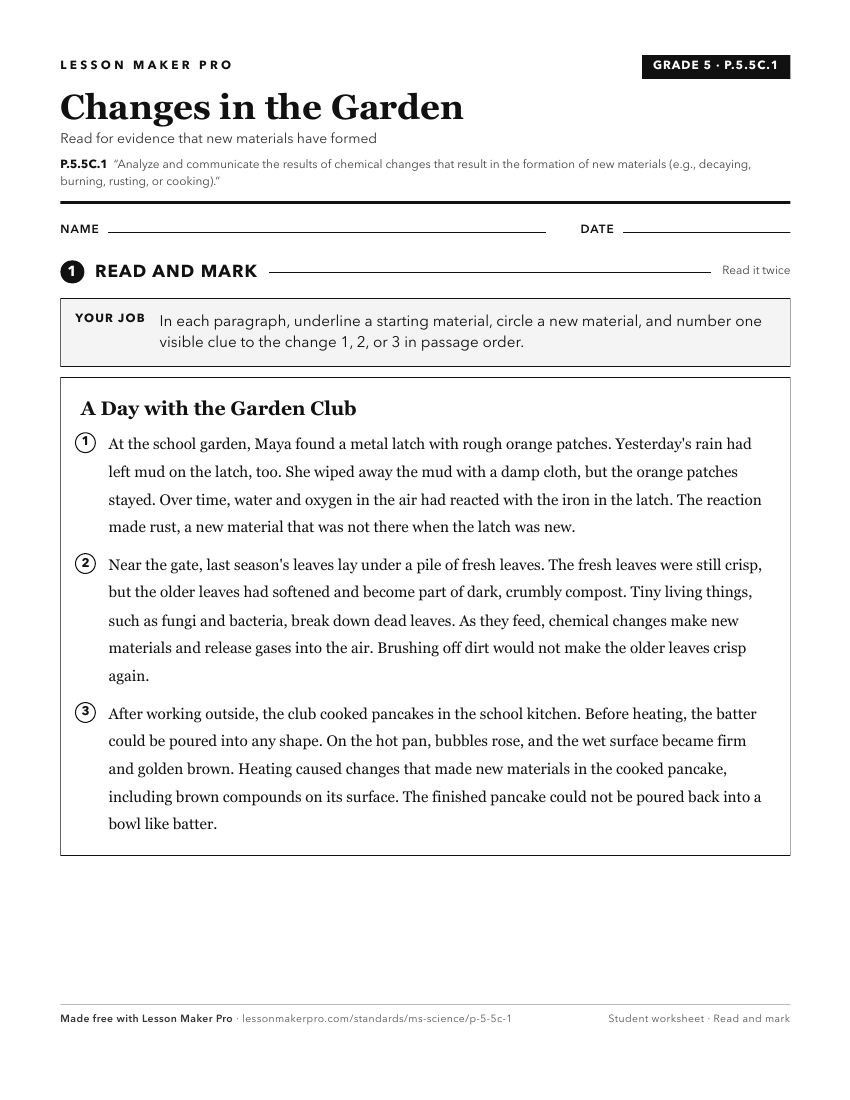
A ready-to-print activity worksheet aligned to P.5.5C.1, with an answer key for the teacher on its own page. No account needed.
PDF, US Letter, prints cleanly in black and white.
Download the worksheetKeep exploring
Related Standards
- P.5.5C.2
Analyze and communicate the results of physical changes to a substance that results in a reversible change (e.g., changes in states of matter with the addition ...
- P.7.5A.2
Analyze and interpret qualitative data to describe substances using chemical properties (the ability to burn or rust).
- P.7.5D.2
Design and conduct scientific investigations to support evidence that chemical reactions (e.g., cooking, combustion, rusting, decomposition, photosynthesis, and...
- PHS.4.1
Design and conduct experiments to investigate physical and chemical changes of various household products (e.g., rusting, sour milk, crushing, grinding, tearing...
Turn this exact standard into a lesson
Grade, subject, topic, and the complete standard are prefilled. Create one free, no account needed.
Also for this standard:Make a WorksheetMake a QuizMake a Sub Lesson