Mississippi Science CHE.6.7
The Standard
- CHE.6
- Students will demonstrate an understanding of the types, causes, and effects of chemical reactions.
Plan and conduct a controlled scientific investigation to produce mathematical evidence to predict and confirm the limiting reagent and percent yield in the reaction. Analyze quantitative data, draw conclusions, and communicate findings. Compare and analyze class data for validity.
2026 Mississippi College- and Career-Readiness Standards for Science · Chemical Reactions
Teacher's field guide
What This Standard Means
What Students Need to Do
- Students plan a test that changes one reactant amount while keeping other conditions the same. They use mole ratios to predict which reactant runs out and how much product can form. They measure the product, calculate percent yield, and compare class results.
What Mastery Looks Like
- Given starting amounts and a balanced equation, students identify the limiting reactant and calculate the expected product. They use a measured amount to find percent yield and check which reactant remains. They can spot a class result that needs a closer look, such as a yield above 100%.
Common Misconceptions
- Students may pick the smaller starting mass as the limiting reactant without converting to moles. They may divide expected yield by measured yield, rather than the other way around. They may treat a high yield as extra product instead of checking for spills or measurement errors.
How to Assess It
- Exit ticket: Mg + 2HCl → MgCl₂ + H₂. If 0.20 mol Mg and 0.30 mol HCl produce 0.12 mol H₂, identify the limiting reactant, calculate percent yield, name one condition to keep the same, and explain why another group's 110% yield is suspect.
Lesson moves
Ways to Teach It
Mix 2 g baking soda with either 10 g or 40 g of 5% vinegar in open cups; weigh each setup before mixing and after fizzing.
Post three groups' percent yields and notes about spills; ask which result seems unreliable and what evidence supports that call.
Give pairs cards with balanced equations, reactant masses, and measured product masses; have them race to find the limiting reactant and percent yield.
Show a bath bomb recipe with 168 g baking soda and 96 g citric acid; provide the equation and ask which ingredient remains.
Free download
Printable CHE.6.7 Worksheet
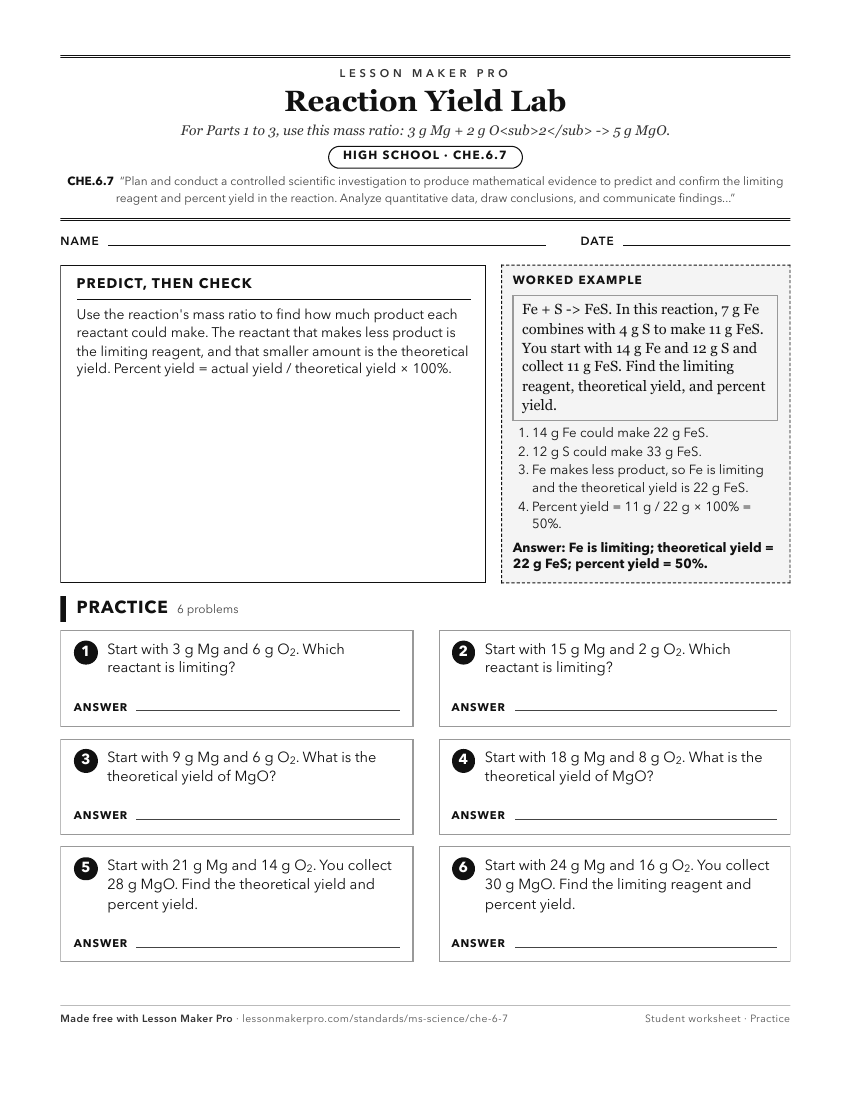
A ready-to-print activity worksheet aligned to CHE.6.7, with an answer key for the teacher on its own page. No account needed.
PDF, US Letter, prints cleanly in black and white.
Download the worksheetKeep exploring
Related Standards
- CHE.7.7
Plan and conduct controlled scientific investigations to produce mathematical evidence that confirms that reactions involving gases conform to the law of conser...
- CHE.4.8
Plan and conduct controlled scientific investigations to produce mathematical evidence of the empirical composition of a compound.
- CHE.6.5
Plan and conduct a controlled scientific investigation to produce mathematical evidence that mass is conserved. Use percent error to analyze the accuracy of res...
- CHE.6.6
Use mathematics and computational analysis to support the concept of percent yield and limiting reagent.
Turn this exact standard into a lesson
Grade, subject, topic, and the complete standard are prefilled. Create one free, no account needed.
Also for this standard:Make a WorksheetMake a QuizMake a Sub Lesson