Mississippi Science P.6.6.7
The Standard
- P.6.6
- Students will demonstrate an understanding of Newton’s laws of motion using real world models and examples.
Determine the relationships between the concepts of potential, kinetic, and thermal energy.
2026 Mississippi College- and Career-Readiness Standards for Science · Motions, Forces, and Energy
Teacher's field guide
What This Standard Means
What Students Need to Do
- Students track energy as an object changes height, moves, and slows down. They explain how stored energy can become motion energy, and how friction transfers some motion energy into thermal energy.
What Mastery Looks Like
- A student can label a ball at the top of a ramp with gravitational potential energy and a rolling ball with kinetic energy. They can explain that friction makes the ball slow down and warms the surfaces it touches.
Common Misconceptions
- Students may think a moving object has no potential energy, even when it is still above the ground. They may also say energy disappears when an object stops, rather than transferring to the surroundings as thermal energy.
How to Assess It
- Show a sketch of a ball rolling down a ramp and stopping on carpet. Ask students to label where it has potential energy, kinetic energy, and where thermal energy increases.
Lesson moves
Ways to Teach It
Roll a marble down a book ramp onto smooth paper and felt, then compare how far it travels on each surface.
Ask students to explain why a skateboarder slows on rough pavement but speeds up going downhill.
Give pairs three cards showing a ball at the top of a ramp, rolling, and stopped; have them label energy changes.
Show a photo of bicycle brakes and ask where the bike's motion energy goes when the rider stops.
Free download
Printable P.6.6.7 Worksheet
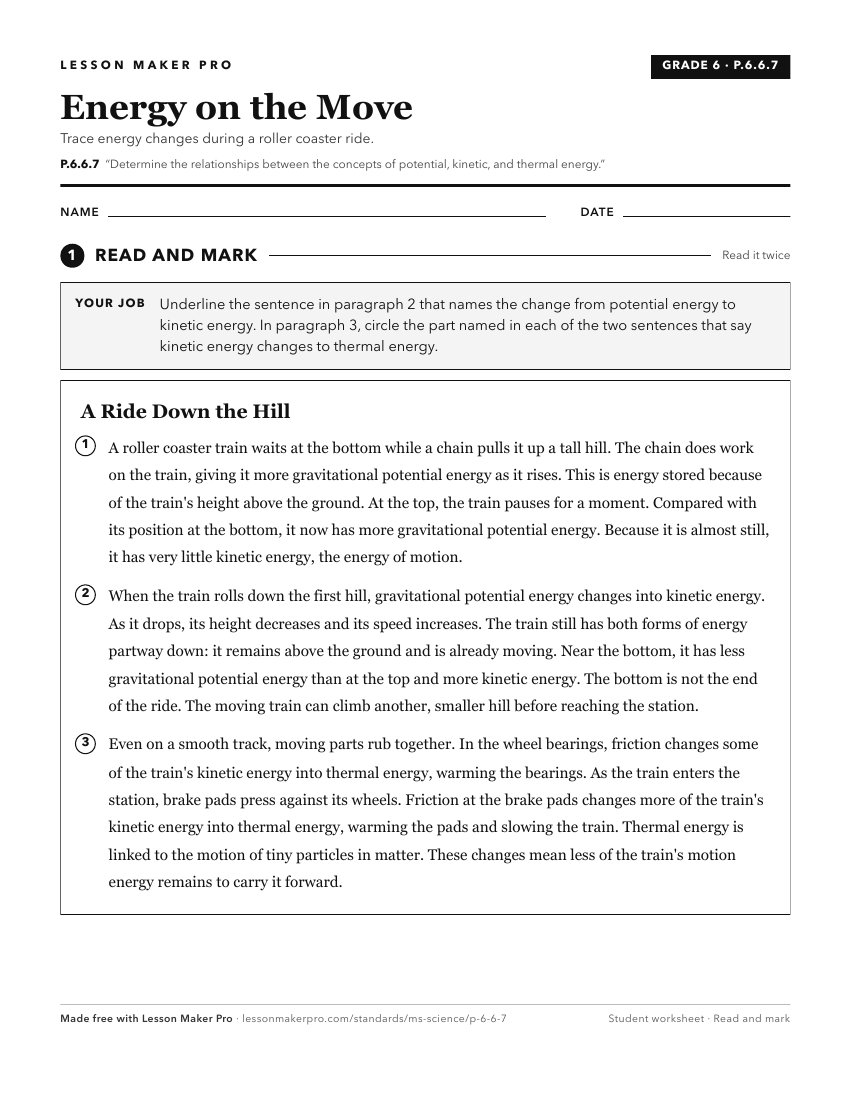
A ready-to-print activity worksheet aligned to P.6.6.7, with an answer key for the teacher on its own page. No account needed.
PDF, US Letter, prints cleanly in black and white.
Download the worksheetKeep exploring
Related Standards
- PHS.7.3
Using mathematical and computational analysis, calculate potential and kinetic energy based on given data. Use equations such as PE=mgh and KE=½ mv2.
- PHS.7.1
Using digital resources, explore forms of energy (e.g., potential, kinetic, mechanical, chemical, electrical, thermal, radiant, and nuclear).
- PHY.3.3
Through real-world applications, draw conclusions about mechanical potential energy and kinetic energy using online simulations and/or laboratory experiences.
- PHS.7.2
Use scientific investigations to explore the transformation of energy from one type to another (e.g., potential to kinetic energy, and mechanical, chemical, ele...
Turn this exact standard into a lesson
Grade, subject, topic, and the complete standard are prefilled. Create one free, no account needed.
Also for this standard:Make a WorksheetMake a QuizMake a Sub Lesson