Mississippi Science PHY.3.11
The Standard
- PHY.3
- Students will develop an understanding of concepts related to work and energy.
Enrichment: Use an engineering design process to design and build a themed Rube Goldberg-type machine that has six or more steps and complete a desired task (e.g., pop a balloon, fill a bottle, shoot a projectile, or raise an object 35 cm) within an allotted time. Include a poster that demonstrates the calculations of the energy transformation or efficiency of the machine. *
2026 Mississippi College- and Career-Readiness Standards for Science · Work and Energy
Teacher's field guide
What This Standard Means
What Students Need to Do
- Students build and test a chain reaction with at least six actions that lifts a weight 35 cm before a timer runs out. They measure the starting and ending heights and use those measurements in an energy calculation on a poster.
What Mastery Looks Like
- The machine completes the lift on repeated timed trials. The student labels where stored energy becomes motion. Their poster shows input and useful output energy in joules, then calculates percent efficiency as output divided by input.
Common Misconceptions
- Students may count six objects instead of six separate actions. They may say energy lost to friction is destroyed, or divide input energy by output energy. Some use 35 instead of 0.35 meters in the energy calculation.
How to Assess It
- Give students this prompt: A 0.20 kg marble drops 0.50 m and lifts a 0.10 kg weight 0.35 m. Using g = 10 m/s², calculate the input energy, useful output energy, and efficiency.
Lesson moves
Ways to Teach It
Give teams cardboard ramps, dominoes, toy cars, string, and pulleys to build and time a six-action chain that lifts a weight.
Ask students to write where the energy goes when a marble strikes a domino and why the final lift gains less energy.
Hand out cards with input and output energies; pairs calculate efficiency and sort the machines from most to least efficient.
Bring in a bicycle; students trace energy from the pedals to the rear wheel and point out where friction reduces useful output.
Free download
Printable PHY.3.11 Worksheet
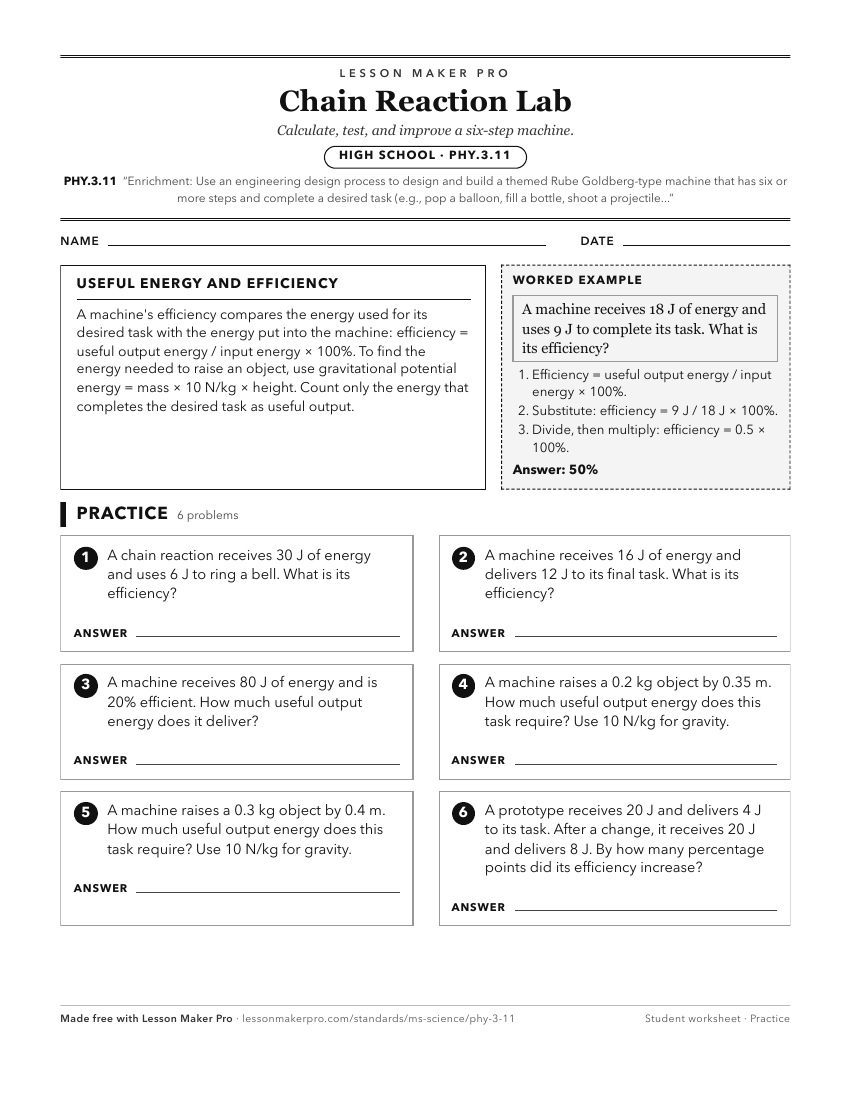
A ready-to-print activity worksheet aligned to PHY.3.11, with an answer key for the teacher on its own page. No account needed.
PDF, US Letter, prints cleanly in black and white.
Download the worksheetKeep exploring
Related Standards
- PHS.6.4
Enrichment: Use an engineering design process to design and build a musical instrument to demonstrate the influence of resonance on music. *
- ENV.4.5
Enrichment: Use an engineering design process to define a problem, design, construct, evaluate, and improve a device or method to reduce or prevent human impact...
- PHS.9.3
Enrichment: Use an engineering design process to construct a working electric motor to perform a task. Communicate the design process and comparisons of task pe...
- PHS.6.7
Enrichment: Use an engineering design process to design and construct an apparatus that forms images to project on a screen or magnify images using lenses and/o...
Turn this exact standard into a lesson
Grade, subject, topic, and the complete standard are prefilled. Create one free, no account needed.
Also for this standard:Make a WorksheetMake a QuizMake a Sub Lesson