Mississippi Science PHY.2
Standard Cluster
Students will develop an understanding of concepts related to Newtonian dynamics. Identify forces acting on a system by applying Newton’s laws mathematically and graphically (e.g., vector and scalar quantities). Use models such as free-body diagrams to explain and predict the motion of an object according to Newton's law of motion, including circular motion. Use mathematical and graphical techniques to solve vector problems and find net forces acting on a body using free-body diagrams and/or online simulations. Use vectors and mathematical analysis to explore the 2D motion of objects. (i.e., projectile and circular motion). Use mathematical and computational analysis to derive simple equations of motion for various systems using Newton’s second law (e.g., net force equations). Use mathematical and computational analysis to explore forces (e.g., friction, force applied, normal, and tension). Analyze real-world applications to draw conclusions about Newton’s three laws of motion using online simulations, probe systems, and/or laboratory experiences. Design an experiment to determine the forces acting on a stationary object on an inclined plane. Test your conclusions. Draw diagrams of forces applied to an object and predict the angle of incline that will result in unbalanced forces acting on the object. Apply the effects of the universal gravitation law to generate a digital/physical graph, and interpret the forces between two masses, acceleration due to gravity, and planetary motion (e.g., situations where g is constant, as in falling bodies). Explain centripetal acceleration while undergoing uniform circular motion to explore Kepler’s third law using online simulations, models, and/or probe systems.
2026 Mississippi College- and Career-Readiness Standards for Science · Newton’s Laws
Cluster contents
Standards in This Cluster
PHY.2 is a cluster heading. These are the individual standards under it.
- PHY.2.1
Identify forces acting on a system by applying Newton’s laws mathematically and graphically (e.g., vector and scalar quantities).
- PHY.2.2
Use models such as free-body diagrams to explain and predict the motion of an object according to Newton's law of motion, including circular motion.
- PHY.2.3
Use mathematical and graphical techniques to solve vector problems and find net forces acting on a body using free-body diagrams and/or online simulations.
- PHY.2.4
Use vectors and mathematical analysis to explore the 2D motion of objects. (i.e., projectile and circular motion).
- PHY.2.5
Use mathematical and computational analysis to derive simple equations of motion for various systems using Newton’s second law (e.g., net force equations).
- PHY.2.6
Use mathematical and computational analysis to explore forces (e.g., friction, force applied, normal, and tension).
- PHY.2.7
Analyze real-world applications to draw conclusions about Newton’s three laws of motion using online simulations, probe systems, and/or laboratory experiences.
- PHY.2.8
Design an experiment to determine the forces acting on a stationary object on an inclined plane. Test your conclusions.
- PHY.2.9
Draw diagrams of forces applied to an object and predict the angle of incline that will result in unbalanced forces acting on the object.
- PHY.2.10
Apply the effects of the universal gravitation law to generate a digital/physical graph, and interpret the forces between two masses, acceleration due to gravit...
- PHY.2.11
Explain centripetal acceleration while undergoing uniform circular motion to explore Kepler’s third law using online simulations, models, and/or probe systems.
Teacher's field guide
What This Cluster Means
What Students Need to Do
- Students draw force diagrams, add force arrows, and use net force to calculate acceleration. They explain projectile motion in horizontal and vertical parts and identify the inward acceleration of an object moving in a circle. They test a ramp prediction and graph how gravitational force changes with distance.
What Mastery Looks Like
- Given a ramp angle and a static friction coefficient, students label the forces and predict whether a block slips. They use force components to calculate acceleration and explain why a turning object accelerates inward. They identify force pairs on different objects and read a graph showing gravity weakening as distance grows.
Common Misconceptions
- Students may draw a forward force on a thrown ball after release or point a ramp’s normal force straight up. They mistake balanced forces on one object for action-reaction forces on two objects. They may say a turning car has no acceleration because its speed stays constant.
How to Assess It
- Exit ticket: A 2 kg block slides down a frictionless 30° ramp. Draw and label its force diagram, then find its acceleration down the ramp using g = 10 m/s².
Lesson moves
Ways to Teach It
Raise one end of a board under a block, mark the angle where it first slips, and draw its weight, normal force, and friction.
A ball rolls off a table while another is released from its edge. Which lands first? Draw motion arrows to explain.
Give pairs a 2 kg mass and arrows of 6 N right and 8 N up. Race to calculate acceleration and direction.
Show a satellite orbit image and ask students to draw Earth's gravitational force at three points, then explain why the satellite turns.
Free download
Printable PHY.2 Worksheet
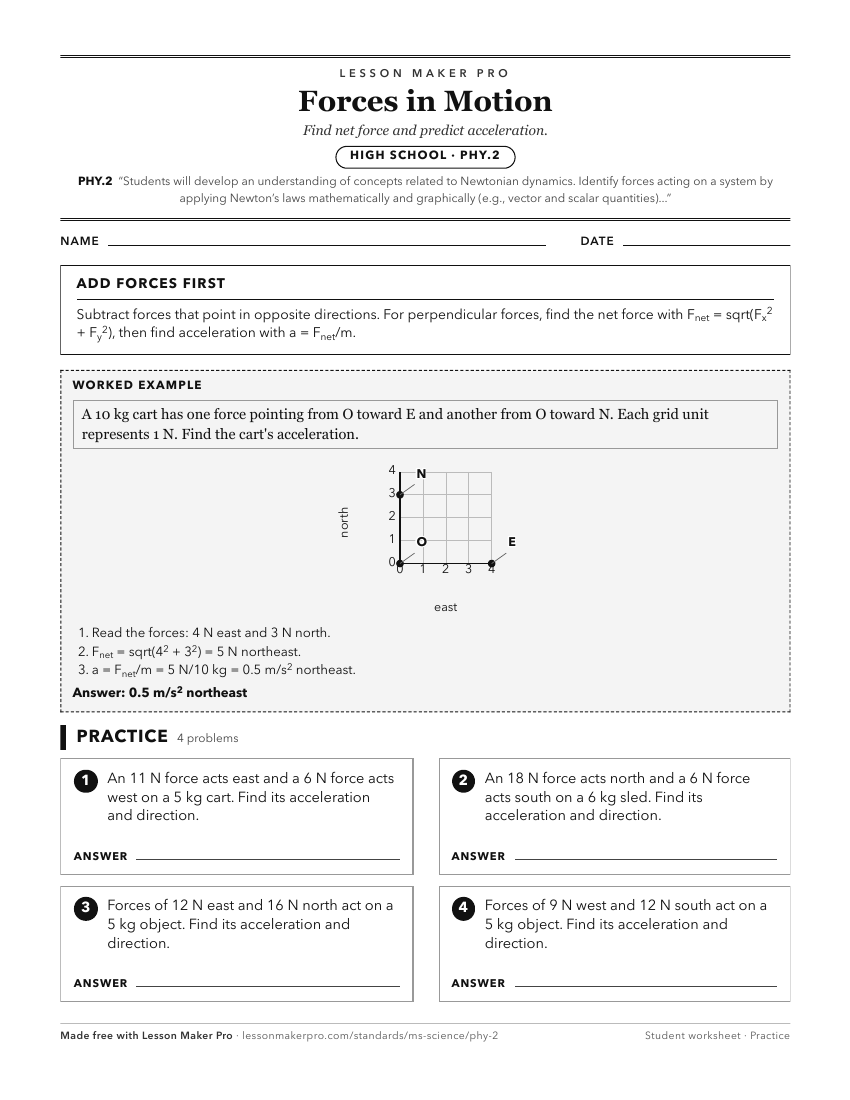
A ready-to-print activity worksheet aligned to PHY.2, with an answer key for the teacher on its own page. No account needed.
PDF, US Letter, prints cleanly in black and white.
Download the worksheetKeep exploring
Related Standards
- ESS.1B
Students will develop an understanding of Earth, the solar system, and the laws that predict the motion of celestial bodies.
- P.5.6
Students will demonstrate an understanding of the factors that affect the motion of an object through a study of Newton's Laws of Motion.
- P.6.6
Students will demonstrate an understanding of Newton’s laws of motion using real world models and examples.
- PHY.3
Students will develop an understanding of concepts related to work and energy.
Turn this cluster into a lesson
Grade, subject, topic, and the complete cluster are prefilled. Create one free, no account needed.
Also for this cluster:Make a WorksheetMake a QuizMake a Sub Lesson