Mississippi Science PHY.2.8
The Standard
- PHY.2
- Students will develop an understanding of concepts related to Newtonian dynamics.
Design an experiment to determine the forces acting on a stationary object on an inclined plane. Test your conclusions.
2026 Mississippi College- and Career-Readiness Standards for Science · Newton’s Laws
Teacher's field guide
What This Standard Means
What Students Need to Do
- Students plan a test with a block on a ramp. They identify gravity, the ramp's push, and friction, then use measurements to work out each force. They change the angle or an applied pull to check their prediction.
What Mastery Looks Like
- A student draws weight straight down and the ramp's push perpendicular to its surface. They show friction acting in the direction needed to keep the block still. They calculate the forces from the block's mass, ramp angle, and any spring-scale reading, then check a second trial.
Common Misconceptions
- Students may draw the ramp's push straight up or set it equal to the block's full weight. They may assume friction always points uphill or is always as large as it can be.
How to Assess It
- Exit ticket: A 0.5 kg block rests on a 30° ramp, with g = 10 m/s². Draw and calculate its three forces, then describe one change to the ramp or applied pull that would test your prediction.
Lesson moves
Ways to Teach It
Place a block on a propped-up board, measure its mass and angle, then pull uphill with a spring scale and record resting readings.
Ask: If the uphill pull increases while the block stays still, when does friction switch from uphill to downhill?
Give pairs ramp sketches with different spring-scale readings; have students place force-arrow cards and explain friction's direction.
Test a phone case on a tilted clipboard, then explain why a grippy dashboard mat keeps it from sliding.
Free download
Printable PHY.2.8 Worksheet
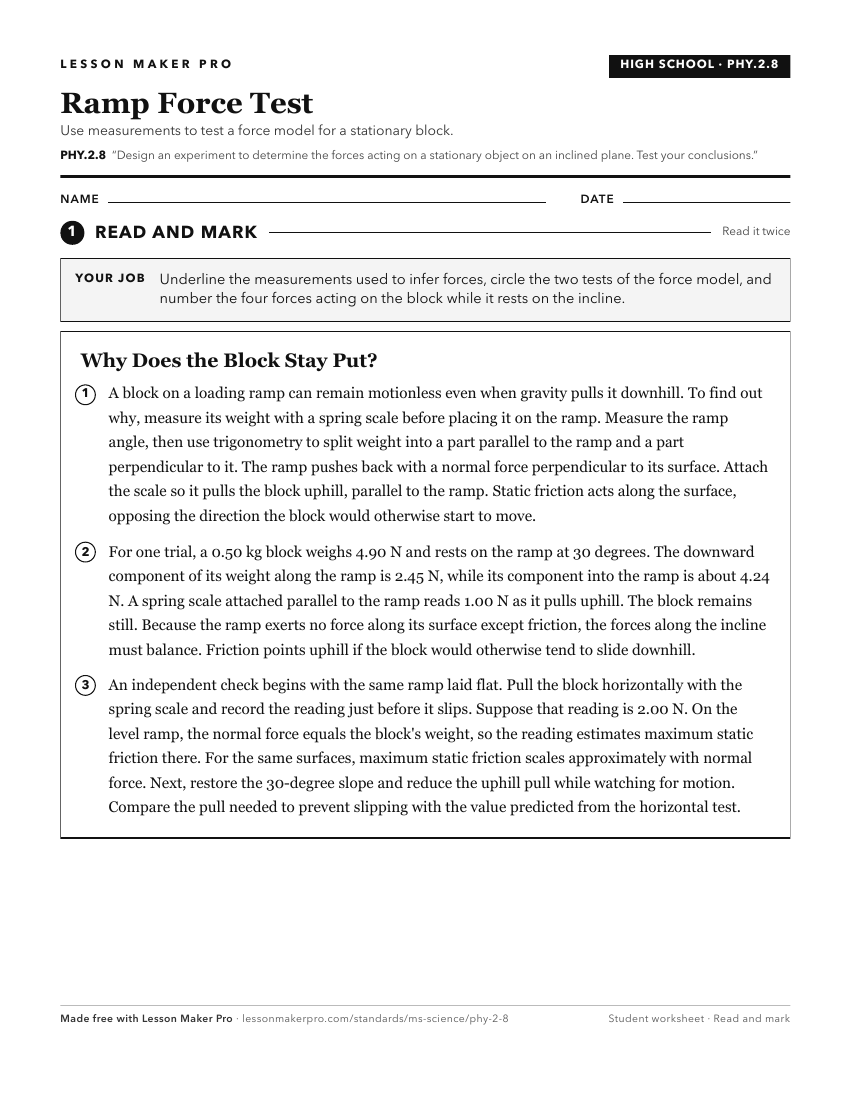
A ready-to-print activity worksheet aligned to PHY.2.8, with an answer key for the teacher on its own page. No account needed.
PDF, US Letter, prints cleanly in black and white.
Download the worksheetKeep exploring
Related Standards
- P.6.6.6
Investigate forces (gravity, friction, drag, lift, thrust) acting on objects (e.g., airplane, bicycle helmets). Use data to explain the differences between the ...
- P.3.6.2
Plan an experiment to investigate the relationship between a force applied to an object (e.g., friction, gravity) and resulting motion of the object.
- PHY.2.9
Draw diagrams of forces applied to an object and predict the angle of incline that will result in unbalanced forces acting on the object.
- P.5.6.4
Plan and conduct scientific investigations to test the effects of balanced and unbalanced forces on the speed and/or direction of objects in motion.
Turn this exact standard into a lesson
Grade, subject, topic, and the complete standard are prefilled. Create one free, no account needed.
Also for this standard:Make a WorksheetMake a QuizMake a Sub Lesson