Mississippi Science PHY.2.9
The Standard
- PHY.2
- Students will develop an understanding of concepts related to Newtonian dynamics.
Draw diagrams of forces applied to an object and predict the angle of incline that will result in unbalanced forces acting on the object.
2026 Mississippi College- and Career-Readiness Standards for Science · Newton’s Laws
Teacher's field guide
What This Standard Means
What Students Need to Do
- Students draw the forces on an object resting on a ramp. They use the diagram to predict when raising the ramp will make the object slide.
What Mastery Looks Like
- A student draws weight straight down, the normal force perpendicular to the ramp, and friction up the ramp. They compare the downhill part of gravity with the maximum static friction to explain which angle starts a slide.
Common Misconceptions
- Some students draw gravity along the ramp or the normal force straight up. Others assume friction can always keep the object still, even on a steep ramp. The angle where sliding starts also depends on the surfaces in contact.
How to Assess It
- A block starts at rest: the downhill part of gravity is 3 N at 15° and 6 N at 30°, while friction can act up the ramp with at most 4 N. Draw force arrows at both angles and circle the angle where the block starts sliding.
Lesson moves
Ways to Teach It
Place an eraser on a board, raise one end slowly, and use a phone level to record the angle when it slides.
Sketch force arrows for an eraser on cardboard and wax paper, then explain why each surface might have a different sliding angle.
Give pairs cards showing downhill pull and maximum friction; have them sort ramp angles into stays put or slides and sketch arrows.
Show a photo of a loading ramp, then have students draw forces on a crate and predict whether making the ramp steeper starts a slide.
Free download
Printable PHY.2.9 Worksheet
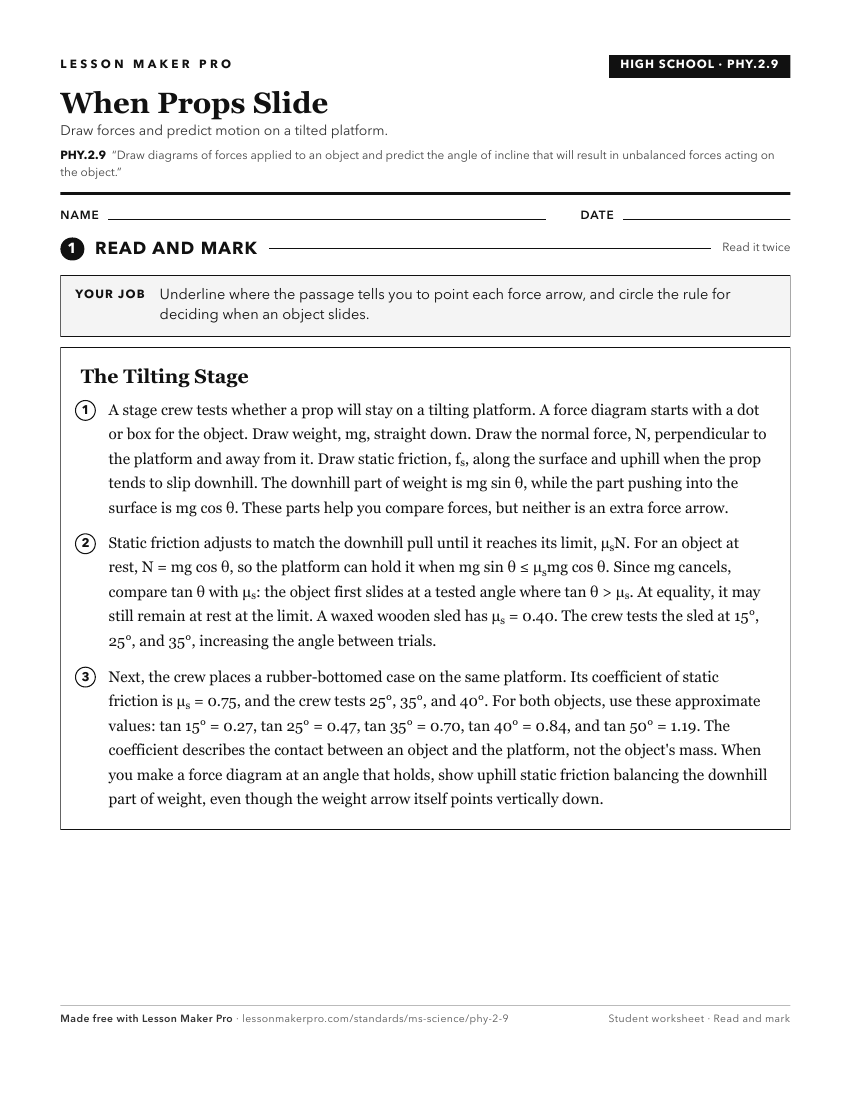
A ready-to-print activity worksheet aligned to PHY.2.9, with an answer key for the teacher on its own page. No account needed.
PDF, US Letter, prints cleanly in black and white.
Download the worksheetKeep exploring
Related Standards
- PHY.2.8
Design an experiment to determine the forces acting on a stationary object on an inclined plane. Test your conclusions.
- PHY.2.3
Use mathematical and graphical techniques to solve vector problems and find net forces acting on a body using free-body diagrams and/or online simulations.
- PHY.2.6
Use mathematical and computational analysis to explore forces (e.g., friction, force applied, normal, and tension).
- P.6.6.2
Use mathematical computation and diagrams to calculate the sum of forces acting on various objects.
Turn this exact standard into a lesson
Grade, subject, topic, and the complete standard are prefilled. Create one free, no account needed.
Also for this standard:Make a WorksheetMake a QuizMake a Sub Lesson