Mississippi Science P.5.6
Standard Cluster
Students will demonstrate an understanding of the factors that affect the motion of an object through a study of Newton's Laws of Motion. Obtain and communicate information describing gravity's effect on an object. Predict the future motion of various objects based on past observation and measurement of position, direction, and speed. Develop and use models to explain how the amount or type of force, both contact and non-contact, affects the motion of an object. Plan and conduct scientific investigations to test the effects of balanced and unbalanced forces on the speed and/or direction of objects in motion. Predict how a change of force, mass, and/or friction affects the motion of an object to convert potential energy into kinetic energy. Design a system to increase the effects of friction on the motion of an object (e.g., non-slip surfaces or vehicle braking systems or flaps on aircraft wings). Use an engineering design process to define the problem, design, construct, evaluate, and improve the system. *
2026 Mississippi College- and Career-Readiness Standards for Science · Motions, Forces, and Energy
Cluster contents
Standards in This Cluster
P.5.6 is a cluster heading. These are the individual standards under it.
- P.5.6.1
Obtain and communicate information describing gravity's effect on an object.
- P.5.6.2
Predict the future motion of various objects based on past observation and measurement of position, direction, and speed.
- P.5.6.3
Develop and use models to explain how the amount or type of force, both contact and non-contact, affects the motion of an object.
- P.5.6.4
Plan and conduct scientific investigations to test the effects of balanced and unbalanced forces on the speed and/or direction of objects in motion.
- P.5.6.5
Predict how a change of force, mass, and/or friction affects the motion of an object to convert potential energy into kinetic energy.
- P.5.6.6
Design a system to increase the effects of friction on the motion of an object (e.g., non-slip surfaces or vehicle braking systems or flaps on aircraft wings). ...
Teacher's field guide
What This Cluster Means
What Students Need to Do
- Students measure an object's position, direction, and speed to predict where it will go next. They test how pushes, gravity, mass, and friction affect motion, and use arrows to show forces. They build and improve a brake that uses friction.
What Mastery Looks Like
- Students use timed measurements to predict a toy car's next position and direction. They use force arrows to explain why it stays still, speeds up, or slows down. They explain how stored energy at the top of a ramp becomes motion, and how mass or friction changes the result.
Common Misconceptions
- Students may think a moving car needs a constant push, rather than noticing that friction slows it. They may think gravity acts only when something falls, or that heavier objects always fall faster. They may think balanced forces mean no forces are acting.
How to Assess It
- Show a toy car at 0, 20, and 40 cm at one-second intervals. Ask students where it will be after three seconds if its motion stays the same, then have them draw force arrows and explain what sandpaper would change.
Lesson moves
Ways to Teach It
Release one toy car from the same ramp height onto bare paper and sandpaper; measure stopping distances and label gravity and friction arrows.
Ask, "Why does a book stay still on a desk but slow down when slid?" Have students draw and compare force arrows.
Hand pairs four one-second position cards for a rolling ball; have them predict its next position, direction, and speed.
Tape felt or rubber under a toy car as a brake; measure stopping distance, revise the pad, and retest.
Free download
Printable P.5.6 Worksheet
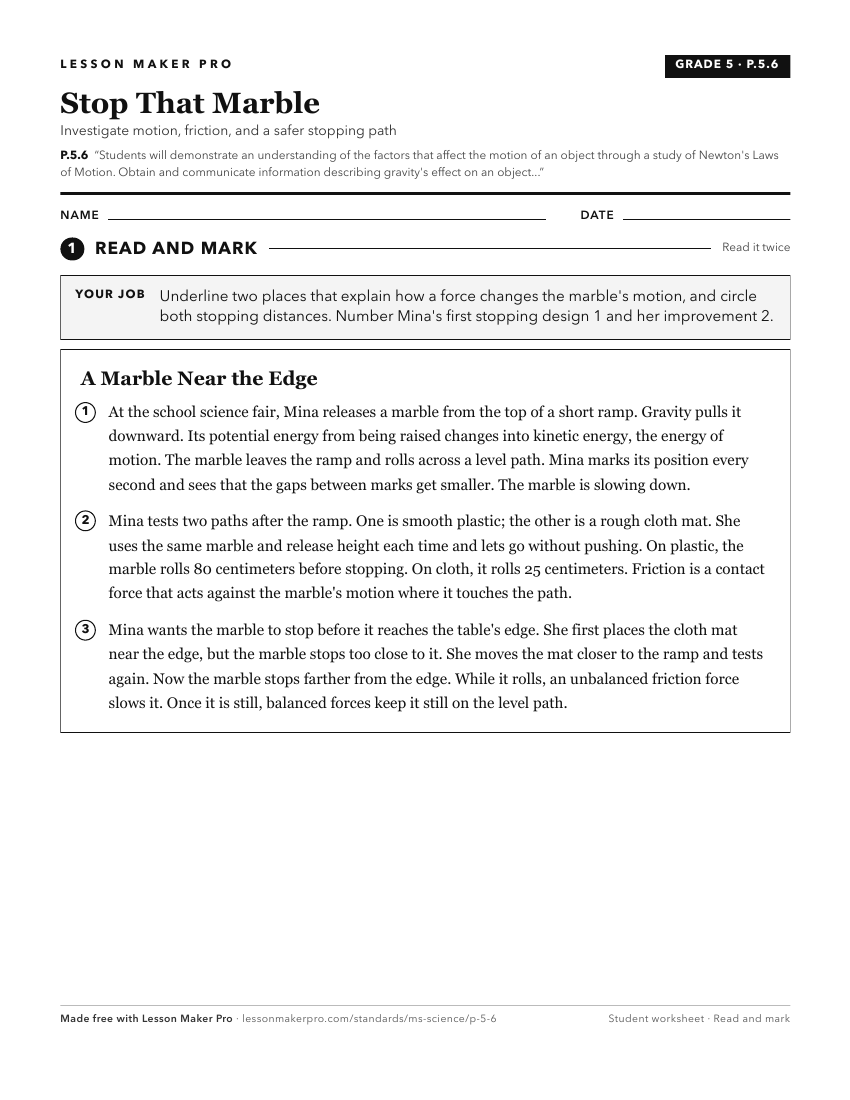
A ready-to-print activity worksheet aligned to P.5.6, with an answer key for the teacher on its own page. No account needed.
PDF, US Letter, prints cleanly in black and white.
Download the worksheetKeep exploring
Related Standards
- PHY.2
Students will develop an understanding of concepts related to Newtonian dynamics.
- P.2.6
Students will demonstrate an understanding of how the motion of objects is affected by pushes, pulls, and friction on an object.
- PHS.5
Students will analyze the scientific principles of motion, force, and work.
- P.6.6
Students will demonstrate an understanding of Newton’s laws of motion using real world models and examples.
Turn this cluster into a lesson
Grade, subject, topic, and the complete cluster are prefilled. Create one free, no account needed.
Also for this cluster:Make a WorksheetMake a QuizMake a Sub Lesson