Mississippi Science P.2.6
Standard Cluster
Students will demonstrate an understanding of how the motion of objects is affected by pushes, pulls, and friction on an object. Conduct a structured investigation to collect, represent, and analyze data from observations and measurements to demonstrate the effects of pushes and pulls with different strengths and directions. Communicate findings (e.g., models or technology). Generate and answer questions about the relationship between (1) friction and the motion of objects and (2) friction and the production of heat. Develop a plan to change the force (push or pull) of friction to solve a human problem (e.g., improve the ride on a playground slide or make a toy car or truck go faster). Use an engineering design process to define the problem, design, construct, evaluate, and improve the plan. *
2026 Mississippi College- and Career-Readiness Standards for Science · Motions, Forces, and Energy
Cluster contents
Standards in This Cluster
P.2.6 is a cluster heading. These are the individual standards under it.
- P.2.6.1
Conduct a structured investigation to collect, represent, and analyze data from observations and measurements to demonstrate the effects of pushes and pulls wit...
- P.2.6.2
Generate and answer questions about the relationship between (1) friction and the motion of objects and (2) friction and the production of heat.
- P.2.6.3
Develop a plan to change the force (push or pull) of friction to solve a human problem (e.g., improve the ride on a playground slide or make a toy car or truck ...
Teacher's field guide
What This Cluster Means
What Students Need to Do
- Students test how the strength and direction of pushes and pulls change a toy’s motion. They measure and graph how far it travels, then use the results to explain what happened. They compare surfaces, feel warmth from rubbing, and improve a toy track or slide.
What Mastery Looks Like
- Students use arrows to show which way they pushed or pulled and a graph to compare travel distances. They explain why a toy slows on a rough surface and why rubbing can make their hands warm. They test a track or slide, then change it to solve a stated problem.
Common Misconceptions
- Some students think every push moves a car the same distance, no matter how hard they push. Others think rough surfaces give a car an extra push instead of slowing it. They may not connect the warmth of rubbed hands to friction.
How to Assess It
- Give students two measurements from the same toy car and push: 40 cm on tile, 15 cm on carpet. Ask them to circle the surface with more friction, draw an arrow for a stronger push, and name one track change that would help the car travel farther.
Lesson moves
Ways to Teach It
Push and pull a toy car with light and strong forces in different directions, measure its travel with a ruler, and graph the results.
Have students rub their palms, then write why their hands feel warm and how carpet might change a sliding toy’s motion.
Play Surface Prediction: teams predict how far a toy car travels across cardboard, felt, and foil, then measure and compare results.
Define a slow-slide problem, build a cardboard slide, test felt and wax paper liners, measure travel, and swap the liner to improve it.
Free download
Printable P.2.6 Worksheet
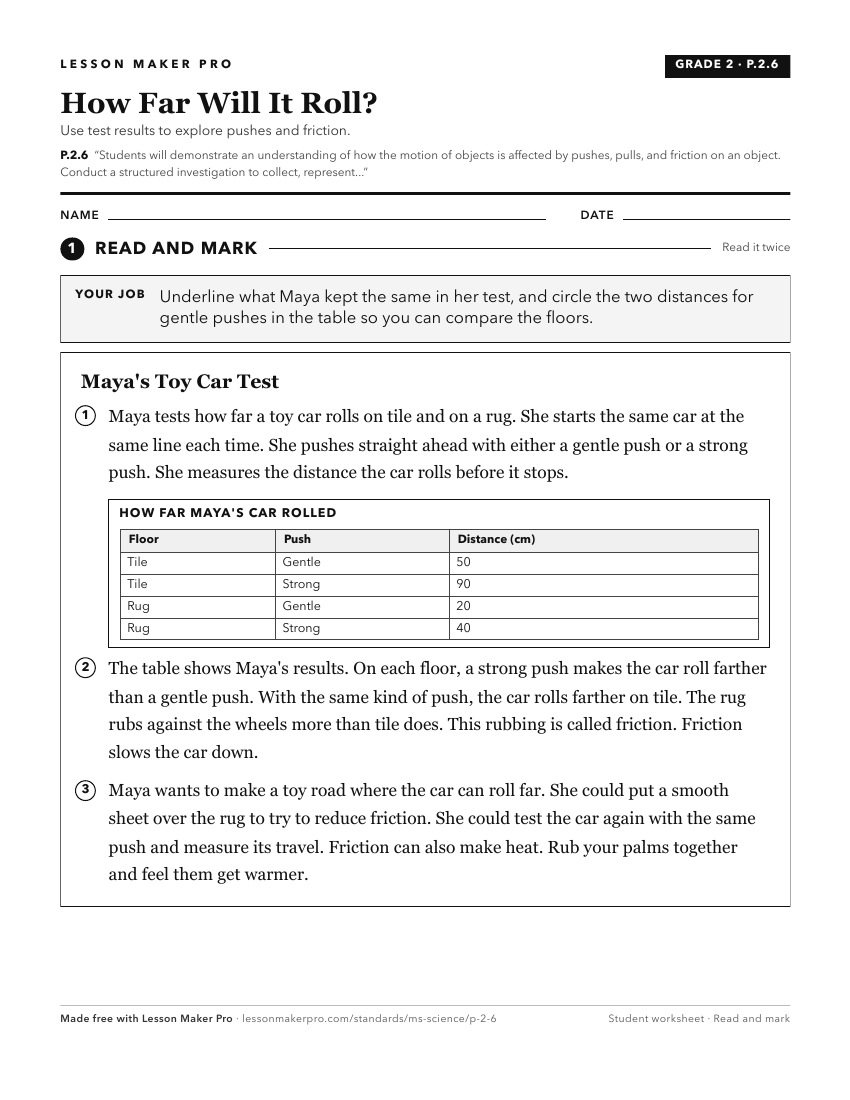
A ready-to-print activity worksheet aligned to P.2.6, with an answer key for the teacher on its own page. No account needed.
PDF, US Letter, prints cleanly in black and white.
Download the worksheetKeep exploring
Related Standards
- P.3.6
Students will demonstrate an understanding of magnets and the effects of pushes, pulls, and friction on the motion of objects.
- PHS.5
Students will analyze the scientific principles of motion, force, and work.
- P.5.6
Students will demonstrate an understanding of the factors that affect the motion of an object through a study of Newton's Laws of Motion.
- P.5.5A
Students will demonstrate an understanding of the physical properties of matter.
Turn this cluster into a lesson
Grade, subject, topic, and the complete cluster are prefilled. Create one free, no account needed.
Also for this cluster:Make a WorksheetMake a QuizMake a Sub Lesson