Mississippi Science P.2.6.1
The Standard
- P.2.6
- Students will demonstrate an understanding of how the motion of objects is affected by pushes, pulls, and friction on an object.
Conduct a structured investigation to collect, represent, and analyze data from observations and measurements to demonstrate the effects of pushes and pulls with different strengths and directions. Communicate findings (e.g., models or technology).
2026 Mississippi College- and Career-Readiness Standards for Science · Motions, Forces, and Energy
Teacher's field guide
What This Standard Means
What Students Need to Do
- Students push and pull the same object with different strengths and directions. They measure how far it moves, record the results, and explain what changed.
What Mastery Looks Like
- A student starts a toy car at the same line for each trial and records distances in centimeters. They use arrows to show direction and measurements to compare the results.
Common Misconceptions
- Students may think a stronger push changes an object's direction rather than how far it moves. They may change the starting point or surface between trials and treat those differences as effects of the force.
How to Assess It
- Exit ticket: On the same floor, a toy car moved 6 cm after a gentle push and 18 cm after a firm push. Draw arrows for both trips and write what the distances show.
Lesson moves
Ways to Teach It
Tape a start line, push and pull a toy car gently and firmly in two directions, then measure and chart each trip.
Show two car trial records and ask, 'Which way did the car move each time, and what distances support your comparison?'
Give pairs arrow cards and toy cars; call out 'gentle pull left' or 'firm push right' and have them model each motion.
Give a rolling suitcase one gentle tug and one firm tug from a taped line; mark and compare its stopping points.
Free download
Printable P.2.6.1 Worksheet
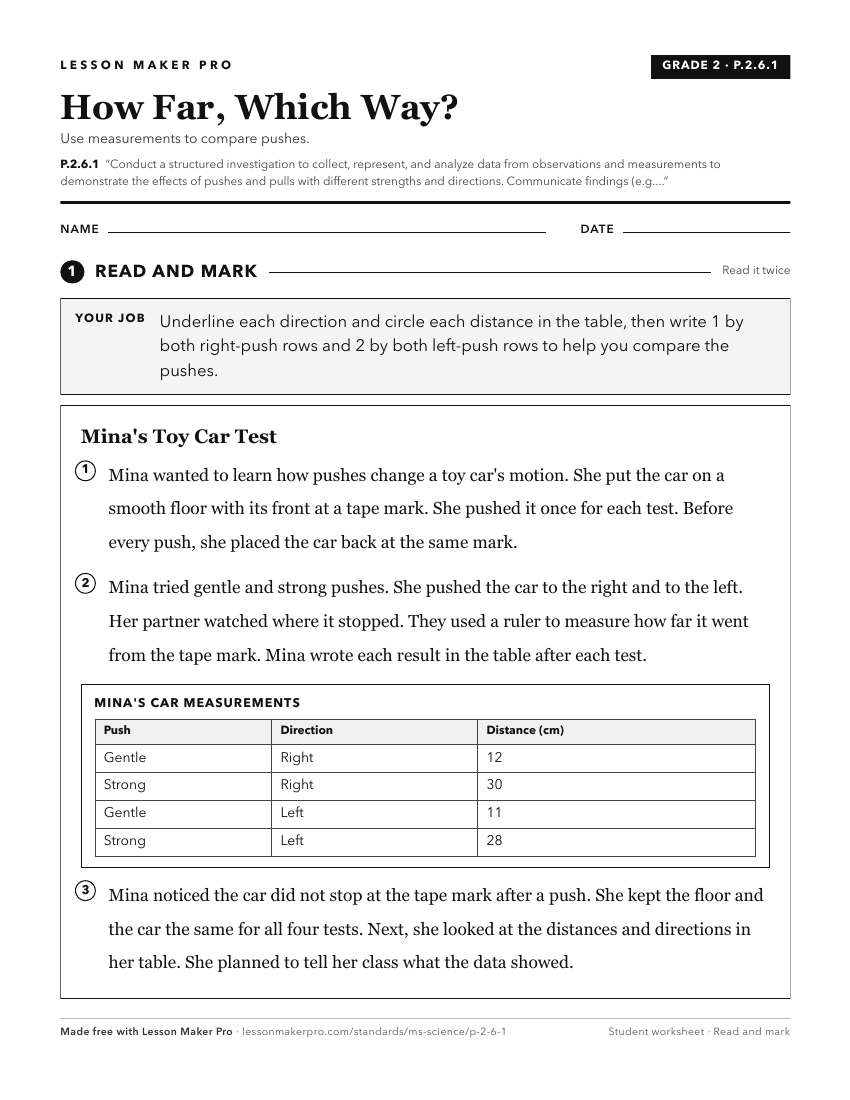
A ready-to-print activity worksheet aligned to P.2.6.1, with an answer key for the teacher on its own page. No account needed.
PDF, US Letter, prints cleanly in black and white.
Download the worksheetKeep exploring
Related Standards
- PHY.1.6
Design and mathematically/graphically analyze quantitative data to explore displacement, velocity, and acceleration of various objects. Use probe systems, video...
- PHY.2.6
Use mathematical and computational analysis to explore forces (e.g., friction, force applied, normal, and tension).
- P.5.6.4
Plan and conduct scientific investigations to test the effects of balanced and unbalanced forces on the speed and/or direction of objects in motion.
- PHS.5.5
Design and construct an investigation using probe systems and/or online simulations to observe relationships between force, mass, and acceleration (F=ma).
Turn this exact standard into a lesson
Grade, subject, topic, and the complete standard are prefilled. Create one free, no account needed.
Also for this standard:Make a WorksheetMake a QuizMake a Sub Lesson