Mississippi Science PHY.3.6
The Standard
- PHY.3
- Students will develop an understanding of concepts related to work and energy.
Enrichment: Design, conduct, and communicate investigations that explore how temperature and thermal energy relate to molecular motion and states of matter.
2026 Mississippi College- and Career-Readiness Standards for Science · Work and Energy
Teacher's field guide
What This Standard Means
What Students Need to Do
- Students plan and run a fair test using ice, a thermometer, and a steady heat source. They record temperature and state over time, then explain their results using particle motion and energy transfer.
What Mastery Looks Like
- Students keep the amount of ice and the heat setting the same across trials. They graph their readings and explain why temperature stays near 0°C while ice melts, even though it keeps absorbing energy.
Common Misconceptions
- Students may think every minute of heating must raise the thermometer reading. Some think particles stop moving in ice or that water molecules themselves change when ice melts.
How to Assess It
- Exit ticket: Graph these one-minute readings as ice warms: 0°C, 0°C, 0°C, 5°C. Explain the flat section using particle motion, and name one factor you would keep the same in a second trial.
Lesson moves
Ways to Teach It
Heat 50 g of ice on a low hot plate, record temperature and state each minute, then graph the results.
Ask: Why can ice absorb energy while its temperature stays near 0°C? Write an answer using particle motion and attraction.
Give groups heating-curve cards and particle-picture cards; have them match each graph segment to a picture and defend one match.
Have students sketch an ice cube melting in a lunchbox and explain why the food stays cool while the ice melts.
Free download
Printable PHY.3.6 Worksheet
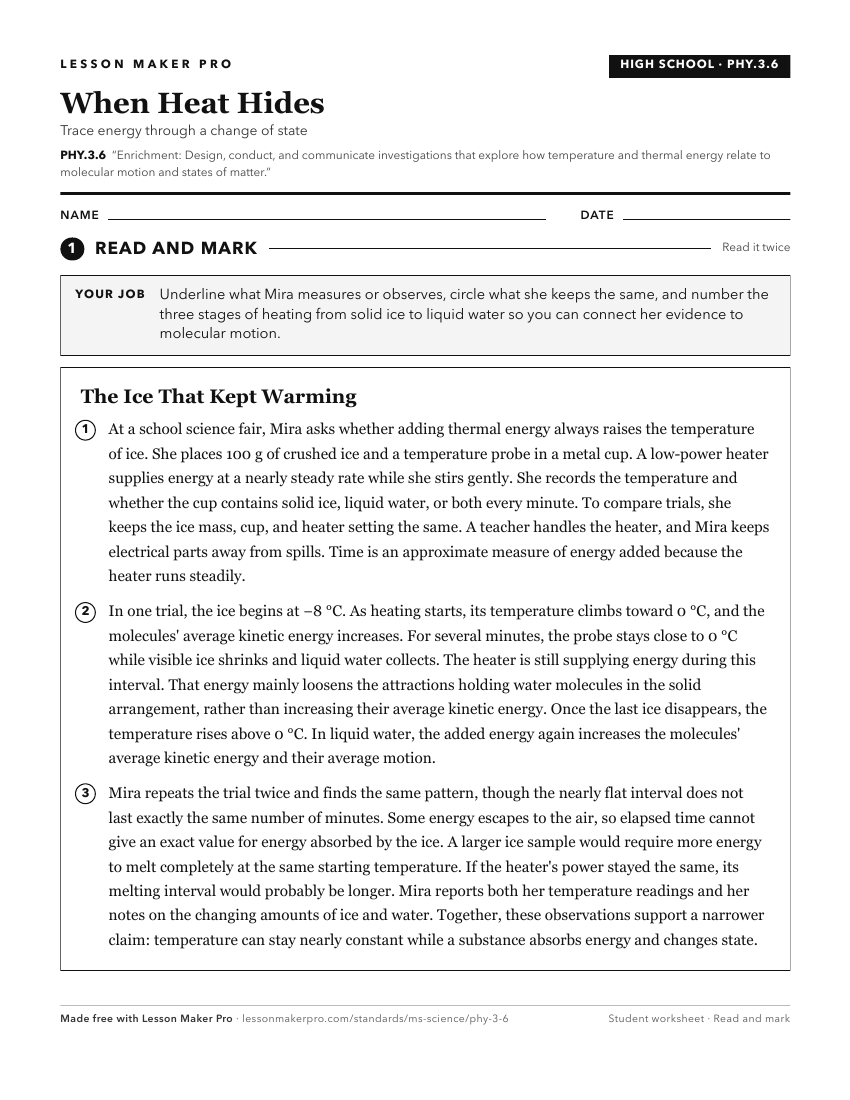
A ready-to-print activity worksheet aligned to PHY.3.6, with an answer key for the teacher on its own page. No account needed.
PDF, US Letter, prints cleanly in black and white.
Download the worksheetKeep exploring
Related Standards
- P.3.5.1
Plan and conduct scientific investigations to determine how changes in heat (i.e., an increase or decrease) change matter from one state to another (e.g., melti...
- CHE.10.4
Enrichment: Use mathematical and computational thinking to solve problems involving heat flow and temperature changes, using known values of specific heat and l...
- CHE.10.1
Enrichment: Construct explanations to explain how temperature and heat flow in terms of the motion of molecules (or atoms).
- CHE.7.2
Enrichment: Use an engineering design process to develop models (e.g., online simulations or student interactive activities) to explain and predict the behavior...
Turn this exact standard into a lesson
Grade, subject, topic, and the complete standard are prefilled. Create one free, no account needed.
Also for this standard:Make a WorksheetMake a QuizMake a Sub Lesson