Mississippi Science PHY.3.5
The Standard
- PHY.3
- Students will develop an understanding of concepts related to work and energy.
Investigate, collect data, and summarize the principles of thermodynamics by exploring how heat energy is transferred from higher temperature to lower temperature until equilibrium is reached.
2026 Mississippi College- and Career-Readiness Standards for Science · Work and Energy
Teacher's field guide
What This Standard Means
What Students Need to Do
- Measure the temperatures of warm and cool materials as they exchange heat. Use the readings to show which way heat moves and when the temperatures become equal.
What Mastery Looks Like
- A student can graph both temperatures over time and point to where the readings meet. They can explain that heat moves from warmer to cooler material until there is no net heat transfer.
Common Misconceptions
- Students may say cold moves into the warm material. They may think the final temperature must be halfway between the starting temperatures, even when the amounts of material differ. Some think equal temperatures mean the particles stop moving.
How to Assess It
- Exit ticket: Two cups of water start at 60°C and 20°C and later both read 40°C. Which way did heat move, and what does the final reading tell you?
Lesson moves
Ways to Teach It
Place a metal cup of warm water in a bowl of cool water and record both temperatures every minute with two thermometers.
Give students a two-column temperature table and ask, “Which water gained energy? What reading shows thermal equilibrium?”
Give pairs temperature cards and have them race to draw the heat-flow arrow and circle the reading where both temperatures match.
Compare warm water in a metal mug and an insulated mug; measure both after ten minutes and explain which lost heat faster.
Free download
Printable PHY.3.5 Worksheet
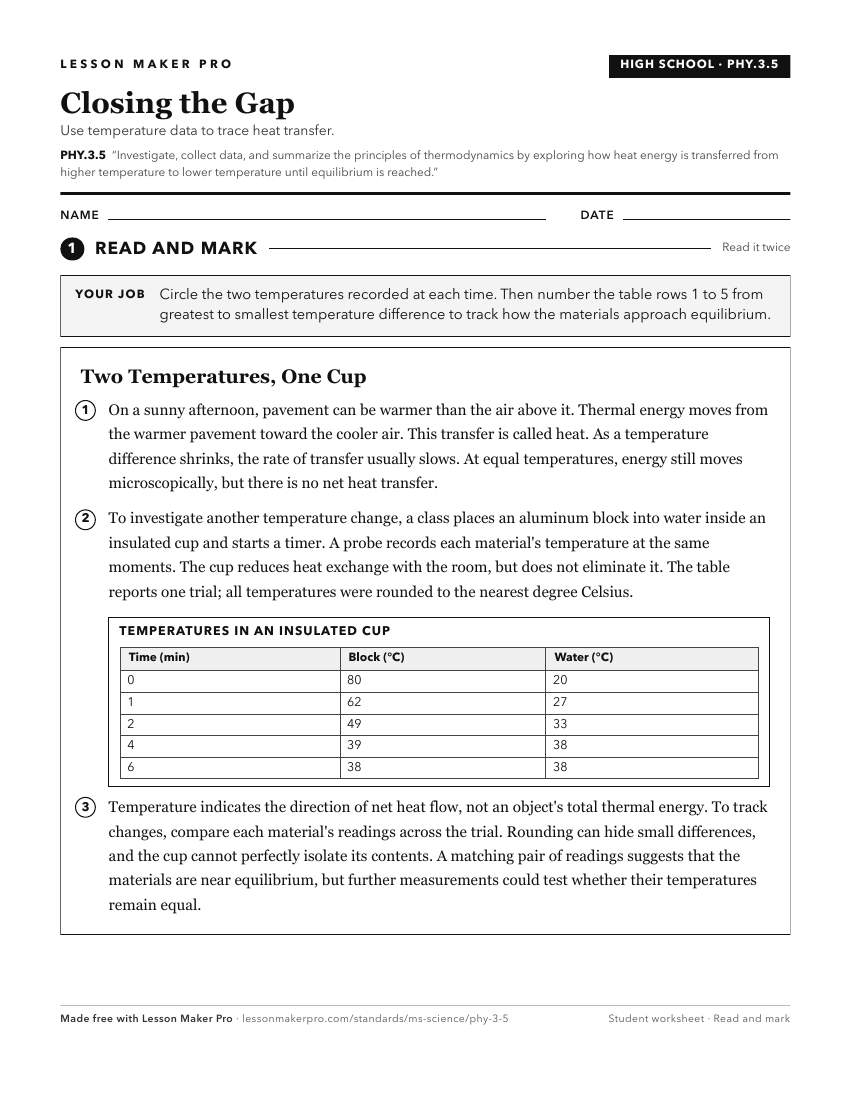
A ready-to-print activity worksheet aligned to PHY.3.5, with an answer key for the teacher on its own page. No account needed.
PDF, US Letter, prints cleanly in black and white.
Download the worksheetKeep exploring
Related Standards
- P.4.6A.1
Obtain and communicate information to compare how different processes (including burning, friction, and electricity) serve as sources of heat energy.
- CHE.7.3
Analyze and interpret heating curve graphs to explain the energy relationship between states of matter (e.g., thermochemistry-water heating from -20oC to 120oC)...
- PHS.7.2
Use scientific investigations to explore the transformation of energy from one type to another (e.g., potential to kinetic energy, and mechanical, chemical, ele...
- P.3.5.1
Plan and conduct scientific investigations to determine how changes in heat (i.e., an increase or decrease) change matter from one state to another (e.g., melti...
Turn this exact standard into a lesson
Grade, subject, topic, and the complete standard are prefilled. Create one free, no account needed.
Also for this standard:Make a WorksheetMake a QuizMake a Sub Lesson