Mississippi Science CHE.7.3
The Standard
- CHE.7
- Students will demonstrate an understanding of the structure and behavior of gases.
Analyze and interpret heating curve graphs to explain the energy relationship between states of matter (e.g., thermochemistry-water heating from -20oC to 120oC).
2026 Mississippi College- and Career-Readiness Standards for Science · Gas Laws
Teacher's field guide
What This Standard Means
What Students Need to Do
- Read a heating curve to tell when ice, liquid water, and steam warm, melt, or boil. Explain when added heat raises temperature and when it changes the state without raising temperature.
What Mastery Looks Like
- A student can label the sloped and flat sections of a water heating curve from -20°C to 120°C. They can explain why the temperature stays at 0°C during melting and 100°C during boiling.
Common Misconceptions
- Students may think the heater stops adding energy when the line goes flat. They may also think boiling breaks water molecules apart, rather than separating them from one another.
How to Assess It
- Give students a water heating curve with flat sections at 0°C and 100°C. Ask them to label each section and explain what added energy does during the 100°C flat section.
Lesson moves
Ways to Teach It
In goggles, heat crushed ice in a beaker on a hot plate, record its temperature each minute, and graph the readings.
Ask students to write: Why does the thermometer stay at 0°C while ice melts, even though the hot plate stays on?
Give pairs an unlabeled water heating curve and have them race to label the states, phase changes, and flat sections.
Show a boiling pot and ask why turning up the burner makes more steam rather than much hotter liquid water.
Free download
Printable CHE.7.3 Worksheet
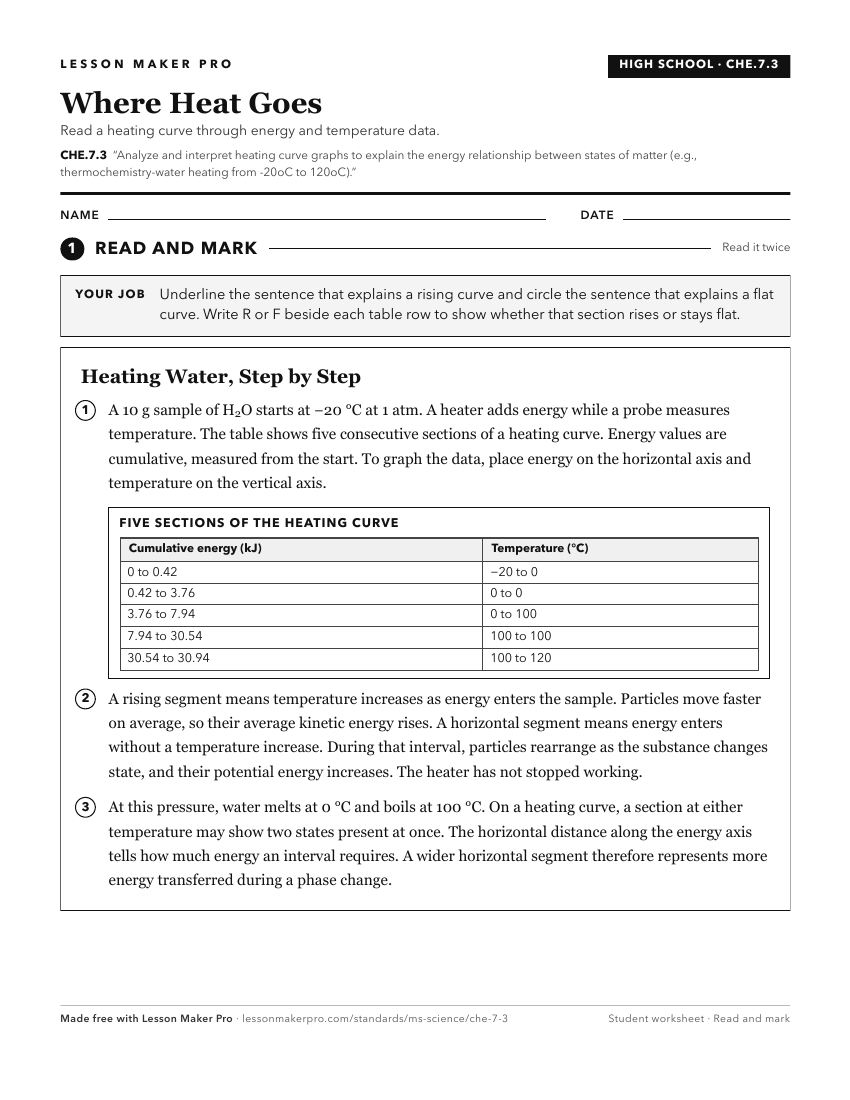
A ready-to-print activity worksheet aligned to CHE.7.3, with an answer key for the teacher on its own page. No account needed.
PDF, US Letter, prints cleanly in black and white.
Download the worksheetKeep exploring
Related Standards
- PHY.3.5
Investigate, collect data, and summarize the principles of thermodynamics by exploring how heat energy is transferred from higher temperature to lower temperatu...
- P.4.6A.1
Obtain and communicate information to compare how different processes (including burning, friction, and electricity) serve as sources of heat energy.
- P.3.5.1
Plan and conduct scientific investigations to determine how changes in heat (i.e., an increase or decrease) change matter from one state to another (e.g., melti...
- CHE.10.2
Enrichment: Classify chemical reactions and phase changes as exothermic or endothermic based on enthalpy values. Use a graphical representation to illustrate th...
Turn this exact standard into a lesson
Grade, subject, topic, and the complete standard are prefilled. Create one free, no account needed.
Also for this standard:Make a WorksheetMake a QuizMake a Sub Lesson