Mississippi Science PHY.3.2
The Standard
- PHY.3
- Students will develop an understanding of concepts related to work and energy.
Use mathematical and computational analysis to explore conservation of momentum and impulse.
2026 Mississippi College- and Career-Readiness Standards for Science · Work and Energy
Teacher's field guide
What This Standard Means
What Students Need to Do
- Students calculate momentum from mass and velocity, including direction. They compare total momentum before and after a collision. They use force and contact time to calculate impulse.
What Mastery Looks Like
- Given data for two colliding carts, students calculate total momentum before and after the collision. They calculate impulse from a change in momentum or from average force and contact time, using the correct sign.
Common Misconceptions
- Students often add speeds without accounting for opposite directions. They may think each cart keeps its own momentum, rather than the pair keeping the same total momentum. They may also think a longer stopping time always means a larger impulse.
How to Assess It
- Exit ticket: A 2 kg cart moving right at 3 m/s hits a stationary 1 kg cart and continues right at 1 m/s. Assuming negligible external forces, find the second cart's velocity and the first cart's impulse, using right as positive.
Lesson moves
Ways to Teach It
Roll two carts beside a meter stick, film their collision, and calculate total momentum before and after from measured masses and speeds.
Post signed velocity data for two colliding carts and ask pairs whether either cart conserves momentum alone; require calculations in their explanation.
Have students enter cart masses and signed velocities in a spreadsheet, then write formulas to check total momentum and each cart's impulse.
Give students two force versus time graphs for crash dummies with and without airbags; have them compare impulse and peak force.
Free download
Printable PHY.3.2 Worksheet
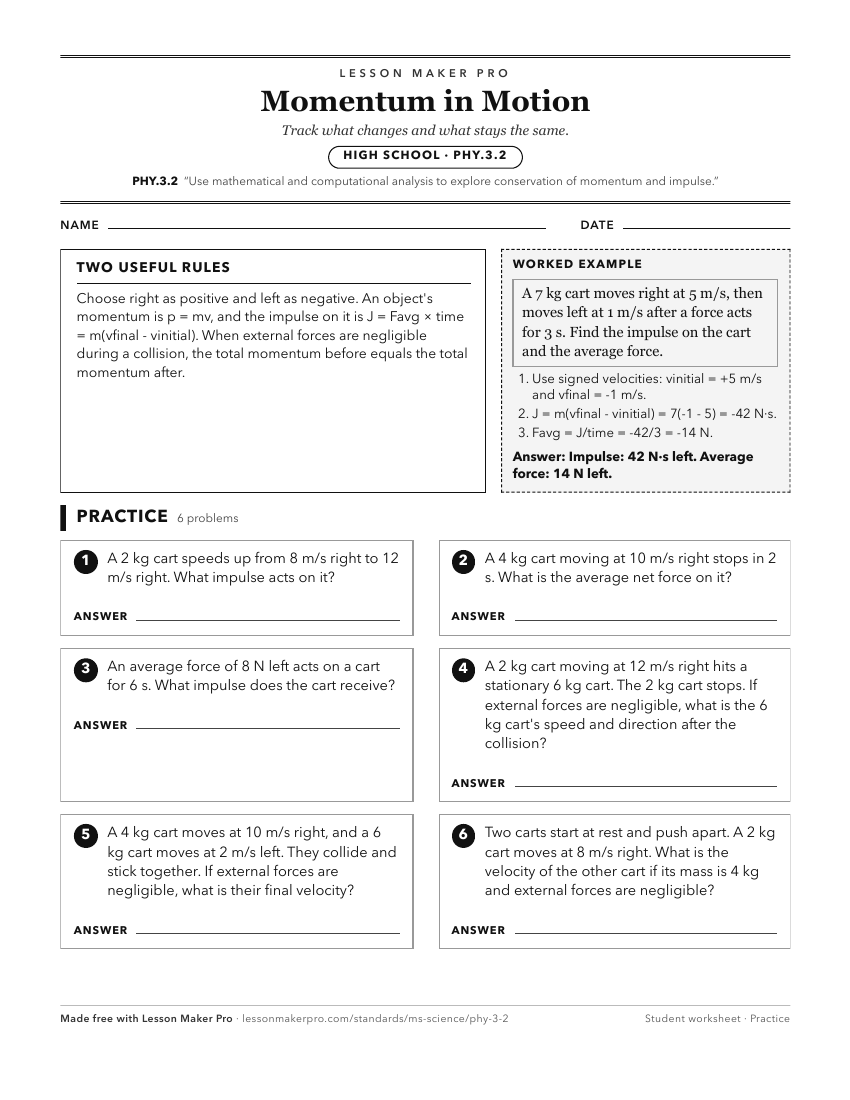
A ready-to-print activity worksheet aligned to PHY.3.2, with an answer key for the teacher on its own page. No account needed.
PDF, US Letter, prints cleanly in black and white.
Download the worksheetKeep exploring
Related Standards
- PHY.1.3
Use mathematical and computational analysis to solve problems using kinematic equations.
- PHY.3.1
Use mathematical and computational analysis to qualitatively and quantitatively analyze the concept of work, energy, and power to explain and apply the conserva...
- PHS.5.6
Use an engineering design process and mathematical analysis to design and construct models to demonstrate the law of conservation of momentum (e.g., roller coas...
- PHY.3.4
Design and conduct investigations to compare conservation of momentum and conservation of kinetic energy in perfectly inelastic and elastic collisions using pro...
Turn this exact standard into a lesson
Grade, subject, topic, and the complete standard are prefilled. Create one free, no account needed.
Also for this standard:Make a WorksheetMake a QuizMake a Sub Lesson