Mississippi Science PHS.9
Standard Cluster
Students will explore basic principles of magnetism and electricity (e.g., static electricity, current electricity, and circuits). Use digital resources and online simulations to investigate the basic principles of electricity, including static electricity, current electricity, and circuits. Use digital resources (e.g., online simulations) to build a model showing the relationship between magnetic fields and electric currents. Distinguish between magnets, motors, and generators, and evaluate modern industrial uses of each. Enrichment: Use an engineering design process to construct a working electric motor to perform a task. Communicate the design process and comparisons of task performance efficiencies. * Use an engineering design process to construct and test conductors, semiconductors, and insulators using various materials to optimize efficiency. *
2026 Mississippi College- and Career-Readiness Standards for Science · Electricity
Cluster contents
Standards in This Cluster
PHS.9 is a cluster heading. These are the individual standards under it.
- PHS.9.1
Use digital resources and online simulations to investigate the basic principles of electricity, including static electricity, current electricity, and circuits...
- PHS.9.2
Distinguish between magnets, motors, and generators, and evaluate modern industrial uses of each.
- PHS.9.3
Enrichment: Use an engineering design process to construct a working electric motor to perform a task. Communicate the design process and comparisons of task pe...
- PHS.9.4
Use an engineering design process to construct and test conductors, semiconductors, and insulators using various materials to optimize efficiency. *
Teacher's field guide
What This Cluster Means
What Students Need to Do
- Students use simulations to compare static charge with current flowing through a circuit. They model the magnetic field made by a current and explain what magnets, motors, and generators do in machines.
What Mastery Looks Like
- A student can build a working circuit in a simulation and predict what happens when the switch opens. They can show that current creates a magnetic field. They can explain the jobs of a scrapyard electromagnet, a conveyor motor, and a wind turbine generator.
Common Misconceptions
- Students may think a charged balloon supplies a steady current or that one wire is enough to light a bulb. They may think a motor and generator do the same job, or that a stationary magnet alone produces current.
How to Assess It
- Exit ticket: Draw a closed battery-bulb circuit and mark the magnetic field around one wire. Explain why a rubbed balloon sticks to a wall and how a motor differs from a generator.
Lesson moves
Ways to Teach It
Wrap insulated wire around a nail, connect it briefly to a battery, and count how many paper clips it lifts before and after adding coils.
Ask: Why can a rubbed balloon stick to a wall without a circuit, while a bulb needs a closed circuit? Have students write an answer.
In PhET Circuit Construction Kit, build a working circuit, open it at three different points, and record what happens to the bulb each time.
Show photos of a scrapyard electromagnet, conveyor motor, and wind turbine generator; have students label each and explain its job.
Free download
Printable PHS.9 Worksheet
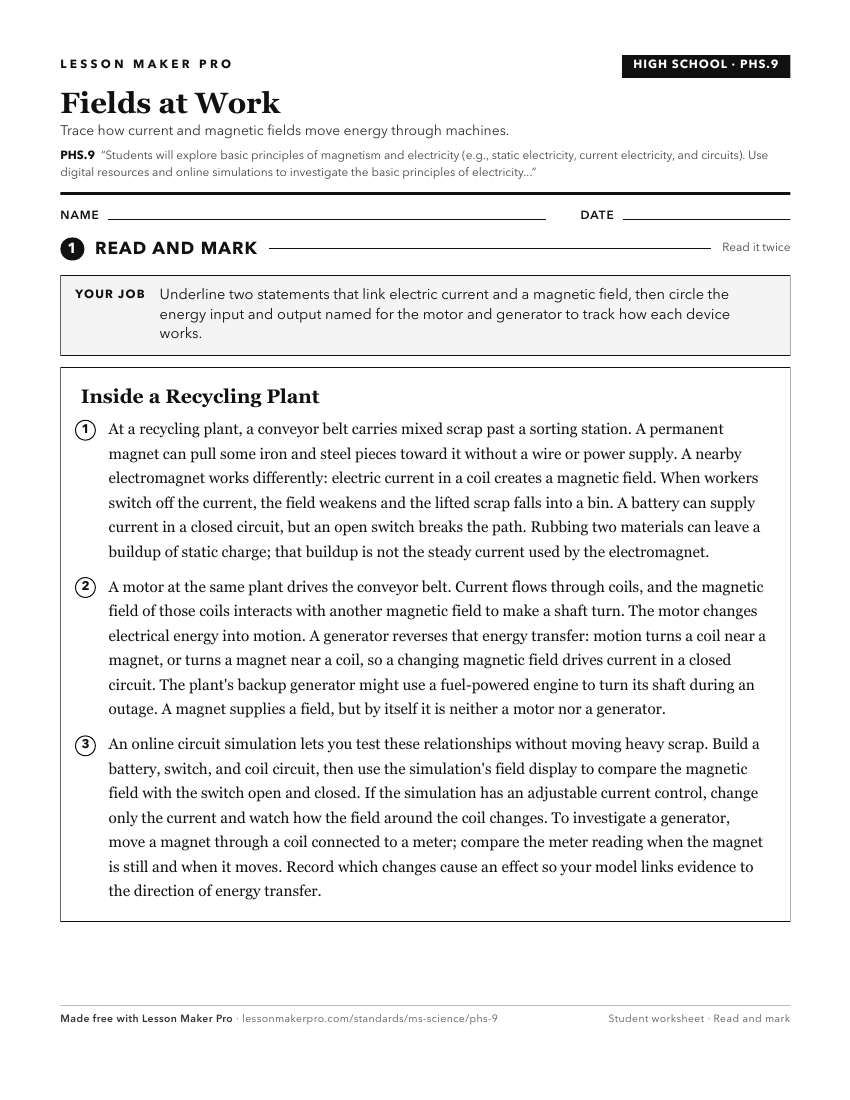
A ready-to-print activity worksheet aligned to PHS.9, with an answer key for the teacher on its own page. No account needed.
PDF, US Letter, prints cleanly in black and white.
Download the worksheetKeep exploring
Related Standards
- PHY.5
Students will investigate the key components of electricity and magnetism.
- P.3.6
Students will demonstrate an understanding of magnets and the effects of pushes, pulls, and friction on the motion of objects.
- P.4.6A
Students will demonstrate an understanding of the common sources and uses of heat and electric energy and the materials used to transfer heat and electricity.
Turn this cluster into a lesson
Grade, subject, topic, and the complete cluster are prefilled. Create one free, no account needed.
Also for this cluster:Make a WorksheetMake a QuizMake a Sub Lesson