Mississippi Science PHY.5
Standard Cluster
Students will investigate the key components of electricity and magnetism. Analyze and explain electricity and the relationship between electricity and magnetism. Explore the characteristics of static charge and how a static charge is generated using simulations. Use mathematical and computational analysis to analyze problems dealing with electric field, electric potential, current, voltage, and resistance as related to Ohm’s law. Develop and use models (e.g., circuit drawing and mathematical representation) to explain how electric circuits work by tracing the path of electrons, including concepts of energy transformation, transfer, conservation of energy, electric charge, and resistance using online simulations, probe systems, and/or laboratory experiences. Design and conduct an investigation of magnetic poles, magnetic flux and magnetic field using online simulations, probe systems, and/or laboratory experiences. Use schematic diagrams to analyze the current flow in series and parallel electric circuits, given the component resistances and the imposed electric potential. Analyze and communicate the relationship between magnetic fields and electrical current by induction, generators, and electric motors (e.g., microphones, speakers, generators, and motors) using Ampere's and Faraday's laws. Enrichment: Design and construct a simple motor to develop an explanation of how the motor transforms electrical energy into mechanical energy and work. Enrichment: Design and draw a schematic of a circuit that will turn on/off a light from two locations in a room like those found in most homes.
2026 Mississippi College- and Career-Readiness Standards for Science · Electricity and Magnetism
Cluster contents
Standards in This Cluster
PHY.5 is a cluster heading. These are the individual standards under it.
- PHY.5.1
Analyze and explain electricity and the relationship between electricity and magnetism.
- PHY.5.2
Explore the characteristics of static charge and how a static charge is generated using simulations.
- PHY.5.3
Use mathematical and computational analysis to analyze problems dealing with electric field, electric potential, current, voltage, and resistance as related to ...
- PHY.5.4
Develop and use models (e.g., circuit drawing and mathematical representation) to explain how electric circuits work by tracing the path of electrons, including...
- PHY.5.5
Design and conduct an investigation of magnetic poles, magnetic flux and magnetic field using online simulations, probe systems, and/or laboratory experiences.
- PHY.5.6
Use schematic diagrams to analyze the current flow in series and parallel electric circuits, given the component resistances and the imposed electric potential.
- PHY.5.7
Analyze and communicate the relationship between magnetic fields and electrical current by induction, generators, and electric motors (e.g., microphones, speake...
- PHY.5.8
Enrichment: Design and construct a simple motor to develop an explanation of how the motor transforms electrical energy into mechanical energy and work.
- PHY.5.9
Enrichment: Design and draw a schematic of a circuit that will turn on/off a light from two locations in a room like those found in most homes.
Teacher's field guide
What This Cluster Means
What Students Need to Do
- Students use a simulation to track electron transfer during static charging and compare electric fields and potential. They draw series and parallel circuits and calculate current, voltage, and resistance. They map magnetic fields around magnets and wires, then explain generators and motors.
What Mastery Looks Like
- Students use Ohm’s law to find branch currents and trace electrons through a complete circuit. They show that charge is conserved while a bulb changes electrical energy into light and heat. They explain how changing magnetic flux induces current and how current makes a motor turn.
Common Misconceptions
- Students may think rubbing creates new charge instead of transferring electrons. They may treat voltage and current as the same thing or think a bulb uses up electrons. They may expect a stationary magnet and coil to produce current.
How to Assess It
- Give students a diagram of a 12 V battery, a switch, and 6 Ω and 3 Ω resistors in parallel, with a compass beside the main wire. Ask them to find each branch current, mark electron flow, and predict whether the compass needle moves when the switch closes.
Lesson moves
Ways to Teach It
Connect a 3 V battery, switch, and bulb; trace the closed loop with a finger and identify light and heat as energy outputs.
In a static-charge simulation, rub a balloon on a sweater; write what moves and why the balloon sticks to a wall.
Give pairs 9 V circuit cards with 3 Ω and 6 Ω resistors in series or parallel; have them calculate branch currents.
Play a low tone through a small speaker; watch its cone and sketch how current and a magnet make it move.
Free download
Printable PHY.5 Worksheet
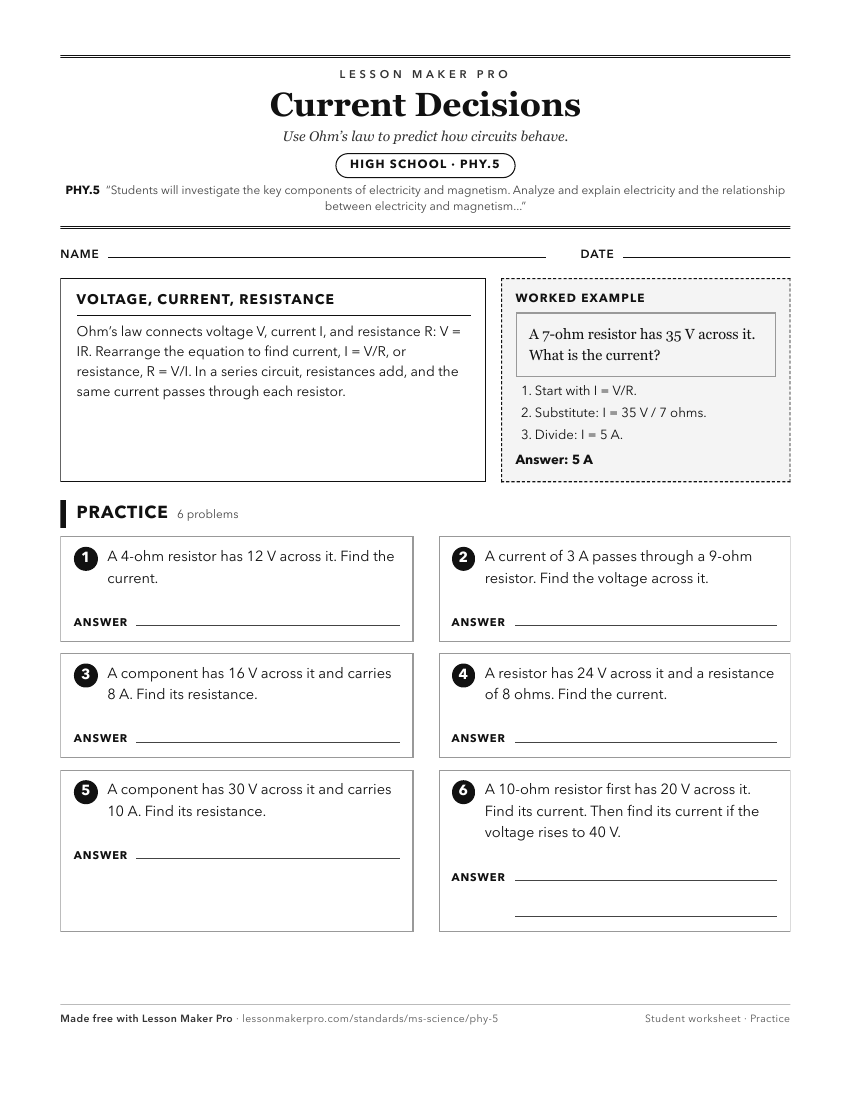
A ready-to-print activity worksheet aligned to PHY.5, with an answer key for the teacher on its own page. No account needed.
PDF, US Letter, prints cleanly in black and white.
Download the worksheetKeep exploring
Related Standards
- PHS.9
Students will explore basic principles of magnetism and electricity (e.g., static electricity, current electricity, and circuits).
- P.4.6A
Students will demonstrate an understanding of the common sources and uses of heat and electric energy and the materials used to transfer heat and electricity.
- PHS.7
Students will examine different forms of energy and energy transformations.
Turn this cluster into a lesson
Grade, subject, topic, and the complete cluster are prefilled. Create one free, no account needed.
Also for this cluster:Make a WorksheetMake a QuizMake a Sub Lesson