Mississippi Science PHY.5.7
The Standard
- PHY.5
- Students will investigate the key components of electricity and magnetism.
Analyze and communicate the relationship between magnetic fields and electrical current by induction, generators, and electric motors (e.g., microphones, speakers, generators, and motors) using Ampere's and Faraday's laws.
2026 Mississippi College- and Career-Readiness Standards for Science · Electricity and Magnetism
Teacher's field guide
What This Standard Means
What Students Need to Do
- Students show how electric current creates a magnetic field and how changing magnetic flux produces voltage. They use Ampere's and Faraday's laws to explain generators and motors. They trace motion, current, and magnetic fields in a speaker or microphone.
What Mastery Looks Like
- Students predict no induced voltage when a magnet stops beside a coil and a reversed meter reading when it moves the other way. They connect higher current to a stronger magnetic field and faster flux change to higher induced voltage. They explain that a generator turns motion into electricity, while a motor turns electricity into motion.
Common Misconceptions
- Students often expect a stationary magnet beside a coil to keep making current. They may swap the roles of motors and generators, or think induced voltage means current flows even when the circuit is open.
How to Assess It
- Draw a north pole moving into a coil connected to a meter. Ask students to predict what the meter shows when the magnet stops, then moves back out, and to explain why.
Lesson moves
Ways to Teach It
Connect a wire coil to a sensitive voltmeter, move a bar magnet in and out, and record the sign and size of each reading.
Ask partners: Why does turning a generator light a bulb, while sending current through a motor turns its shaft?
Play a prediction game with diagrams of a magnet entering, leaving, or stopping beside a coil; score explanations of voltage size and direction.
Show diagrams of a bicycle dynamo powering a lamp and a speaker; have students label where motion produces current and where current produces motion.
Free download
Printable PHY.5.7 Worksheet
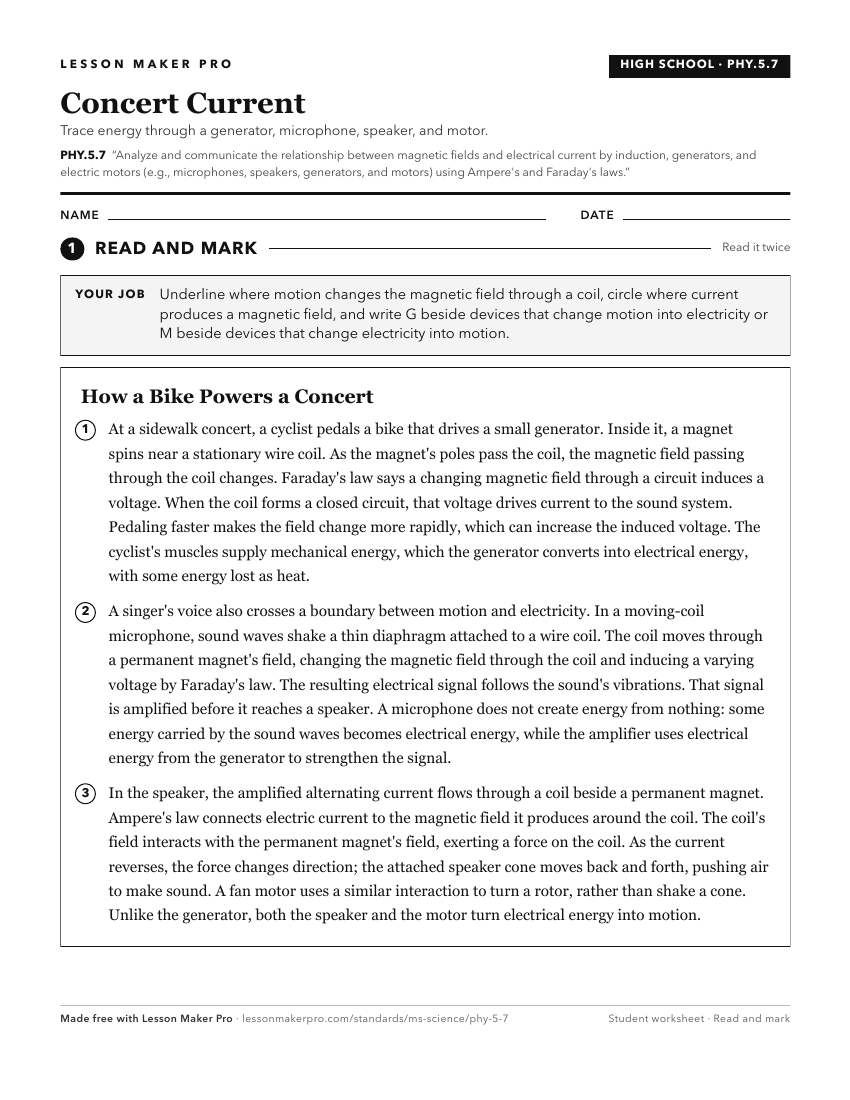
A ready-to-print activity worksheet aligned to PHY.5.7, with an answer key for the teacher on its own page. No account needed.
PDF, US Letter, prints cleanly in black and white.
Download the worksheetKeep exploring
Related Standards
- PHS.9.1
Use digital resources and online simulations to investigate the basic principles of electricity, including static electricity, current electricity, and circuits...
- P.3.6.3
Research and communicate information to explain how magnets are used in everyday life.
- PHS.9.2
Distinguish between magnets, motors, and generators, and evaluate modern industrial uses of each.
- PHY.5.1
Analyze and explain electricity and the relationship between electricity and magnetism.
Turn this exact standard into a lesson
Grade, subject, topic, and the complete standard are prefilled. Create one free, no account needed.
Also for this standard:Make a WorksheetMake a QuizMake a Sub Lesson