Mississippi Science PHY.5.3
The Standard
- PHY.5
- Students will investigate the key components of electricity and magnetism.
Use mathematical and computational analysis to analyze problems dealing with electric field, electric potential, current, voltage, and resistance as related to Ohm’s law.
2026 Mississippi College- and Career-Readiness Standards for Science · Electricity and Magnetism
Teacher's field guide
What This Standard Means
What Students Need to Do
- Students calculate electric field from force and charge, and electric potential from energy and charge. They find voltage between two points and use Ohm’s law to solve for current or resistance. They check voltage and current patterns with a graph or spreadsheet.
What Mastery Looks Like
- A student can find the voltage across a distance along a uniform electric field. They solve V = IR with units and find resistance from the slope of a voltage-versus-current graph. They can explain how potential at one point differs from voltage between two points.
Common Misconceptions
- Students may call the potential at one point a voltage without naming a second point. They may report electric field in volts instead of volts per meter. Some think higher resistance means more current at the same voltage, or calculate resistance as current divided by voltage.
How to Assess It
- Exit ticket: A 2 C charge feels a 6 N force in a uniform field. Find the field strength, the voltage across 2 m along the field, and the current through a 3 Ω resistor at that voltage.
Lesson moves
Ways to Teach It
Connect two AA batteries and a 100 Ω resistor; measure voltage across the resistor and current through it, then calculate resistance.
Show a battery diagram and ask: How is the electric potential at one terminal different from the voltage between its terminals?
Enter voltage and current pairs in a spreadsheet, graph voltage against current, and find resistance from the slope.
Read a 5 V, 2 A USB charger label; calculate current for a 10 Ω load and check it against the rating.
Free download
Printable PHY.5.3 Worksheet
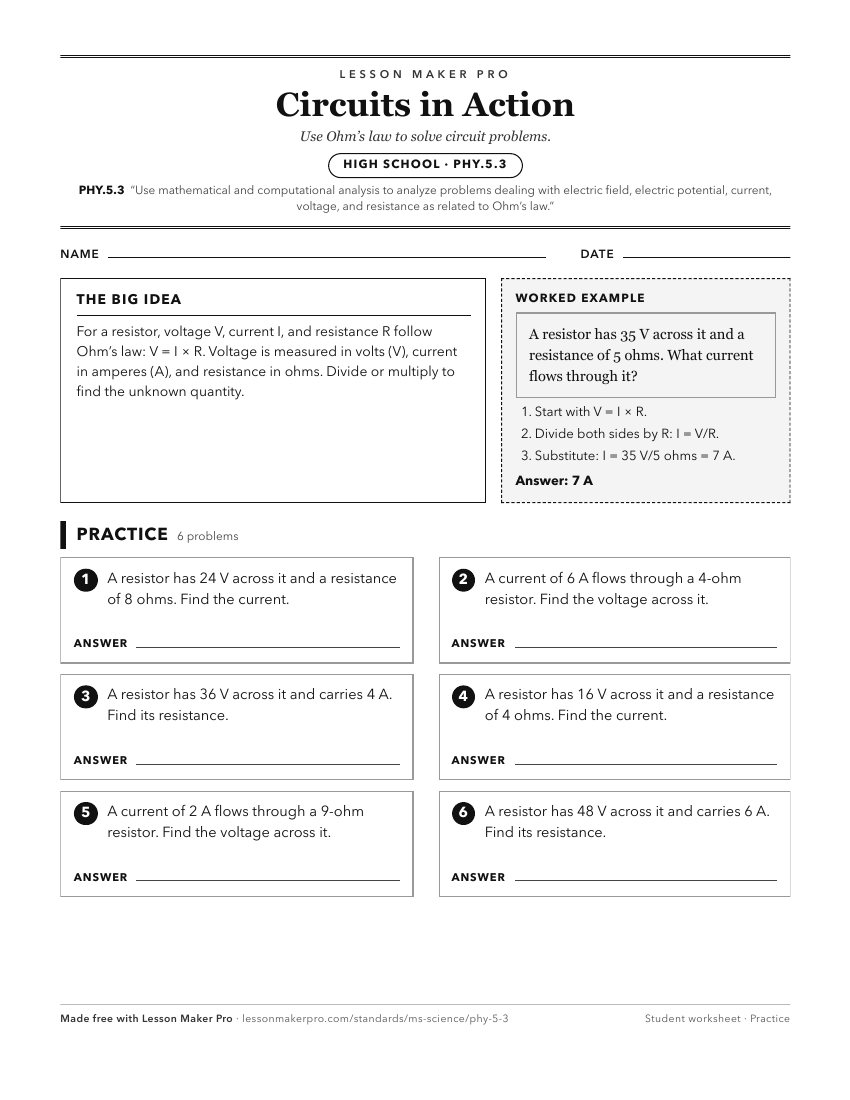
A ready-to-print activity worksheet aligned to PHY.5.3, with an answer key for the teacher on its own page. No account needed.
PDF, US Letter, prints cleanly in black and white.
Download the worksheetKeep exploring
Related Standards
- PHY.3.1
Use mathematical and computational analysis to qualitatively and quantitatively analyze the concept of work, energy, and power to explain and apply the conserva...
- PHY.5.6
Use schematic diagrams to analyze the current flow in series and parallel electric circuits, given the component resistances and the imposed electric potential.
- PHY.2.6
Use mathematical and computational analysis to explore forces (e.g., friction, force applied, normal, and tension).
- PHS.1.6
Use mathematical and computational analysis to solve density problems. Manipulate the density formula to determine density, volume, or mass or use dimensional a...
Turn this exact standard into a lesson
Grade, subject, topic, and the complete standard are prefilled. Create one free, no account needed.
Also for this standard:Make a WorksheetMake a QuizMake a Sub Lesson