Mississippi Science PHY.5.2
The Standard
- PHY.5
- Students will investigate the key components of electricity and magnetism.
Explore the characteristics of static charge and how a static charge is generated using simulations.
2026 Mississippi College- and Career-Readiness Standards for Science · Electricity and Magnetism
Teacher's field guide
What This Standard Means
What Students Need to Do
- Students use a simulation to rub materials and track where electrons move. They use the charge display to predict when objects attract or repel.
What Mastery Looks Like
- A student can show that electrons move from the sweater to the balloon, leaving the balloon negative and the sweater positive. They can explain why two rubbed balloons repel and why a charged balloon sticks to a neutral wall.
Common Misconceptions
- Students may think rubbing creates charge or that positive charges move from the sweater to the balloon. Some think a neutral wall cannot attract a charged object.
How to Assess It
- Exit ticket: Rub the balloon on the sweater in the simulation, then move it near the wall. Sketch where electrons moved and explain why the balloon sticks.
Lesson moves
Ways to Teach It
In PhET Balloons and Static Electricity, rub a balloon on the sweater, turn on the charge display, and record where electrons move.
Ask students to write two sentences explaining why a negatively charged balloon sticks to a neutral wall.
Give pairs cards showing two rubbed balloons, a rubbed balloon and a sweater, and a rubbed balloon and a wall; predict, then test.
Rub an inflated balloon on dry hair, hold it near a wall, and compare what happens with the simulation.
Free download
Printable PHY.5.2 Worksheet
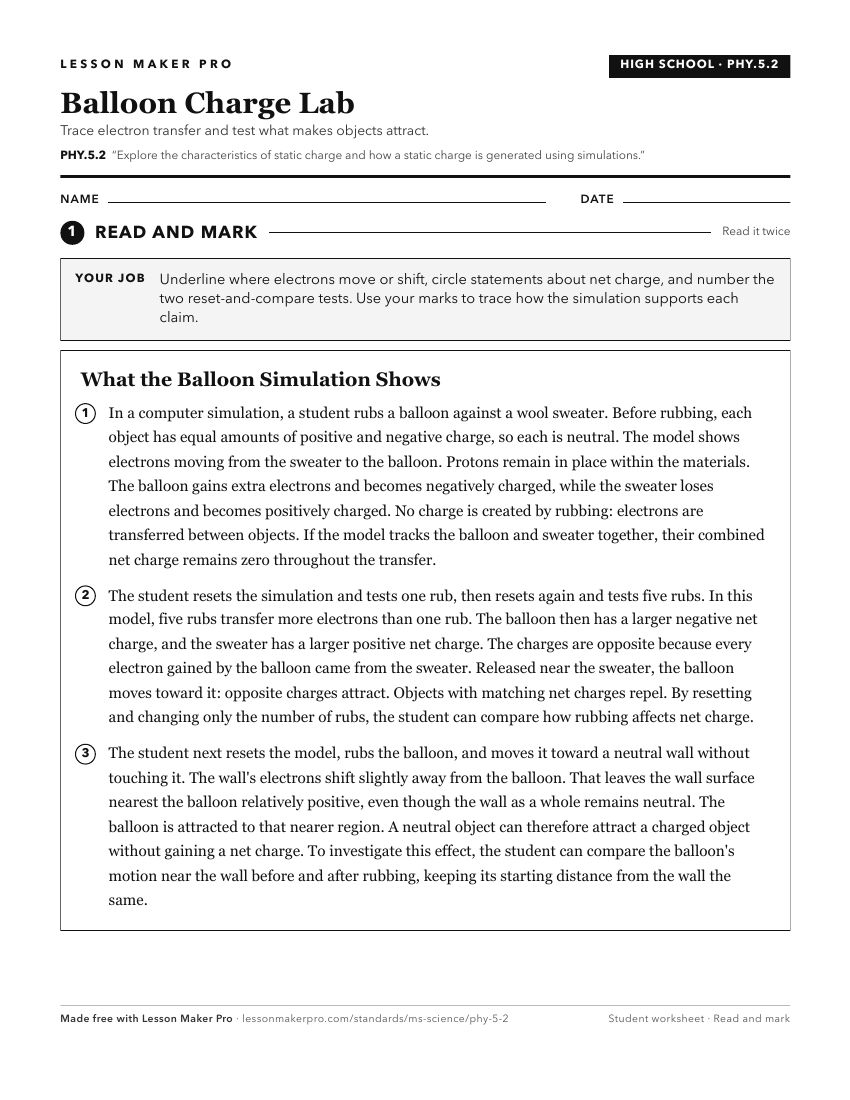
A ready-to-print activity worksheet aligned to PHY.5.2, with an answer key for the teacher on its own page. No account needed.
PDF, US Letter, prints cleanly in black and white.
Download the worksheetKeep exploring
Related Standards
- PHS.9.1
Use digital resources and online simulations to investigate the basic principles of electricity, including static electricity, current electricity, and circuits...
- PHS.9
Students will explore basic principles of magnetism and electricity (e.g., static electricity, current electricity, and circuits).
- PHY.3.3
Through real-world applications, draw conclusions about mechanical potential energy and kinetic energy using online simulations and/or laboratory experiences.
- PHY.5.4
Develop and use models (e.g., circuit drawing and mathematical representation) to explain how electric circuits work by tracing the path of electrons, including...
Turn this exact standard into a lesson
Grade, subject, topic, and the complete standard are prefilled. Create one free, no account needed.
Also for this standard:Make a WorksheetMake a QuizMake a Sub Lesson