Mississippi Science PHS.9.4
The Standard
- PHS.9
- Students will explore basic principles of magnetism and electricity (e.g., static electricity, current electricity, and circuits).
Use an engineering design process to construct and test conductors, semiconductors, and insulators using various materials to optimize efficiency. *
2026 Mississippi College- and Career-Readiness Standards for Science · Electricity
Teacher's field guide
What This Standard Means
What Students Need to Do
- Students build a battery, resistor, and LED circuit, then test copper, steel, and plastic in a gap. They reverse the LED, cover bare connections, and compare voltage drops to choose a connection that wastes less energy.
What Mastery Looks Like
- A student predicts which materials will complete the circuit and explains why a reversed LED stays dark. They measure voltage drop across two metal connections, choose the lower-loss one, and place tape where bare contacts might touch.
Common Misconceptions
- Students may call a reversed LED an insulator instead of checking its direction. They may put tape between contacts, then wrongly conclude that the metal beneath it does not conduct. Some judge efficiency by LED brightness alone without measuring voltage drop.
How to Assess It
- Exit ticket: In a battery, resistor, and LED circuit, a copper link drops 0.05 V and a steel link drops 0.30 V. Which link wastes less energy, why might the LED stay dark when reversed, and where would you put tape to prevent a short?
Lesson moves
Ways to Teach It
Build a 9 V battery, 470-ohm resistor, and LED circuit; swap copper foil and steel strips at one gap and measure voltage drop.
Ask: Why does the LED go dark when you turn it around, even though the wires and battery stay the same?
Give pairs cards labeled copper, plastic, and LED; have them place each as a bridge, cover, or one-way component on a circuit diagram.
Show a cutaway drawing of a light-up USB cable; students label its conducting wires, insulating jacket, and semiconductor LED.
Free download
Printable PHS.9.4 Worksheet
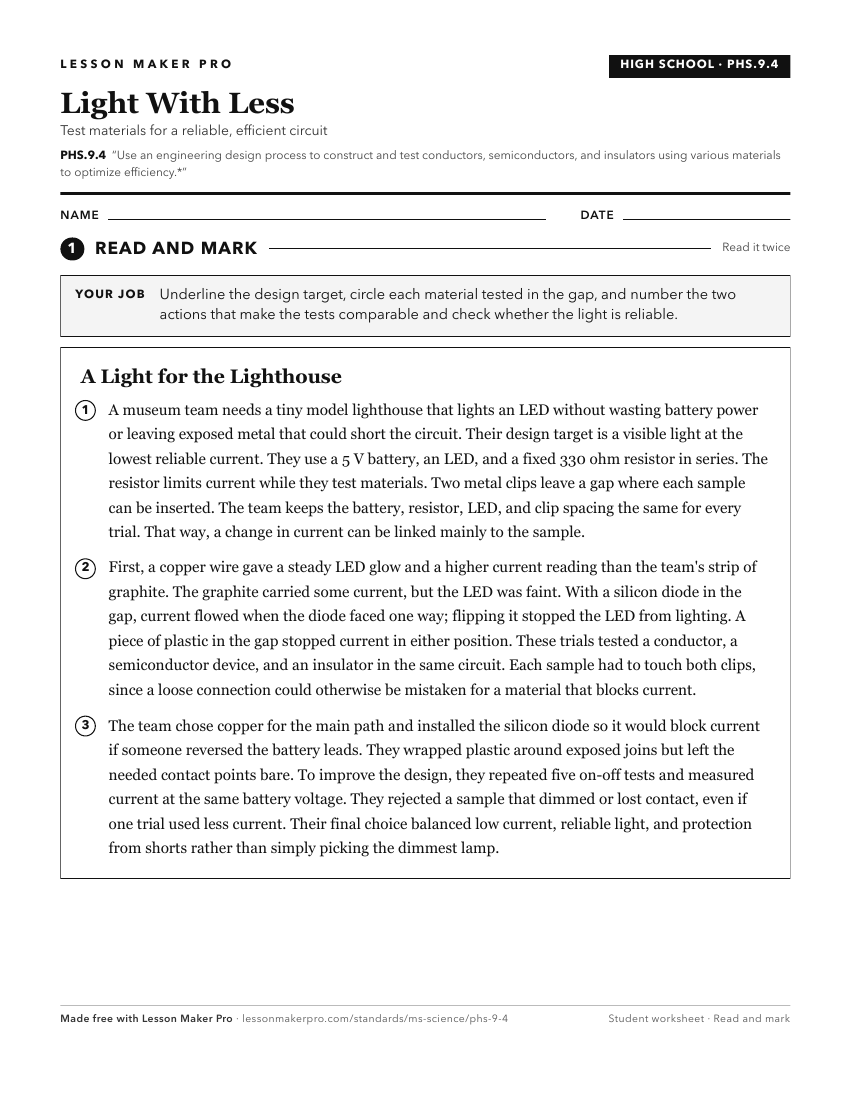
A ready-to-print activity worksheet aligned to PHS.9.4, with an answer key for the teacher on its own page. No account needed.
PDF, US Letter, prints cleanly in black and white.
Download the worksheetKeep exploring
Related Standards
- P.4.6A.2
Plan and conduct scientific investigations to classify different materials as either an insulator or conductor of electricity.
- PHS.9.3
Enrichment: Use an engineering design process to construct a working electric motor to perform a task. Communicate the design process and comparisons of task pe...
- P.4.6A.6
Design a device that converts any form of energy from one form to another form (e.g., construct a musical instrument that will convert vibrations to sound by co...
- P.5.5B.4
Design an effective system (e.g., sifting, filtration, evaporation, magnetic attraction, or floatation) for separating various mixtures. Use an engineering desi...
Turn this exact standard into a lesson
Grade, subject, topic, and the complete standard are prefilled. Create one free, no account needed.
Also for this standard:Make a WorksheetMake a QuizMake a Sub Lesson