Mississippi Science PHS.8
Standard Cluster
Students will demonstrate an understanding of temperature scales, heat, and thermal energy transfer. Compare and contrast temperature scales by converting between Celsius, Fahrenheit, and Kelvin. Apply particle theory to phase change and analyze freezing point, melting point, boiling point, vaporization, and condensation of different substances. Relate thermal energy transfer to real world applications of conduction (e.g., quenching metals), convection (e.g., movement of air masses/weather/plate tectonics), and radiation (e.g., electromagnetic). Enrichment: Use an engineering design process to construct a simulation of heat energy transfer between systems. Calculate the calories/joules of energy generated by burning food products. Communicate conclusions based on evidence from the simulation. *
2026 Mississippi College- and Career-Readiness Standards for Science · Thermal Energy
Cluster contents
Standards in This Cluster
PHS.8 is a cluster heading. These are the individual standards under it.
- PHS.8.1
Compare and contrast temperature scales by converting between Celsius, Fahrenheit, and Kelvin.
- PHS.8.2
Apply particle theory to phase change and analyze freezing point, melting point, boiling point, vaporization, and condensation of different substances.
- PHS.8.3
Relate thermal energy transfer to real world applications of conduction (e.g., quenching metals), convection (e.g., movement of air masses/weather/plate tectoni...
- PHS.8.4
Enrichment: Use an engineering design process to construct a simulation of heat energy transfer between systems. Calculate the calories/joules of energy generat...
Teacher's field guide
What This Cluster Means
What Students Need to Do
- Students convert temperatures among Celsius, Fahrenheit, and Kelvin. They use particle motion to explain melting, freezing, vaporization, and condensation. They identify conduction, convection, and radiation in everyday situations.
What Mastery Looks Like
- A student converts 25°C to 77°F and 298.15 K with units. They explain why an ice-water mixture stays at the same temperature while ice melts. They can tell whether a pan handle, rising warm air, or sunlight transfers energy by conduction, convection, or radiation.
Common Misconceptions
- Students may treat heat and temperature as the same thing or add 273 to a Fahrenheit reading to get Kelvin. They may think temperature must rise during melting or that cold flows from ice into warm water.
How to Assess It
- Exit ticket: Convert 20°C to Fahrenheit and Kelvin. Explain why ice can keep melting without getting warmer, then name how heat moves through a metal spoon in soup.
Lesson moves
Ways to Teach It
Record the temperature of an ice-water mixture as it warms, then sketch particle arrangements before and after the ice melts.
Ask students to write how a pan handle warms, why air above the pan rises, and how sunlight warms the pan.
Give pairs cards labeled 0°C, 100°C, 32°F, 212°F, 273.15 K, and 373.15 K; have them calculate and match equivalent temperatures.
Use a snack label to convert its listed Calories to kilojoules, then ask why that number is not the snack's temperature.
Free download
Printable PHS.8 Worksheet
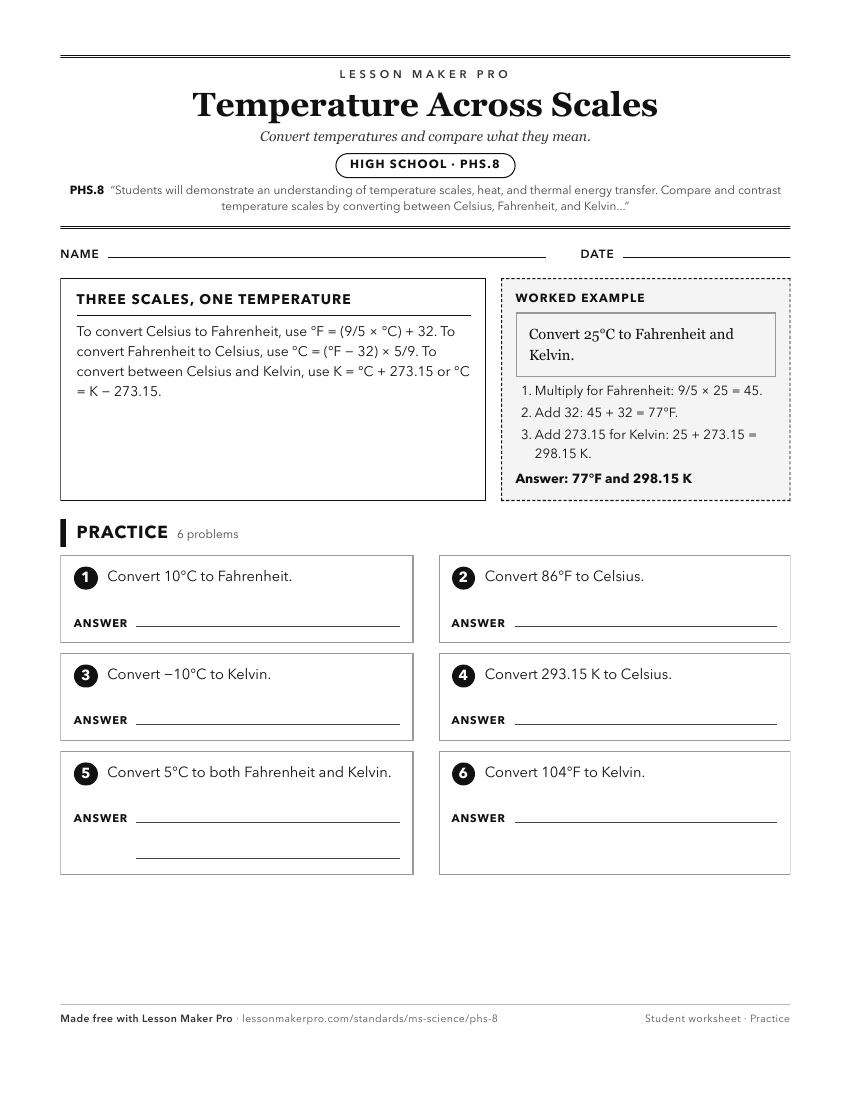
A ready-to-print activity worksheet aligned to PHS.8, with an answer key for the teacher on its own page. No account needed.
PDF, US Letter, prints cleanly in black and white.
Download the worksheetKeep exploring
Related Standards
- E.4.9B
Students will demonstrate an understanding of weather and climate patterns.
- P.4.6A
Students will demonstrate an understanding of the common sources and uses of heat and electric energy and the materials used to transfer heat and electricity.
- P.5.5A
Students will demonstrate an understanding of the physical properties of matter.
- P.7.5B
Students will demonstrate an understanding about the effects of temperature and pressure on physical state, molecular motion, and molecular interactions.
Turn this cluster into a lesson
Grade, subject, topic, and the complete cluster are prefilled. Create one free, no account needed.
Also for this cluster:Make a WorksheetMake a QuizMake a Sub Lesson