Mississippi Science PHS.8.1
The Standard
- PHS.8
- Students will demonstrate an understanding of temperature scales, heat, and thermal energy transfer.
Compare and contrast temperature scales by converting between Celsius, Fahrenheit, and Kelvin.
2026 Mississippi College- and Career-Readiness Standards for Science · Thermal Energy
Teacher's field guide
What This Standard Means
What Students Need to Do
- Students convert temperatures among Celsius, Fahrenheit, and Kelvin. They compare where zero falls on each scale and how large each unit is.
What Mastery Looks Like
- Given 25°C, a student calculates 77°F and 298.15 K, then converts either value back to 25°C. They explain that a change of 1°C equals a change of 1 K, but not 1°F.
Common Misconceptions
- Students may add 32 to a Celsius reading without first multiplying by 9/5. They may think 0°C and 0 K are the same temperature, or write a degree symbol before K.
How to Assess It
- Exit ticket: Convert 20°C to °F and K. Write one sentence explaining why the three numbers differ.
Lesson moves
Ways to Teach It
Give pairs a dual-scale thermometer to measure room temperature, read °C and °F, and calculate K from the Celsius reading.
Have students write two sentences explaining why water freezes at 0°C, 32°F, and 273.15 K.
Hand out cards labeled −40°C, −40°F, 233.15 K, 0°C, 32°F, and 273.15 K; students group matching temperatures.
Show a weather report listing 30°C; students calculate its Fahrenheit and Kelvin values and choose a scale for a local forecast.
Free download
Printable PHS.8.1 Worksheet
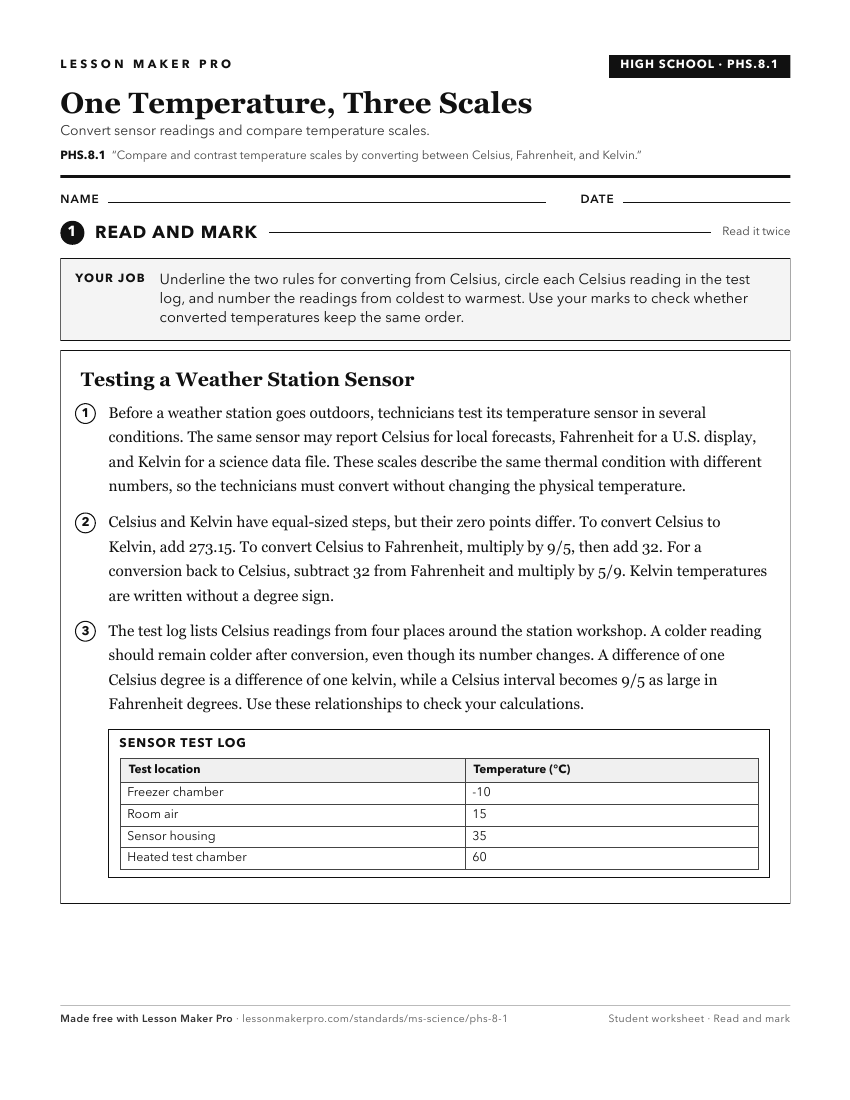
A ready-to-print activity worksheet aligned to PHS.8.1, with an answer key for the teacher on its own page. No account needed.
PDF, US Letter, prints cleanly in black and white.
Download the worksheetKeep exploring
Related Standards
- PHY.3.5
Investigate, collect data, and summarize the principles of thermodynamics by exploring how heat energy is transferred from higher temperature to lower temperatu...
- CHE.7.3
Analyze and interpret heating curve graphs to explain the energy relationship between states of matter (e.g., thermochemistry-water heating from -20oC to 120oC)...
- E.1.9A.3
Construct an explanation for the general pattern of change in daily temperatures by measuring and calculating the difference between morning and afternoon tempe...
- PHS.8
Students will demonstrate an understanding of temperature scales, heat, and thermal energy transfer.
Turn this exact standard into a lesson
Grade, subject, topic, and the complete standard are prefilled. Create one free, no account needed.
Also for this standard:Make a WorksheetMake a QuizMake a Sub Lesson