Mississippi Science PHS.8.4
The Standard
- PHS.8
- Students will demonstrate an understanding of temperature scales, heat, and thermal energy transfer.
Enrichment: Use an engineering design process to construct a simulation of heat energy transfer between systems. Calculate the calories/joules of energy generated by burning food products. Communicate conclusions based on evidence from the simulation. *
2026 Mississippi College- and Career-Readiness Standards for Science · Thermal Energy
Teacher's field guide
What This Standard Means
What Students Need to Do
- Students build a simulation that tracks heat moving from a warmer system to a cooler one. They test it against temperature readings and revise it. They use water temperature changes to estimate energy released by burning food.
What Mastery Looks Like
- Students calculate heat gained by water in joules and calories using its mass and temperature change. They explain a difference between simulated and measured temperatures with evidence, such as heat lost to the air.
Common Misconceptions
- Students may assume all the heat from burning food reaches the water. They may confuse small calories with food Calories or forget to use the water's mass in their calculation.
How to Assess It
- A cracker warms 100 g of water from 20°C to 30°C, but a simulation predicts 32°C. Using 4.18 J/g°C and 4.18 J per calorie, calculate the water's gain in joules and calories, then explain the gap.
Lesson moves
Ways to Teach It
Nest a sealed cup of warm water in cool water, log both temperatures, then build and revise a spreadsheet model to match them.
Show predicted and measured temperatures; ask students to write which system gained heat and cite two numbers.
Deal cards with water masses and temperature changes; partners calculate joules, convert to small calories, and check each other's units.
Compare a snack label's Calories per gram with cracker-burning data, then name one path heat takes besides warming the water.
Free download
Printable PHS.8.4 Worksheet
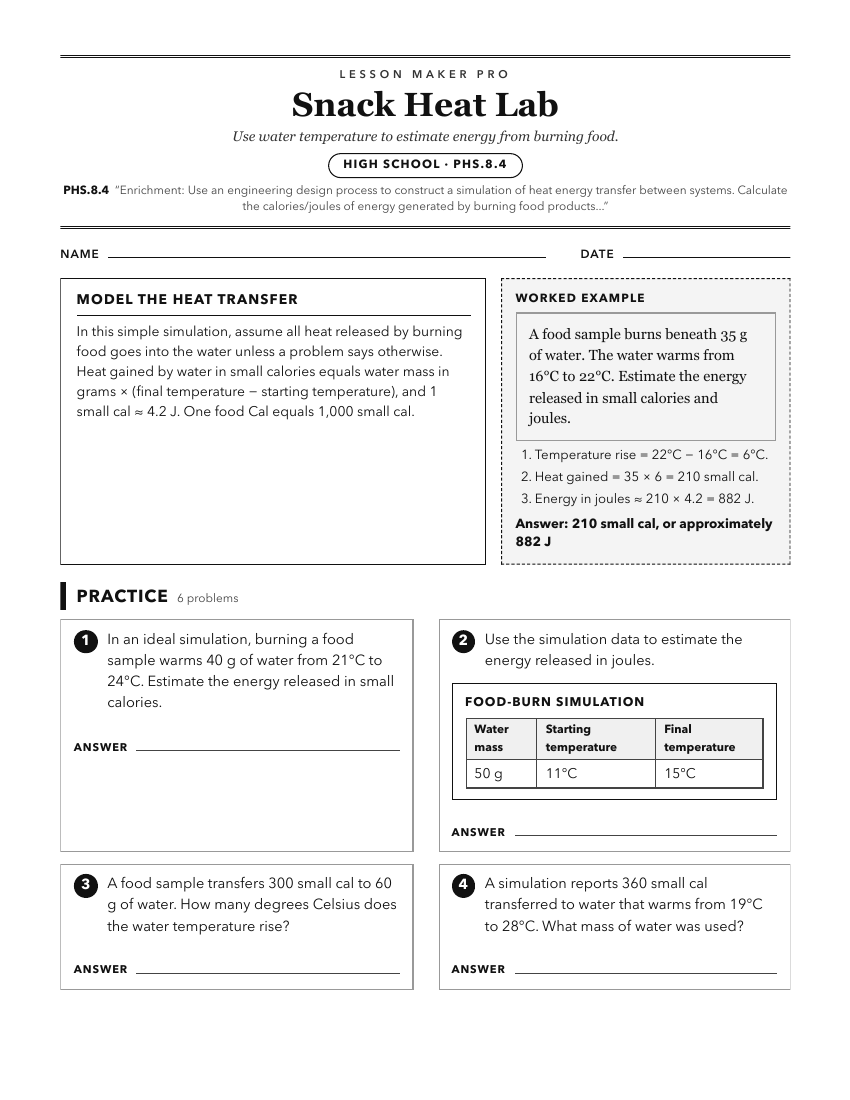
A ready-to-print activity worksheet aligned to PHS.8.4, with an answer key for the teacher on its own page. No account needed.
PDF, US Letter, prints cleanly in black and white.
Download the worksheetKeep exploring
Related Standards
- P.4.6A.1
Obtain and communicate information to compare how different processes (including burning, friction, and electricity) serve as sources of heat energy.
- PHY.3.6
Enrichment: Design, conduct, and communicate investigations that explore how temperature and thermal energy relate to molecular motion and states of matter.
- CHE.7.5
Enrichment: Use an engineering design process and online simulations or lab investigations to design and model the results of controlled scientific investigatio...
- P.4.6A.3
Develop models demonstrating how heat and electrical energy can be transformed into other forms of energy (e.g., motion, sound, heat, or light).
Turn this exact standard into a lesson
Grade, subject, topic, and the complete standard are prefilled. Create one free, no account needed.
Also for this standard:Make a WorksheetMake a QuizMake a Sub Lesson