Mississippi Science P.7.5B
Standard Cluster
Students will demonstrate an understanding about the effects of temperature and pressure on physical state, molecular motion, and molecular interactions. Make predictions about the effect of temperature and pressure on the relative motion of atoms and molecules (speed, expansion, and condensation) relative to recent breakthroughs in polymer and materials science (e.g., self-healing protective films, silicone computer processors, previous/porous concrete). Use evidence from multiple scientific investigations to communicate the relationships between pressure, volume, density, and temperature of a gas. Ask questions to explain how density of matter (observable in various objects) is affected by a change in heat and/or pressure.
2026 Mississippi College- and Career-Readiness Standards for Science · Organization of Matter and Chemical Interactions
Cluster contents
Standards in This Cluster
P.7.5B is a cluster heading. These are the individual standards under it.
- P.7.5B.1
Make predictions about the effect of temperature and pressure on the relative motion of atoms and molecules (speed, expansion, and condensation) relative to rec...
- P.7.5B.2
Use evidence from multiple scientific investigations to communicate the relationships between pressure, volume, density, and temperature of a gas.
- P.7.5B.3
Ask questions to explain how density of matter (observable in various objects) is affected by a change in heat and/or pressure.
Teacher's field guide
What This Cluster Means
What Students Need to Do
- Students predict how heating, cooling, and squeezing affect particle speed, spacing, and changes of state. They use two gas investigations to explain changes in pressure, volume, and density. They ask how heat or pressure can change an object's density.
What Mastery Looks Like
- A student explains that warming usually makes particles move faster, while squeezing a gas packs the same particles into less space and raises its density. They use results from a syringe and a balloon to support their predictions. They know cooling can slow particles enough for a gas to condense.
Common Misconceptions
- Students may think gas particles themselves grow when heated, rather than moving farther apart. Some assume squeezing a gas always makes its particles move faster. Others think the amount of gas changes when its volume changes.
How to Assess It
- Exit ticket: A capped syringe is pushed to half its volume, and a balloon is warmed. Predict what happens to the pressure or volume, particle speed, and density in each, using evidence from both investigations.
Lesson moves
Ways to Teach It
Seal a syringe tip and push its plunger, then move a balloon-topped bottle between warm and cold water; record both volume changes.
Ask students to write: Why does air in a squeezed syringe get denser, while air in a warmed balloon spreads out?
Give pairs particle cards showing gas before and after heating, cooling, or compression; have them sort the cards and explain speed and spacing.
Show a self-healing screen protector package; ask how gentle warming might help its polymer chains move and close a small scratch.
Free download
Printable P.7.5B Worksheet
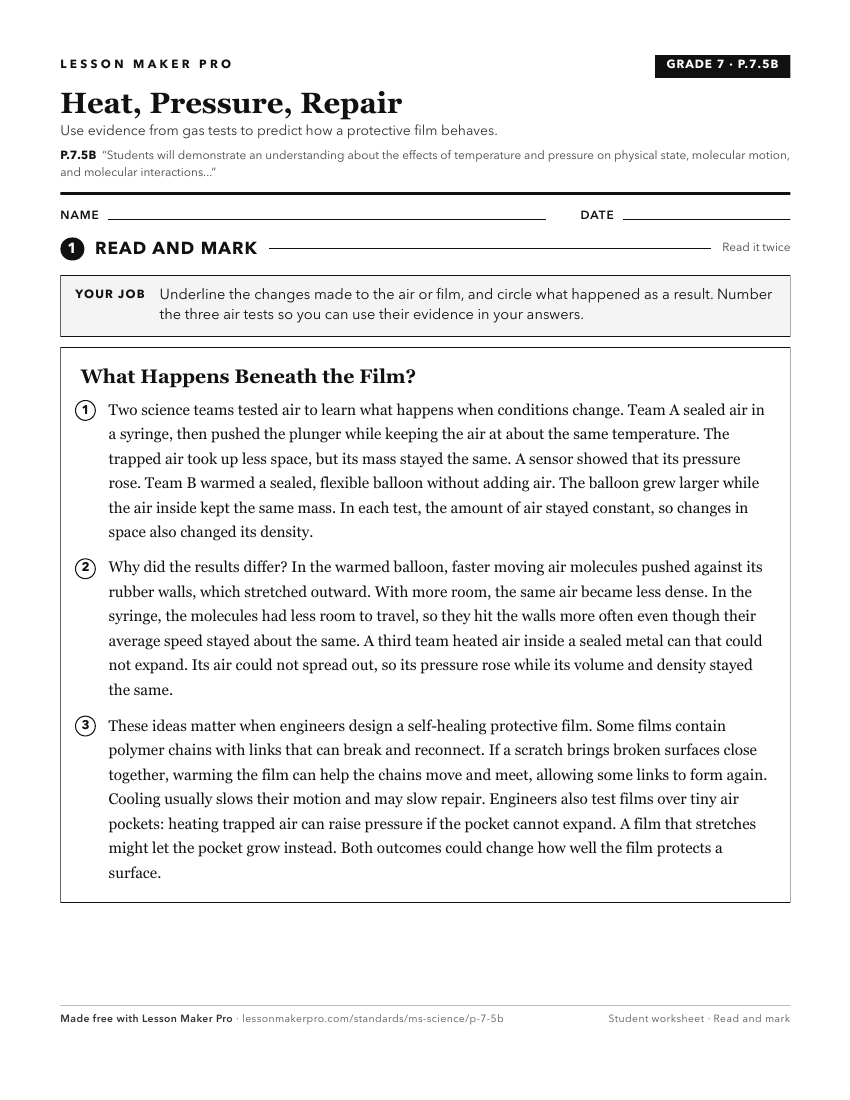
A ready-to-print activity worksheet aligned to P.7.5B, with an answer key for the teacher on its own page. No account needed.
PDF, US Letter, prints cleanly in black and white.
Download the worksheetKeep exploring
Related Standards
- P.K.5A
Students will demonstrate an understanding of the solid and liquid states of matter.
- P.3.5
Students will demonstrate an understanding of the physical properties of matter to explain why matter can change states between a solid, liquid, or gas dependen...
- P.7.5A
Students will demonstrate an understanding of the physical and chemical properties of matter.
- P.5.5A
Students will demonstrate an understanding of the physical properties of matter.
Turn this cluster into a lesson
Grade, subject, topic, and the complete cluster are prefilled. Create one free, no account needed.
Also for this cluster:Make a WorksheetMake a QuizMake a Sub Lesson