Mississippi Science P.3.5
Standard Cluster
Students will demonstrate an understanding of the physical properties of matter to explain why matter can change states between a solid, liquid, or gas dependent upon the addition or removal of heat. Plan and conduct scientific investigations to determine how changes in heat (i.e., an increase or decrease) change matter from one state to another (e.g., melting, freezing, condensing, boiling, or evaporating). Develop and use models to communicate the concept that matter is made of particles too small to be seen that move freely around in space (e.g., inflation and shape of a balloon, wind blowing leaves, or dust suspended in the air). Plan and conduct investigations that particles speed up or slow down with addition or removal of heat.
2026 Mississippi College- and Career-Readiness Standards for Science · Organization of Matter and Chemical Interactions
Cluster contents
Standards in This Cluster
P.3.5 is a cluster heading. These are the individual standards under it.
- P.3.5.1
Plan and conduct scientific investigations to determine how changes in heat (i.e., an increase or decrease) change matter from one state to another (e.g., melti...
- P.3.5.2
Develop and use models to communicate the concept that matter is made of particles too small to be seen that move freely around in space (e.g., inflation and sh...
- P.3.5.3
Plan and conduct investigations that particles speed up or slow down with addition or removal of heat.
Teacher's field guide
What This Cluster Means
What Students Need to Do
- Students observe how adding or removing heat changes water between a solid, liquid, and gas. They record what happens and use dots and arrows to show how tiny particles move in each state.
What Mastery Looks Like
- A student can explain why an ice cube melts and why droplets form on the outside of a cold cup. Their model shows particles close together in ice, sliding past one another in liquid water, and spread out in water vapor. It shows faster motion when particles gain heat.
Common Misconceptions
- Students may think melted ice disappears or that droplets on a cold cup leaked from inside. They may think air has no particles because they cannot see them. Some think heating makes particles bigger rather than making them move faster.
How to Assess It
- Show a drawing of ice melting beside a cold cup with droplets on its outside. Ask students to name each change, tell where the heat or water came from, and draw particle motion before and after.
Lesson moves
Ways to Teach It
Put equal ice cubes in sealed bags, place one in sunlight and one in shade, and record how much melts every two minutes.
Ask, 'Where did the water on the outside of this cold cup come from?' Have students write an explanation.
Give pairs ice, liquid water, water vapor, heating, and cooling cards to arrange, then act out particle motion for each state.
Show a photo of a wet sidewalk drying and ask students to sketch where the water goes as sunlight warms it.
Free download
Printable P.3.5 Worksheet
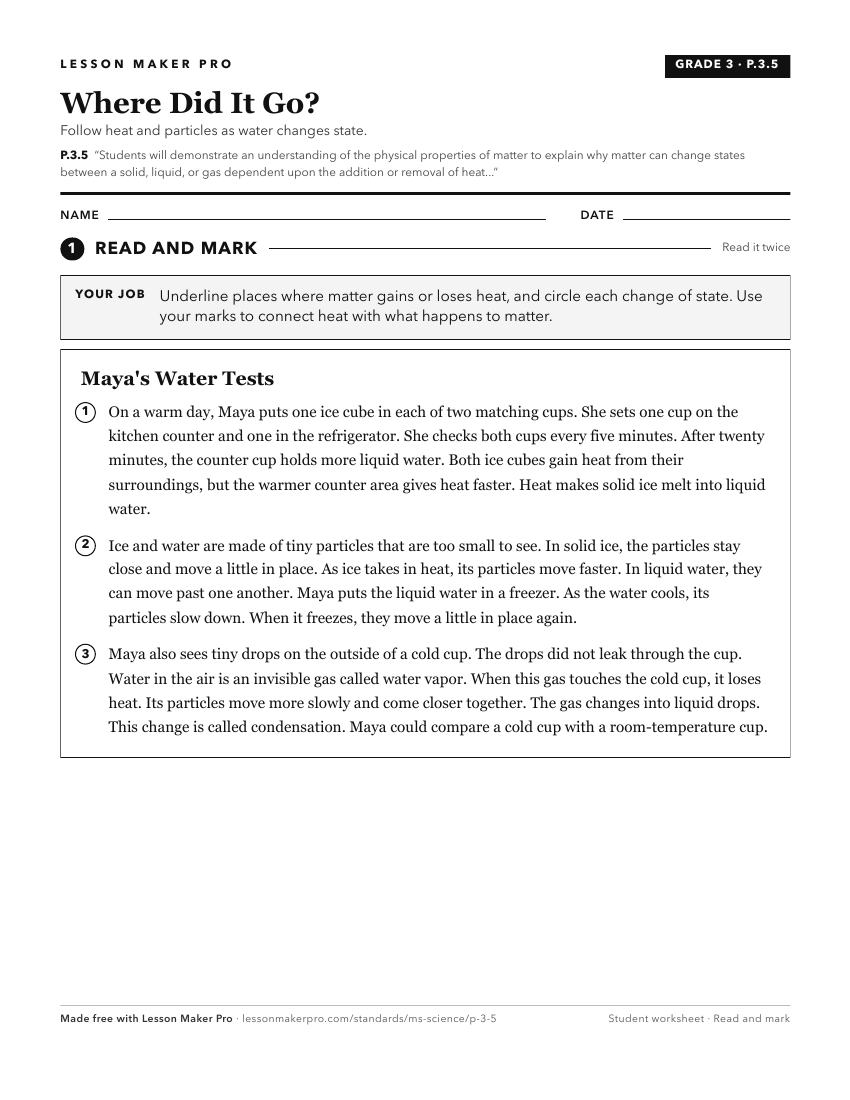
A ready-to-print activity worksheet aligned to P.3.5, with an answer key for the teacher on its own page. No account needed.
PDF, US Letter, prints cleanly in black and white.
Download the worksheetKeep exploring
Related Standards
- P.K.5A
Students will demonstrate an understanding of the solid and liquid states of matter.
- P.7.5A
Students will demonstrate an understanding of the physical and chemical properties of matter.
- P.5.5A
Students will demonstrate an understanding of the physical properties of matter.
- P.2.5
Students will demonstrate an understanding of the properties of matter.
Turn this cluster into a lesson
Grade, subject, topic, and the complete cluster are prefilled. Create one free, no account needed.
Also for this cluster:Make a WorksheetMake a QuizMake a Sub Lesson