Mississippi Science P.3.5.2
The Standard
- P.3.5
- Students will demonstrate an understanding of the physical properties of matter to explain why matter can change states between a solid, liquid, or gas dependent upon the addition or removal of heat.
Develop and use models to communicate the concept that matter is made of particles too small to be seen that move freely around in space (e.g., inflation and shape of a balloon, wind blowing leaves, or dust suspended in the air).
2026 Mississippi College- and Career-Readiness Standards for Science · Organization of Matter and Chemical Interactions
Teacher's field guide
What This Standard Means
What Students Need to Do
- Students make models of air as tiny particles they cannot see. They use their models to show how air moves through space, fills a balloon, or pushes leaves.
What Mastery Looks Like
- A student draws separate dots with arrows to show air particles moving, even when the air looks empty. They explain that pumping air into a balloon adds particles that push outward and change its shape.
Common Misconceptions
- Students may think air is nothing because they cannot see it. They may mistake visible dust for air particles or draw the particles sitting still.
How to Assess It
- Exit ticket: Draw a flat balloon and an inflated balloon. Add dots and arrows for air particles, then explain why the balloon changes shape.
Lesson moves
Ways to Teach It
Inflate a balloon with a pump, then have pairs draw air particle dots and motion arrows inside it before and after inflation.
Ask students to write two sentences answering, 'How can wind move a leaf if we cannot see the air?'
Give pairs balloon and wind picture cards; have them race to add dots and arrows showing how air moves in each scene.
Show a bicycle pump and tire; have students sketch where air particles go when someone pumps up the tire.
Free download
Printable P.3.5.2 Worksheet
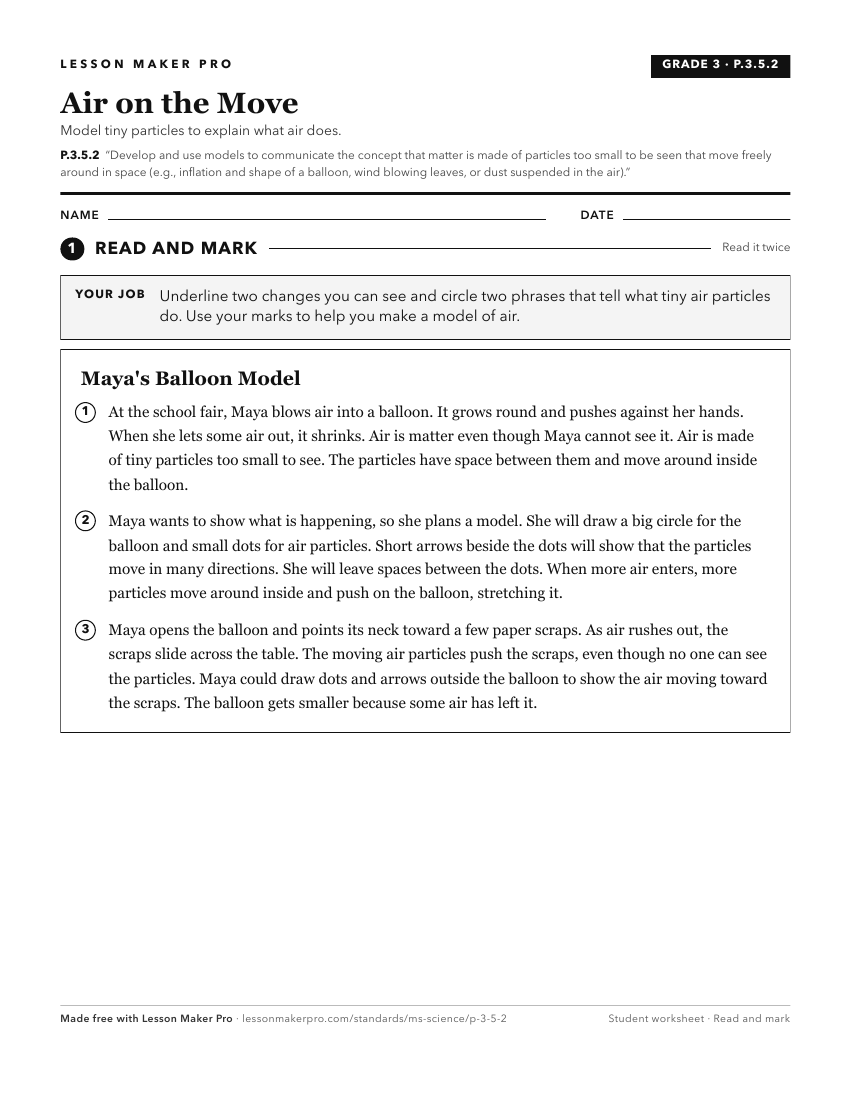
A ready-to-print activity worksheet aligned to P.3.5.2, with an answer key for the teacher on its own page. No account needed.
PDF, US Letter, prints cleanly in black and white.
Download the worksheetKeep exploring
Related Standards
- FB.2.1
Develop and use simple atomic models to describe the components of elements (e.g., relative position, charges of protons, neutrons, and electrons).
- P.7.5C.1
Develop and use models that explain the structure of an atom.
- P.4.6B.3
Develop and use models to communicate how light travels and behaves when it strikes an object, including reflection, refraction, and absorption.
- PHS.1.1
Use contextual evidence to describe particle theory of matter. Examine the particle properties of solids, liquids, and gases.
Turn this exact standard into a lesson
Grade, subject, topic, and the complete standard are prefilled. Create one free, no account needed.
Also for this standard:Make a WorksheetMake a QuizMake a Sub Lesson