Mississippi Science PHS.1.1
The Standard
- PHS.1
- Students will demonstrate an understanding of the nature of matter.
Use contextual evidence to describe particle theory of matter. Examine the particle properties of solids, liquids, and gases.
2026 Mississippi College- and Career-Readiness Standards for Science · Nature of Matter
Teacher's field guide
What This Standard Means
What Students Need to Do
- Students use observations of shape, flow, and compression as evidence for how particles behave. They draw particle models of solids, liquids, and gases and use them to explain changes of state.
What Mastery Looks Like
- A student explains why air in a capped syringe compresses much more than water. Their diagrams show solid particles in fixed positions, liquid particles sliding past each other, and gas particles spread far apart.
Common Misconceptions
- Students may draw liquid particles as far apart as gas particles or think gases have no mass. Some think particles themselves melt or disappear when matter changes state.
How to Assess It
- Exit ticket: Sketch particles in an ice cube, a drop of water, and air in a capped syringe. Explain why the air compresses much more than the water.
Lesson moves
Ways to Teach It
Have students press capped, needle-free syringes filled with air and water, then sketch particle spacing to explain the difference.
Ask students to write: When a puddle disappears, where does the water go, and what evidence supports your answer?
Give pairs particle diagrams and observation cards to sort into solid, liquid, and gas, then ask them to justify each match.
Place a cold drink can on a desk and have students explain the droplets outside it with a particle sketch.
Free download
Printable PHS.1.1 Worksheet
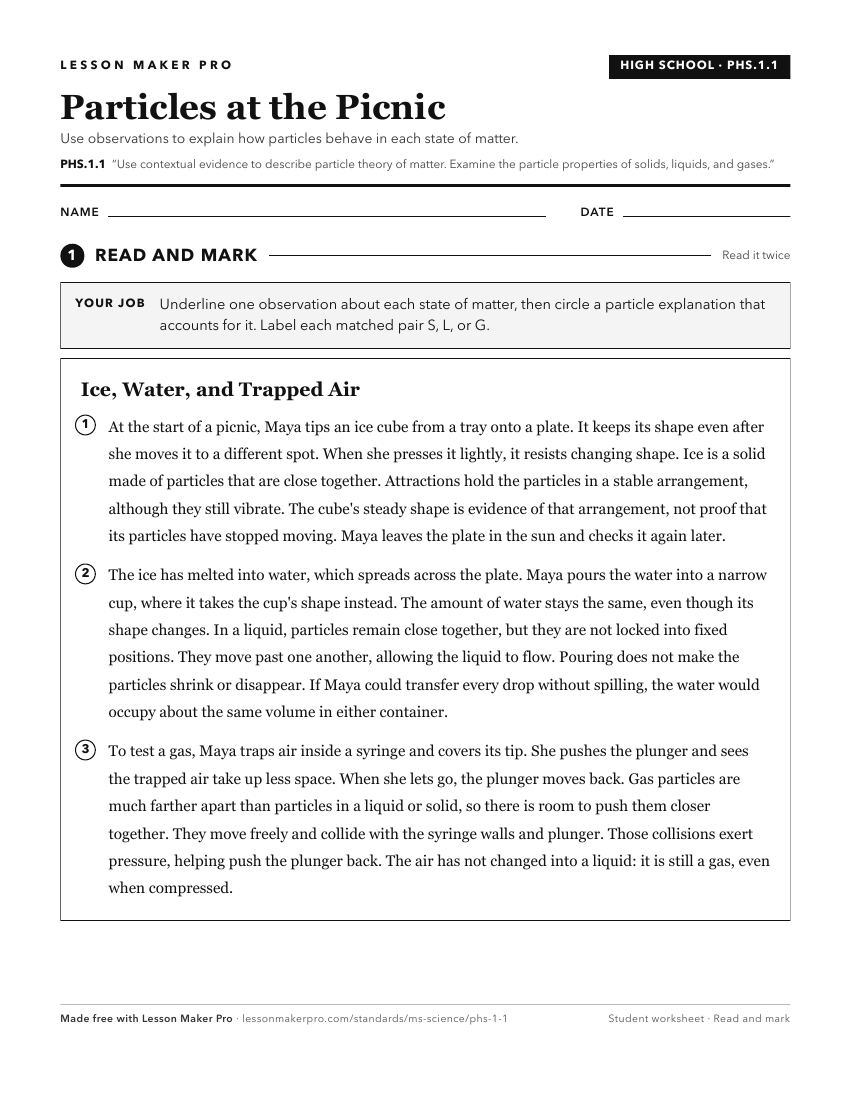
A ready-to-print activity worksheet aligned to PHS.1.1, with an answer key for the teacher on its own page. No account needed.
PDF, US Letter, prints cleanly in black and white.
Download the worksheetKeep exploring
Related Standards
- P.K.5A
Students will demonstrate an understanding of the solid and liquid states of matter.
- P.5.5A.2
Collect, analyze, and interpret data from measurements of the physical properties of solids, liquids, and gases (e.g., volume, shape, movement, and spacing of p...
- P.3.5
Students will demonstrate an understanding of the physical properties of matter to explain why matter can change states between a solid, liquid, or gas dependen...
- PHS.8.2
Apply particle theory to phase change and analyze freezing point, melting point, boiling point, vaporization, and condensation of different substances.
Turn this exact standard into a lesson
Grade, subject, topic, and the complete standard are prefilled. Create one free, no account needed.
Also for this standard:Make a WorksheetMake a QuizMake a Sub Lesson