Mississippi Science PHS.8.2
The Standard
- PHS.8
- Students will demonstrate an understanding of temperature scales, heat, and thermal energy transfer.
Apply particle theory to phase change and analyze freezing point, melting point, boiling point, vaporization, and condensation of different substances.
2026 Mississippi College- and Career-Readiness Standards for Science · Thermal Energy
Teacher's field guide
What This Standard Means
What Students Need to Do
- Students use particle diagrams to explain melting, freezing, boiling, and condensation. They read temperature graphs to find when different substances change state. They distinguish evaporation at a liquid's surface from boiling throughout it.
What Mastery Looks Like
- A student can label phase changes on heating and cooling graphs for water and ethanol. They explain why the temperature of a pure substance stays steady during a phase change. They know a substance melts and freezes at the same temperature under the same pressure.
Common Misconceptions
- Students may think particles stop moving when a substance freezes. They may expect temperature to keep rising while pure ice melts. Some assume every liquid boils at 100°C.
How to Assess It
- Show a water heating and cooling graph with flat sections at 0°C and 100°C. Ask students to label melting, freezing, boiling, and condensation, then explain one flat section using particles.
Lesson moves
Ways to Teach It
Put a thermometer in a cup of crushed ice, record its temperature every minute as it melts, and graph the readings.
Ask: Why does the thermometer stay near 0°C while ice is melting? Have students answer with a particle sketch.
Give pairs temperature cards for water and ethanol, then have them race to match each card to a phase and particle diagram.
Set a cold drink can on a desk and ask students to sketch where the outside droplets came from.
Free download
Printable PHS.8.2 Worksheet
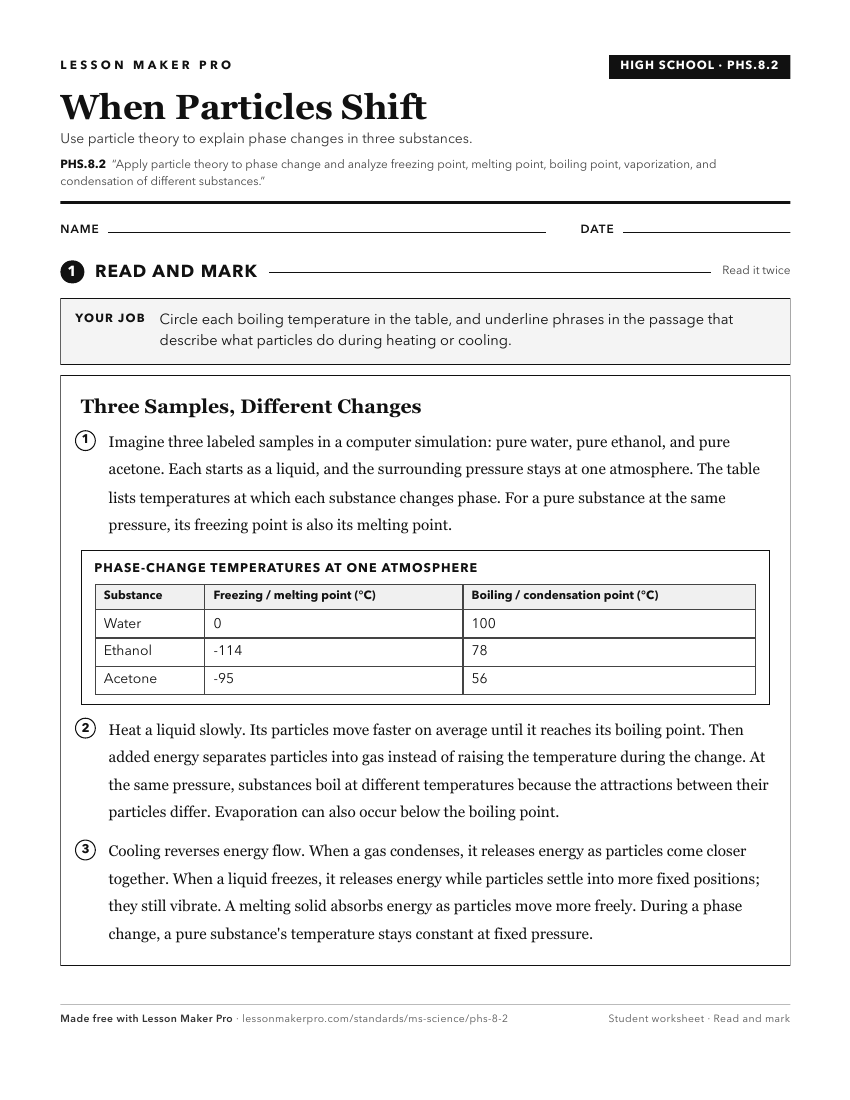
A ready-to-print activity worksheet aligned to PHS.8.2, with an answer key for the teacher on its own page. No account needed.
PDF, US Letter, prints cleanly in black and white.
Download the worksheetKeep exploring
Related Standards
- P.5.5C.2
Analyze and communicate the results of physical changes to a substance that results in a reversible change (e.g., changes in states of matter with the addition ...
- P.3.5
Students will demonstrate an understanding of the physical properties of matter to explain why matter can change states between a solid, liquid, or gas dependen...
- P.3.5.1
Plan and conduct scientific investigations to determine how changes in heat (i.e., an increase or decrease) change matter from one state to another (e.g., melti...
- PHS.1.1
Use contextual evidence to describe particle theory of matter. Examine the particle properties of solids, liquids, and gases.
Turn this exact standard into a lesson
Grade, subject, topic, and the complete standard are prefilled. Create one free, no account needed.
Also for this standard:Make a WorksheetMake a QuizMake a Sub Lesson