Mississippi Science PHS.8.3
The Standard
- PHS.8
- Students will demonstrate an understanding of temperature scales, heat, and thermal energy transfer.
Relate thermal energy transfer to real world applications of conduction (e.g., quenching metals), convection (e.g., movement of air masses/weather/plate tectonics), and radiation (e.g., electromagnetic).
2026 Mississippi College- and Career-Readiness Standards for Science · Thermal Energy
Teacher's field guide
What This Standard Means
What Students Need to Do
- Students trace thermal energy from warmer places to cooler places. They explain whether direct contact, moving air or water, or electromagnetic waves carry it.
What Mastery Looks Like
- A student identifies conduction where hot steel touches cool water, convection where warmed air rises, and radiation where sunlight heats pavement. They draw arrows to show where energy moves and explain each choice.
Common Misconceptions
- Students may say heat rises, when it is warm air that rises. They may think sunlight needs air to transfer energy, or that water cools hot metal without gaining energy from it.
How to Assess It
- Exit ticket: For hot steel dipped in water, warm air rising above pavement, and sunlight heating pavement, name the transfer method and show where the energy goes.
Lesson moves
Ways to Teach It
Put metal and plastic spoons in warm water for three minutes, then compare their handle temperatures with a thermometer.
Ask why air blows toward shore on a sunny afternoon; have students sketch rising air over land and cooler air moving in.
Have pairs sort cards showing a hot pan handle, swirling pot water, and a heat lamp by transfer method.
Show a photo of a blacksmith quenching steel; have students draw energy arrows into the water and through the moving water.
Free download
Printable PHS.8.3 Worksheet
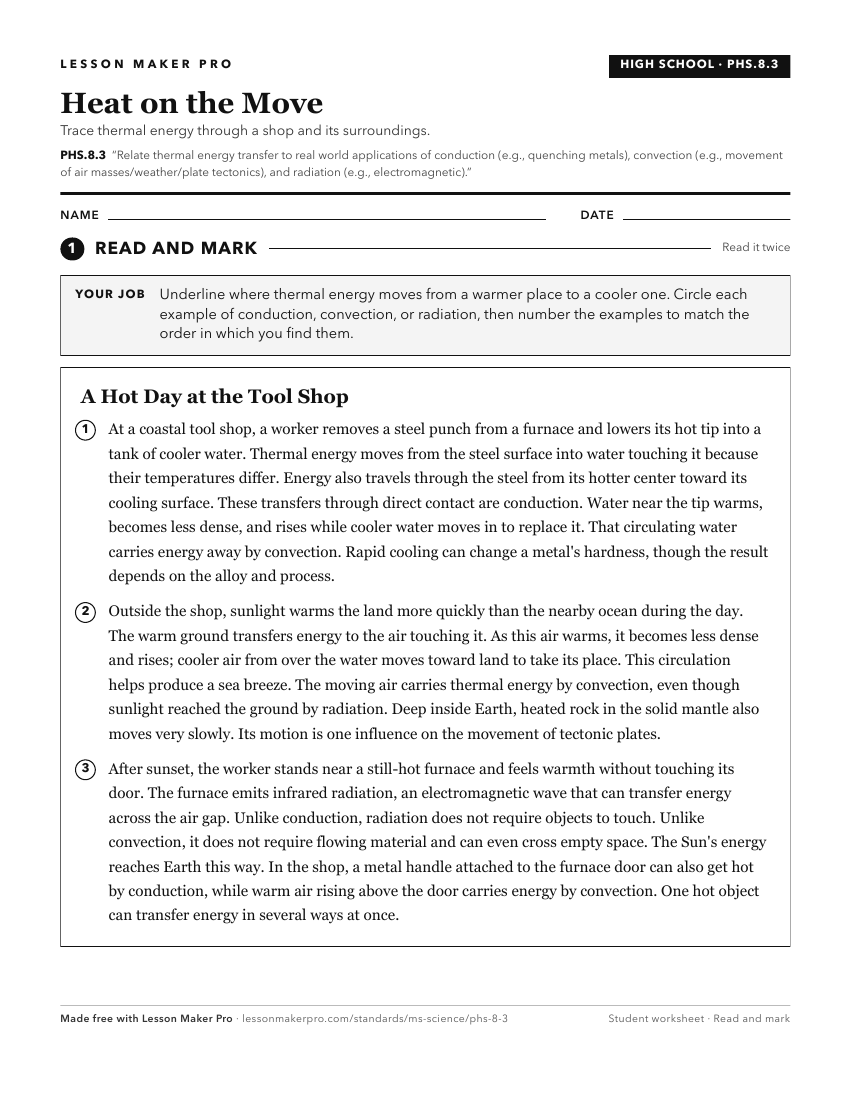
A ready-to-print activity worksheet aligned to PHS.8.3, with an answer key for the teacher on its own page. No account needed.
PDF, US Letter, prints cleanly in black and white.
Download the worksheetKeep exploring
Related Standards
- P.4.6A.1
Obtain and communicate information to compare how different processes (including burning, friction, and electricity) serve as sources of heat energy.
- ESS.3.4
Research and communicate information to explain the importance of the transfer of thermal energy among the hydrosphere, geosphere, and atmosphere. Include the u...
- PHS.8
Students will demonstrate an understanding of temperature scales, heat, and thermal energy transfer.
- P.6.6.7
Determine the relationships between the concepts of potential, kinetic, and thermal energy.
Turn this exact standard into a lesson
Grade, subject, topic, and the complete standard are prefilled. Create one free, no account needed.
Also for this standard:Make a WorksheetMake a QuizMake a Sub Lesson