Mississippi Science CHE.2.2
The Standard
- CHE.2
- Students will demonstrate an understanding of the atomic structure and the historical developments leading to modern atomic theory.
Construct models (e.g., ball and stick, online simulations, mathematical computations) of atomic nuclei to explain the abundance weighted average (relative mass) of elements and isotopes on the published mass of elements.
2026 Mississippi College- and Career-Readiness Standards for Science · Atomic Theory
Teacher's field guide
What This Standard Means
What Students Need to Do
- Students build models of isotopes with the same number of protons but different numbers of neutrons. They use each isotope’s mass and percent abundance to estimate an element’s average atomic mass.
What Mastery Looks Like
- A student can draw chlorine nuclei with 17 protons and either 18 or 20 neutrons. They can use the isotopes’ abundances to estimate a mass near 35.5 and explain why it is closer to 35 than 37.
Common Misconceptions
- Students may think the mass on the periodic table describes every atom of an element. Some change the number of protons when drawing isotopes, or take a simple average without using the percent abundances.
How to Assess It
- Exit ticket: Boron-10 is 20% abundant and boron-11 is 80% abundant. Draw each nucleus, calculate the average mass, and explain why it is closer to 11.
Lesson moves
Ways to Teach It
Build two chlorine nuclei with red proton and blue neutron counters, then place three chlorine-35 cards beside one chlorine-37 card.
Ask: Why is chlorine’s listed mass near 35.5 rather than exactly 35 or 37? Explain using your models.
Give pairs isotope cards labeled chlorine-35, 75%, and chlorine-37, 25%; have them calculate 0.75(35) + 0.25(37).
Find chlorine’s mass on a periodic table, then explain why chlorine atoms in table salt do not all have that exact mass.
Free download
Printable CHE.2.2 Worksheet
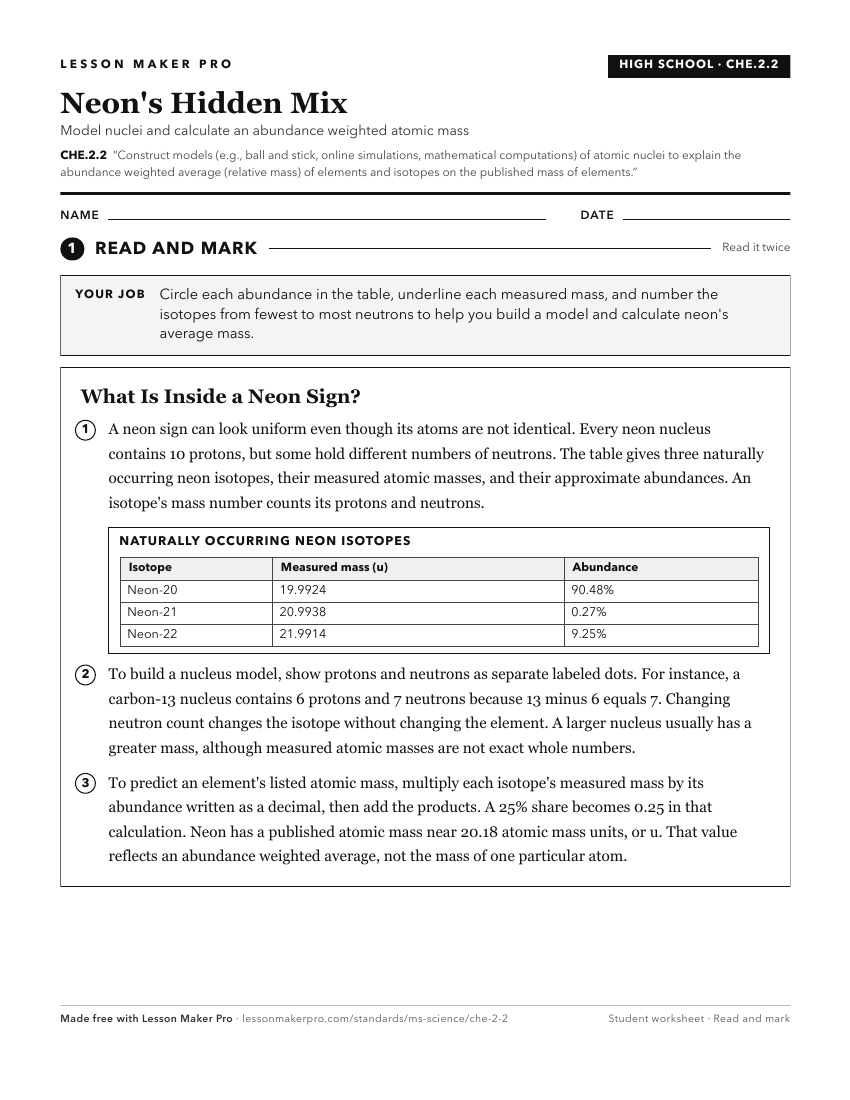
A ready-to-print activity worksheet aligned to CHE.2.2, with an answer key for the teacher on its own page. No account needed.
PDF, US Letter, prints cleanly in black and white.
Download the worksheetKeep exploring
Related Standards
- FB.2.1
Develop and use simple atomic models to describe the components of elements (e.g., relative position, charges of protons, neutrons, and electrons).
- P.7.5C.1
Develop and use models that explain the structure of an atom.
- PHS.3.5
Use mathematical and computational analysis to determine the atomic mass of binary compounds.
- PHS.2.1
Research and develop models (e.g., 3-D models, online simulations, or ball and stick) to investigate both modern and historical theories of atomic structure. Co...
Turn this exact standard into a lesson
Grade, subject, topic, and the complete standard are prefilled. Create one free, no account needed.
Also for this standard:Make a WorksheetMake a QuizMake a Sub Lesson