Mississippi Science PHS.3.5
The Standard
- PHS.3
- Students will analyze the organization of the periodic table of elements to predict atomic interactions.
Use mathematical and computational analysis to determine the atomic mass of binary compounds.
2026 Mississippi College- and Career-Readiness Standards for Science · Periodic Table
Teacher's field guide
What This Standard Means
What Students Need to Do
- Students read a formula with two elements and count the atoms of each. They use atomic masses from the periodic table, multiply by any subscripts, and add the results.
What Mastery Looks Like
- For CaCl2, a student adds the mass of one calcium atom and two chlorine atoms. They get 110.98 amu and can show each step.
Common Misconceptions
- Students may add each element’s mass only once, ignoring the subscript. Others use the atomic number instead of the atomic mass, or multiply the whole sum by the subscript.
How to Assess It
- Exit ticket: Calculate the formula mass of CaCl2 using Ca = 40.08 amu and Cl = 35.45 amu. Show how you used the subscript.
Lesson moves
Ways to Teach It
Give pairs element cards labeled with atomic masses; have them build CaCl2 with one calcium card and two chlorine cards, then total the masses.
Ask why CO2 has a greater formula mass than CO; have students write one sentence that explains the role of the subscript.
Pairs draw NaCl, MgO, or CaCl2 cards, calculate each mass with a calculator, and earn a point when their partner verifies it.
Show labels for table salt and calcium chloride deicer; have students use their formulas to compare the mass of one formula unit of each.
Free download
Printable PHS.3.5 Worksheet
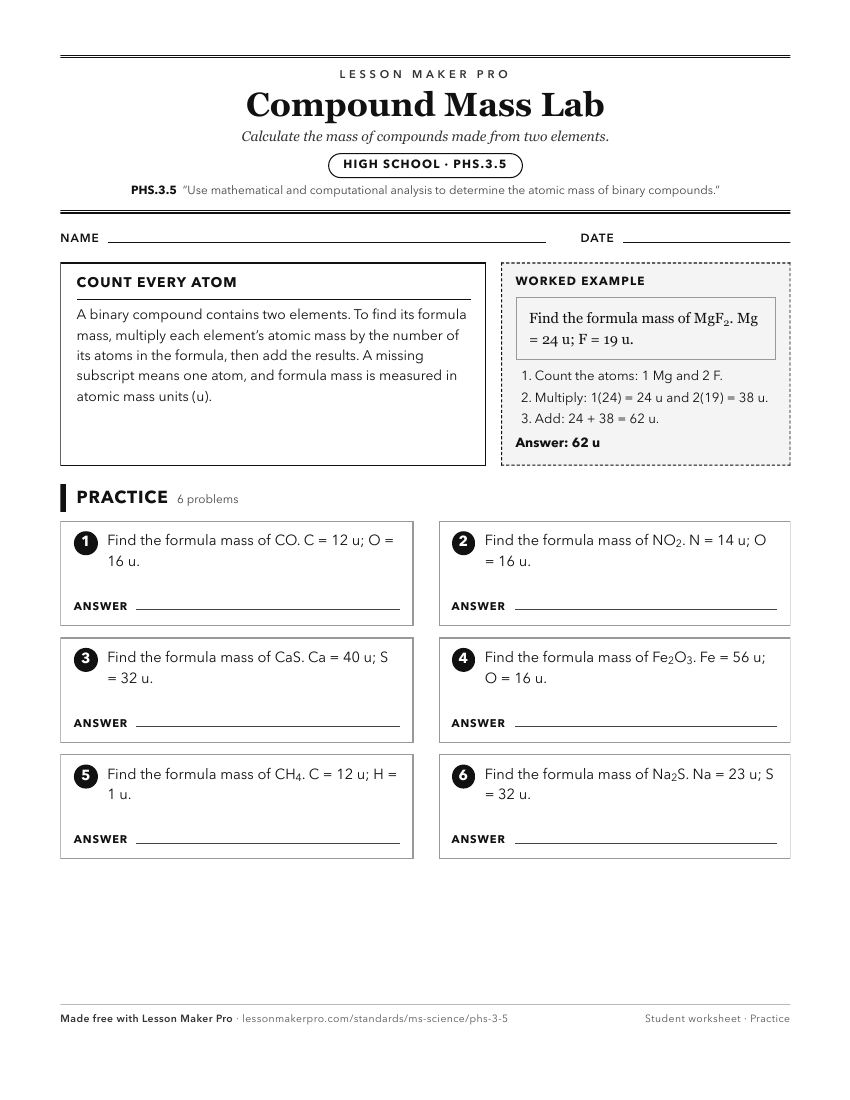
A ready-to-print activity worksheet aligned to PHS.3.5, with an answer key for the teacher on its own page. No account needed.
PDF, US Letter, prints cleanly in black and white.
Download the worksheetKeep exploring
Related Standards
- CHE.6.3
Use mathematics and computational analysis to represent the ratio of reactants and products in terms of masses, molecules, and moles (stoichiometry).
- CHE.2.2
Construct models (e.g., ball and stick, online simulations, mathematical computations) of atomic nuclei to explain the abundance weighted average (relative mass...
- CHE.8.7
Use mathematical and computational analysis to predict the results of reactions using the concentration of solutions (i.e., solution stoichiometry).
- CHE.4.6
Use mathematical and computational analysis to determine the empirical formula and the percent composition of compounds.
Turn this exact standard into a lesson
Grade, subject, topic, and the complete standard are prefilled. Create one free, no account needed.
Also for this standard:Make a WorksheetMake a QuizMake a Sub Lesson