Mississippi Science CHE.3
Standard Cluster
Students will demonstrate an understanding of the periodic table as a systematic representation to predict properties of elements. Explore and communicate the organization of the periodic table, including history, groups, families, family names, metals, nonmetals, metalloids, and transition metals. Analyze properties of atoms and ions (e.g., metal/nonmetal/metalloid behavior, electrical/heat conductivity, electronegativity and electron affinity, ionization energy, and atomic/ionic radii) using periodic trends of elements based on the periodic table. Analyze the periodic table to identify quantum numbers (e.g., valence shell electrons, energy level, orbitals, sublevels, and oxidation numbers).
2026 Mississippi College- and Career-Readiness Standards for Science · Periodic Table
Cluster contents
Standards in This Cluster
CHE.3 is a cluster heading. These are the individual standards under it.
- CHE.3.1
Explore and communicate the organization of the periodic table, including history, groups, families, family names, metals, nonmetals, metalloids, and transition...
- CHE.3.2
Analyze properties of atoms and ions (e.g., metal/nonmetal/metalloid behavior, electrical/heat conductivity, electronegativity and electron affinity, ionization...
- CHE.3.3
Analyze the periodic table to identify quantum numbers (e.g., valence shell electrons, energy level, orbitals, sublevels, and oxidation numbers).
Teacher's field guide
What This Cluster Means
What Students Need to Do
- Students use an element's place on the table to name its family, classify it, and predict whether it conducts electricity. They read electron configurations to find valence electrons, energy levels, sublevels, occupied orbitals, and likely ion charges. They use table trends to compare atomic and ionic size, ionization energy, electronegativity, and electron affinity.
What Mastery Looks Like
- Given sodium and chlorine, a student names their families, counts valence electrons, and predicts their ions. They explain why a sodium atom is larger than a chlorine atom, but smaller than it was after losing an electron. They identify occupied energy levels and sublevels from electron configurations.
Common Misconceptions
- Students often think every property rises from left to right, even though atomic size usually falls. They confuse a group's shared valence pattern with a period's shared number of energy levels. They may think ions stay the same size as neutral atoms, or confuse electronegativity with electron affinity.
How to Assess It
- Exit ticket: For magnesium and sulfur, name each family and predict each ion's charge. Circle the larger neutral atom and explain your choice using their table positions.
Lesson moves
Ways to Teach It
Hand out mass-and-property cards for the first 18 elements, omit silicon, and have groups arrange the cards and predict silicon's properties.
Ask, 'Why does fluorine attract bonding electrons more strongly than lithium, yet both form ions?' Have partners cite position and valence electrons.
Run a board relay: teams fill orbital boxes for Mg and S, give valence counts, then rank atomic radii and ionization energies.
Show a copper wire and a sulfur sample; ask students to use table placement to explain which conducts electricity and why.
Free download
Printable CHE.3 Worksheet
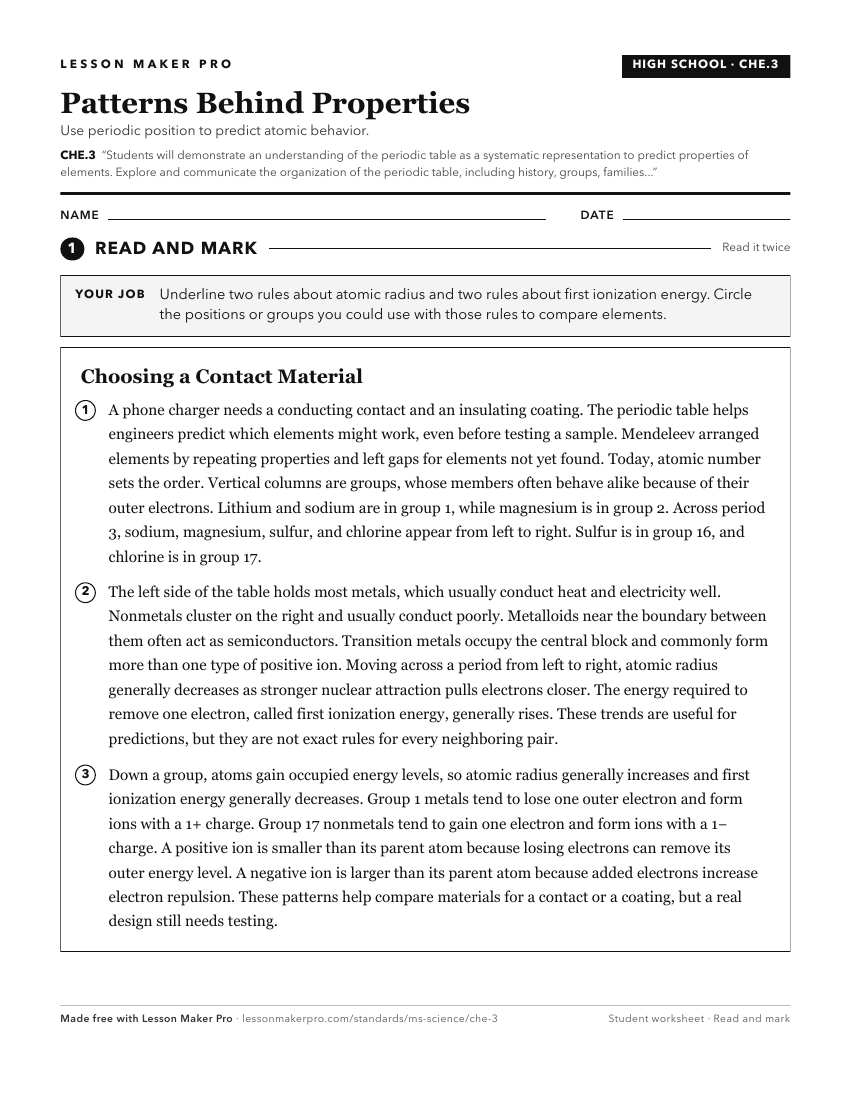
A ready-to-print activity worksheet aligned to CHE.3, with an answer key for the teacher on its own page. No account needed.
PDF, US Letter, prints cleanly in black and white.
Download the worksheetKeep exploring
Related Standards
- P.7.5A
Students will demonstrate an understanding of the physical and chemical properties of matter.
- PHS.3
Students will analyze the organization of the periodic table of elements to predict atomic interactions.
- P.7.5C
Students will demonstrate an understanding of the proper use of the periodic table to predict and identify elemental properties and how elements interact.
- P.2.5
Students will demonstrate an understanding of the properties of matter.
Turn this cluster into a lesson
Grade, subject, topic, and the complete cluster are prefilled. Create one free, no account needed.
Also for this cluster:Make a WorksheetMake a QuizMake a Sub Lesson