Mississippi Science P.7.5C.5
The Standard
- P.7.5C
- Students will demonstrate an understanding of the proper use of the periodic table to predict and identify elemental properties and how elements interact.
Describe concepts used to construct chemical formulas (e.g., CH4, H2O) to determine the number of atoms in a chemical formula.
2026 Mississippi College- and Career-Readiness Standards for Science · Organization of Matter and Chemical Interactions
Teacher's field guide
What This Standard Means
What Students Need to Do
- Students identify the element symbols in a chemical formula. They use subscripts to count atoms of each element and treat a missing subscript as one.
What Mastery Looks Like
- Given C2H6O, a student counts two carbon atoms, six hydrogen atoms, and one oxygen atom. They find nine atoms total and explain that the 6 applies only to hydrogen.
Common Misconceptions
- Students may apply the 2 in H2O to both hydrogen and oxygen, or count the 2 itself as an atom. They may say oxygen has zero atoms because O has no subscript.
How to Assess It
- Exit ticket: In C2H6O, how many atoms of each element are there, and how many atoms are there total? What does the missing subscript after O mean?
Lesson moves
Ways to Teach It
Give pairs two bead colors and cards labeled H2O and CH4; have them build each molecule and tally atoms by element.
Ask students to write why CO and CO2 have different numbers of atoms, even though both contain carbon and oxygen.
Give groups formula cards for CO2, CH4, and NH3; have them race to match each card with its atom counts.
Put H2O and CO2 cards beside a water bottle and a fizzy drink; ask students to count the atoms in each formula.
Free download
Printable P.7.5C.5 Worksheet
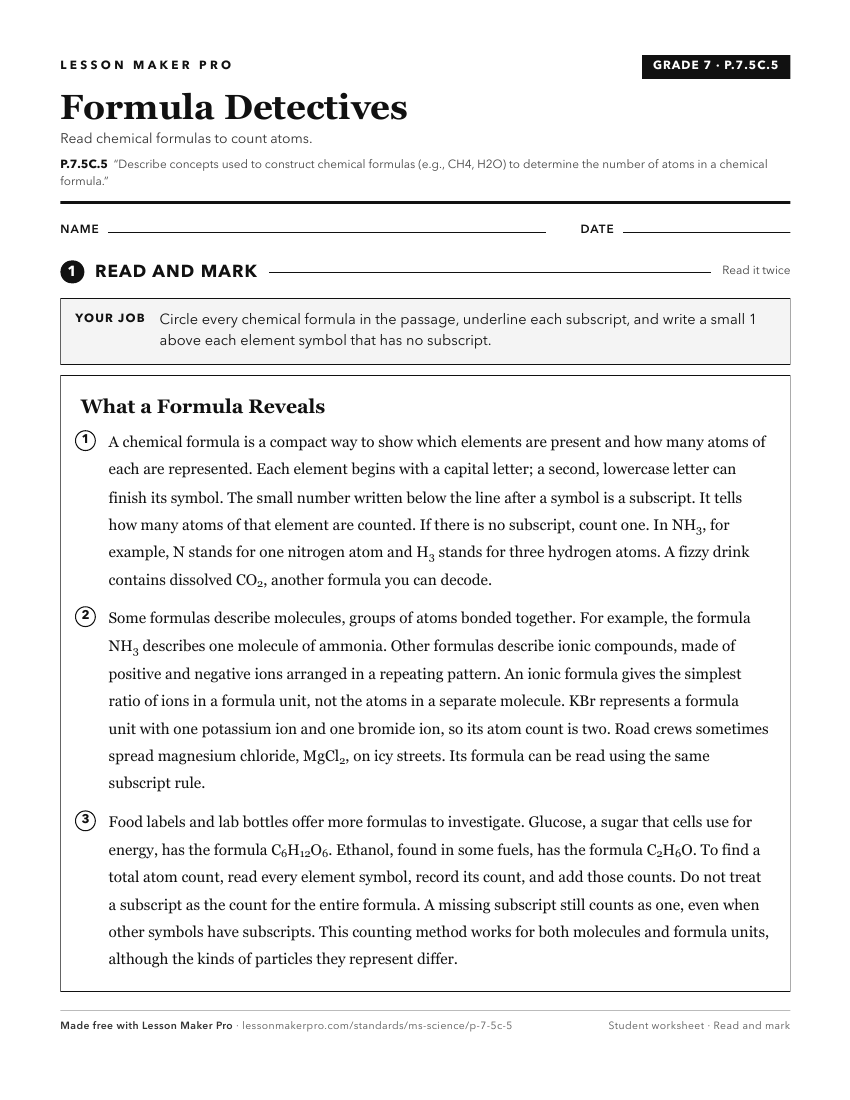
A ready-to-print activity worksheet aligned to P.7.5C.5, with an answer key for the teacher on its own page. No account needed.
PDF, US Letter, prints cleanly in black and white.
Download the worksheetKeep exploring
Related Standards
- CHE.5
Students will investigate and understand the accepted nomenclature used to identify the name and chemical formulas of compounds.
- P.7.5E.3
Compare and contrast balanced and unbalanced chemical equations to demonstrate the number of atoms does not change in the reaction.
- P.7.5D
Students will demonstrate an understanding of chemical formulas and common chemical substances to predict the types of reactions and possible outcomes of the re...
- CHE.4.6
Use mathematical and computational analysis to determine the empirical formula and the percent composition of compounds.
Turn this exact standard into a lesson
Grade, subject, topic, and the complete standard are prefilled. Create one free, no account needed.
Also for this standard:Make a WorksheetMake a QuizMake a Sub Lesson