Mississippi Science CHE.5
Standard Cluster
Students will investigate and understand the accepted nomenclature used to identify the name and chemical formulas of compounds. Use the periodic table and a list of common polyatomic ions as a model to derive chemical compound formulas from compound names and compound names from chemical formulas. Generate formulas of ionic and covalent compounds from compound names. Discuss compounds in everyday life and compile lists and uses of these chemicals. Generate names of ionic and covalent compounds from their formulas. Name binary compounds, binary acids, stock compounds, ternary compounds, and ternary acids.
2026 Mississippi College- and Career-Readiness Standards for Science · Naming Compounds
Cluster contents
Standards in This Cluster
CHE.5 is a cluster heading. These are the individual standards under it.
- CHE.5.1
Use the periodic table and a list of common polyatomic ions as a model to derive chemical compound formulas from compound names and compound names from chemical...
- CHE.5.2
Generate formulas of ionic and covalent compounds from compound names. Discuss compounds in everyday life and compile lists and uses of these chemicals.
- CHE.5.3
Generate names of ionic and covalent compounds from their formulas. Name binary compounds, binary acids, stock compounds, ternary compounds, and ternary acids.
Teacher's field guide
What This Cluster Means
What Students Need to Do
- Students use a periodic table and a polyatomic ion chart to turn compound names into formulas and formulas into names. They apply different naming rules to ionic compounds, molecular compounds, and acids. They identify familiar compounds and their uses.
What Mastery Looks Like
- Given a name or formula, a student can write its matching formula or name. They use charges, parentheses, Roman numerals, prefixes, and acid endings correctly. They can give a use for table salt or baking soda.
Common Misconceptions
- Students may write Ca2O2 instead of reducing it to CaO. They may use prefixes for ionic compounds or omit Roman numerals for metals with more than one charge. They may call HCl(aq) hydrogen chloride instead of hydrochloric acid.
How to Assess It
- Exit ticket: Name FeCl3, CO2, and HNO3(aq). Write formulas for calcium nitrate, dinitrogen tetroxide, and hydrochloric acid.
Lesson moves
Ways to Teach It
Give pairs cards labeled Ca2+, Fe3+, Cl-, and NO3-; have them build neutral compounds with repeated ion cards and write each name.
Write HCl(g), HCl(aq), and HNO3(aq) on the board; ask students to explain why the three names differ.
Run a six-card match using iron(III) chloride, carbon dioxide, calcium nitrate, FeCl3, CO2, and Ca(NO3)2.
Bring a table salt box and baking soda carton; students write NaCl and NaHCO3, identify each compound's ions, and list one use.
Free download
Printable CHE.5 Worksheet
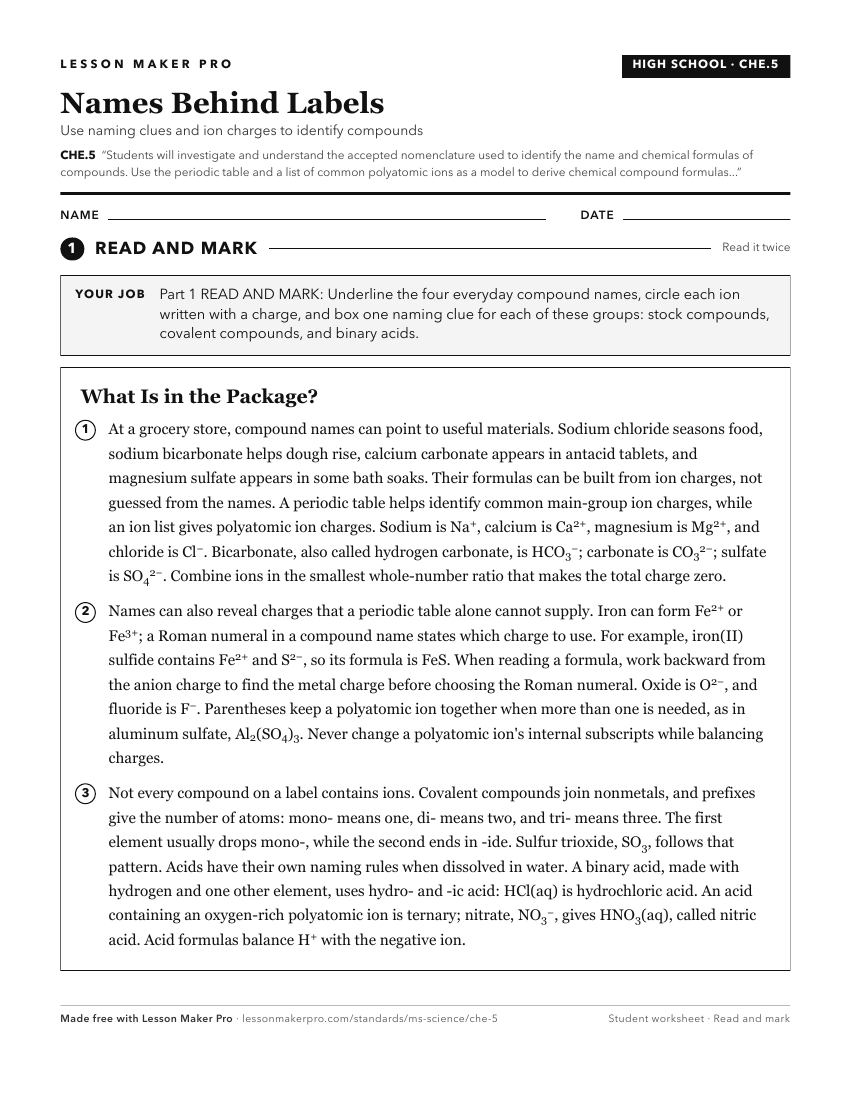
A ready-to-print activity worksheet aligned to CHE.5, with an answer key for the teacher on its own page. No account needed.
PDF, US Letter, prints cleanly in black and white.
Download the worksheetKeep exploring
Related Standards
- P.7.5D
Students will demonstrate an understanding of chemical formulas and common chemical substances to predict the types of reactions and possible outcomes of the re...
- CHE.4
Students will demonstrate an understanding of the types of bonds and resulting atomic structures for the classification of chemical compounds.
- CHE.6
Students will demonstrate an understanding of the types, causes, and effects of chemical reactions.
Turn this cluster into a lesson
Grade, subject, topic, and the complete cluster are prefilled. Create one free, no account needed.
Also for this cluster:Make a WorksheetMake a QuizMake a Sub Lesson