Mississippi Science P.7.5D
Standard Cluster
Students will demonstrate an understanding of chemical formulas and common chemical substances to predict the types of reactions and possible outcomes of the reactions. Analyze evidence from scientific investigations to predict likely outcomes of chemical reactions. Design and conduct scientific investigations to support evidence that chemical reactions (e.g., cooking, combustion, rusting, decomposition, photosynthesis, and cellular respiration) have occurred. Collect, organize, and interpret data using various tools (e.g., litmus paper, pH paper, cabbage juice) regarding neutralization of acids and bases using common substances. Build a model to explain that chemical reactions can store (formation of bonds) or release energy (breaking of bonds).
2026 Mississippi College- and Career-Readiness Standards for Science · Organization of Matter and Chemical Interactions
Cluster contents
Standards in This Cluster
P.7.5D is a cluster heading. These are the individual standards under it.
- P.7.5D.1
Analyze evidence from scientific investigations to predict likely outcomes of chemical reactions.
- P.7.5D.2
Design and conduct scientific investigations to support evidence that chemical reactions (e.g., cooking, combustion, rusting, decomposition, photosynthesis, and...
- P.7.5D.3
Collect, organize, and interpret data using various tools (e.g., litmus paper, pH paper, cabbage juice) regarding neutralization of acids and bases using common...
- P.7.5D.4
Build a model to explain that chemical reactions can store (formation of bonds) or release energy (breaking of bonds).
Teacher's field guide
What This Cluster Means
What Students Need to Do
- Students use formulas to identify reactants and predict possible products. They run a reaction and record evidence of change, including pH readings as an acid and base mix. They use a model to explain how bond changes affect energy.
What Mastery Looks Like
- Students use bubbles and pH readings to support a claim that vinegar and baking soda reacted. They identify the reactants and products from formulas. They explain that breaking bonds takes energy, forming bonds releases it, and the balance determines the overall energy change.
Common Misconceptions
- Students may treat a cabbage juice color change alone as proof that a new substance formed. They may think mixing any acid and base always gives a neutral result. They may think breaking bonds releases energy.
How to Assess It
- Exit ticket: Vinegar at pH 3 and baking soda fizz when mixed, then the mixture reads pH 6. Ask what evidence shows a reaction, whether the mixture is neutral, and whether forming new bonds takes or releases energy.
Lesson moves
Ways to Teach It
Add baking soda solution drop by drop to vinegar; record pH with test strips and note bubbles after each addition.
Ask: If cabbage juice changes color, does that alone prove a new substance formed? Have students explain their answer.
Give pairs cards labeled CH3COOH, NaHCO3, CO2, H2O, and CH3COONa; have them sort the formulas into reactants and products.
Show a video of a gas stove lighting; ask students to list evidence of a reaction and where the released energy goes.
Free download
Printable P.7.5D Worksheet
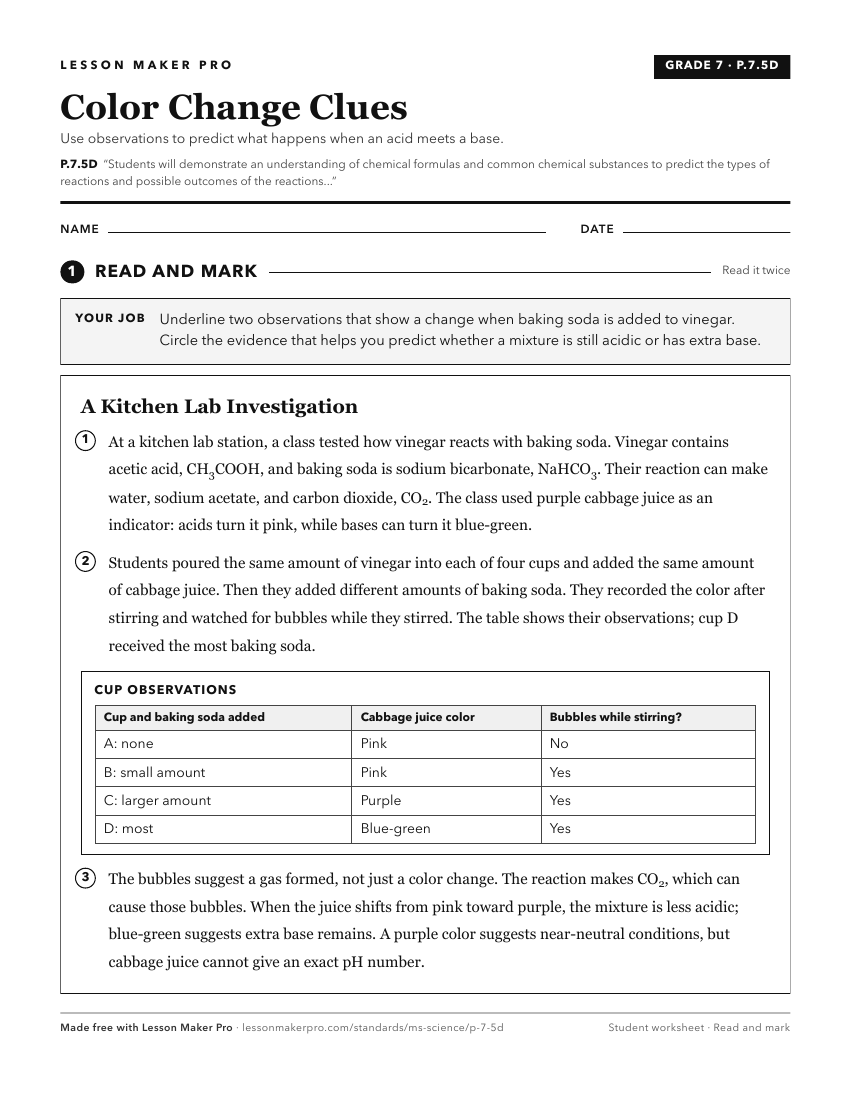
A ready-to-print activity worksheet aligned to P.7.5D, with an answer key for the teacher on its own page. No account needed.
PDF, US Letter, prints cleanly in black and white.
Download the worksheetKeep exploring
Related Standards
- CHE.5
Students will investigate and understand the accepted nomenclature used to identify the name and chemical formulas of compounds.
- P.7.5A
Students will demonstrate an understanding of the physical and chemical properties of matter.
- CHE.6
Students will demonstrate an understanding of the types, causes, and effects of chemical reactions.
- CHE.8
Students will demonstrate an understanding of the nature of properties of various types of chemical solutions.
Turn this cluster into a lesson
Grade, subject, topic, and the complete cluster are prefilled. Create one free, no account needed.
Also for this cluster:Make a WorksheetMake a QuizMake a Sub Lesson