Mississippi Science CHE.8
Standard Cluster
Students will demonstrate an understanding of the nature of properties of various types of chemical solutions. Use mathematical and computational analysis to quantitatively express the concentration of solutions using concepts such as molarity, percent by mass, and dilution. Develop and use models (e.g., online simulations, games, or video representations) to explain the dissolving process in solvents on the molecular level. Analyze and interpret data to predict the effect of temperature and pressure on solids and gases dissolved in water. Design, conduct, and communicate the results of experiments to test the conductivity of common ionic and covalent compounds in solution. Use mathematical and computational analysis to analyze molarity, molality, dilution, and percentage dilution problems. Design, conduct, and communicate the results of experiments to produce a specified volume of a solution of a specific molarity, and dilute a solution of a known molarity. Use mathematical and computational analysis to predict the results of reactions using the concentration of solutions (i.e., solution stoichiometry). Enrichment: Investigate parts per million and/or parts per billion as it applies to environmental concerns in your geographic region, and reference laws that govern these factors.
2026 Mississippi College- and Career-Readiness Standards for Science · Solutions
Cluster contents
Standards in This Cluster
CHE.8 is a cluster heading. These are the individual standards under it.
- CHE.8.1
Use mathematical and computational analysis to quantitatively express the concentration of solutions using concepts such as molarity, percent by mass, and dilut...
- CHE.8.2
Develop and use models (e.g., online simulations, games, or video representations) to explain the dissolving process in solvents on the molecular level.
- CHE.8.3
Analyze and interpret data to predict the effect of temperature and pressure on solids and gases dissolved in water.
- CHE.8.4
Design, conduct, and communicate the results of experiments to test the conductivity of common ionic and covalent compounds in solution.
- CHE.8.5
Use mathematical and computational analysis to analyze molarity, molality, dilution, and percentage dilution problems.
- CHE.8.6
Design, conduct, and communicate the results of experiments to produce a specified volume of a solution of a specific molarity, and dilute a solution of a known...
- CHE.8.7
Use mathematical and computational analysis to predict the results of reactions using the concentration of solutions (i.e., solution stoichiometry).
- CHE.8.8
Enrichment: Investigate parts per million and/or parts per billion as it applies to environmental concerns in your geographic region, and reference laws that go...
Teacher's field guide
What This Cluster Means
What Students Need to Do
- Students make and dilute solutions, then calculate their concentrations. They use concentration to predict reaction amounts. They model dissolving with particle drawings and use data to explain conductivity and solubility.
What Mastery Looks Like
- A student can calculate molarity, molality, mass percent, and dilution using the correct units. They can prepare a target concentration and use it to find how much product a reaction makes. They can explain why a solution conducts and predict how temperature and pressure affect dissolved solids and gases.
Common Misconceptions
- Students may confuse molarity with molality or use solvent volume instead of solution volume. Some think dilution removes solute, or that every dissolved substance conducts electricity. Others expect gases to dissolve better as water warms.
How to Assess It
- Exit ticket: You dilute 25.0 mL of 1.0 M NaCl to 100.0 mL. Calculate the new molarity, sketch the ions before and after dilution, and predict whether the final solution conducts electricity.
Lesson moves
Ways to Teach It
Have pairs make 100 mL of 0.10 M NaCl from a 1.0 M stock, then compare its conductivity with sugar water.
Show particle drawings of salt and sugar dissolving; ask students to explain why one solution conducts and the other does not.
Give groups five data cards on molarity, molality, mass percent, dilution, and solution reactions; have them calculate and check each answer.
Print a local water quality report; have students compare its nitrate reading with the legal limit and explain the difference.
Free download
Printable CHE.8 Worksheet
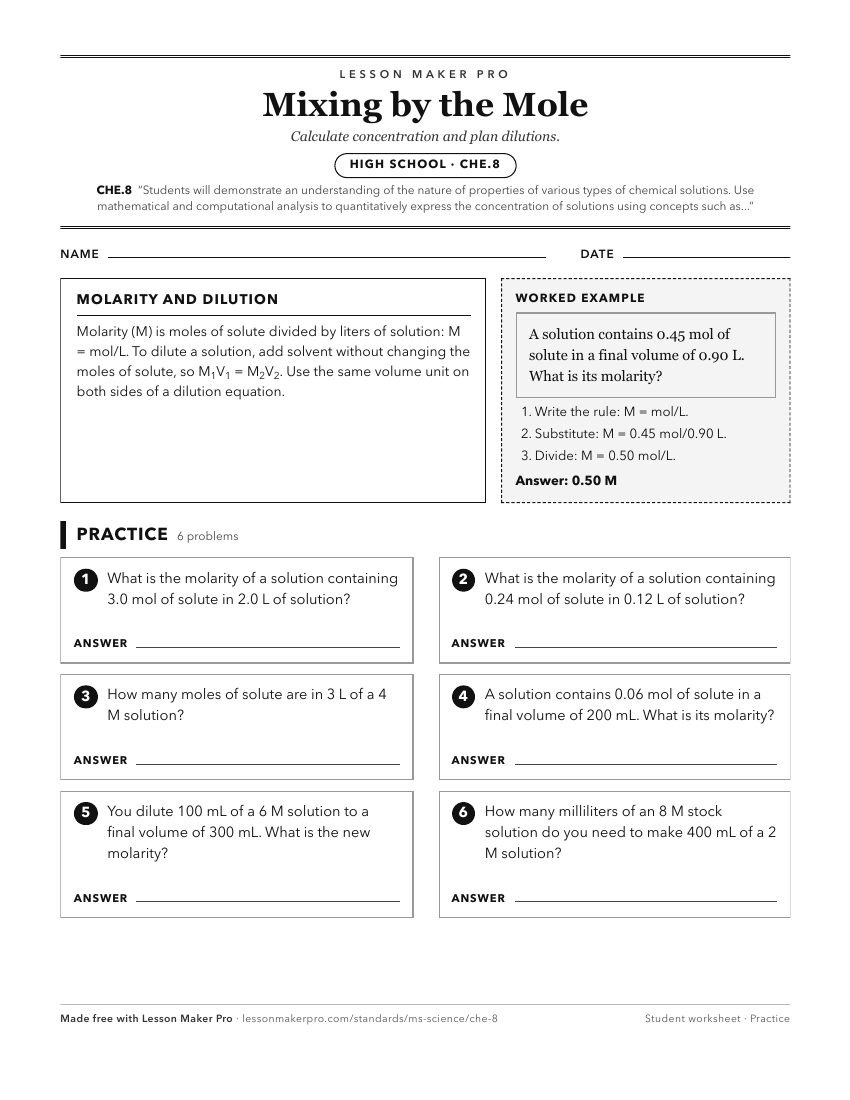
A ready-to-print activity worksheet aligned to CHE.8, with an answer key for the teacher on its own page. No account needed.
PDF, US Letter, prints cleanly in black and white.
Download the worksheetKeep exploring
Related Standards
- P.5.5C
Students will demonstrate an understanding of the difference between physical and chemical changes.
- P.7.5A
Students will demonstrate an understanding of the physical and chemical properties of matter.
- P.5.5B
Students will demonstrate an understanding of mixtures and solutions.
- CHE.6
Students will demonstrate an understanding of the types, causes, and effects of chemical reactions.
Turn this cluster into a lesson
Grade, subject, topic, and the complete cluster are prefilled. Create one free, no account needed.
Also for this cluster:Make a WorksheetMake a QuizMake a Sub Lesson