Mississippi Science P.5.5C
Standard Cluster
Students will demonstrate an understanding of the difference between physical and chemical changes. Analyze and communicate the results of chemical changes that result in the formation of new materials (e.g., decaying, burning, rusting, or cooking). Analyze and communicate the results of physical changes to a substance that results in a reversible change (e.g., changes in states of matter with the addition or removal of energy, changes in size or shape, or combining/separating mixtures or solutions). Analyze and interpret data to support claims that when two substances are mixed, the total weight of matter is conserved.
2026 Mississippi College- and Career-Readiness Standards for Science · Organization of Matter and Chemical Interactions
Cluster contents
Standards in This Cluster
P.5.5C is a cluster heading. These are the individual standards under it.
- P.5.5C.1
Analyze and communicate the results of chemical changes that result in the formation of new materials (e.g., decaying, burning, rusting, or cooking).
- P.5.5C.2
Analyze and communicate the results of physical changes to a substance that results in a reversible change (e.g., changes in states of matter with the addition ...
- P.5.5C.3
Analyze and interpret data to support claims that when two substances are mixed, the total weight of matter is conserved.
Teacher's field guide
What This Cluster Means
What Students Need to Do
- Students tell whether a change makes a new material or only changes a material's form. They describe what happens during rusting, cooking, and melting. They use measurements to show that mixing substances does not change their total mass.
What Mastery Looks Like
- A student can explain why rusting makes a new material but melting ice does not, and show how melted ice can refreeze. They use before-and-after mass readings from a sealed bag to show that matter remains when gas forms.
Common Misconceptions
- Students may call any visible change chemical, including melting ice or bending a nail. They may think bubbles always prove a chemical change, or that gas escaping means matter has disappeared.
How to Assess It
- Exit ticket: Ice melts while vinegar and baking soda react in a sealed bag. Label each change and explain why the bag has the same mass before and after mixing.
Lesson moves
Ways to Teach It
Weigh a sealed bag with vinegar in a cup and baking soda beside it; tip the cup, watch what happens, and reweigh.
Compare a rusty nail with a bent nail; ask students to write which formed a new material and what evidence supports their claim.
Sort cards showing melting ice, burning toast, tearing paper, and frying eggs; ask pairs to defend their placement of one card.
Show melted butter and a cooked egg; ask which change can be reversed by cooling and why.
Free download
Printable P.5.5C Worksheet
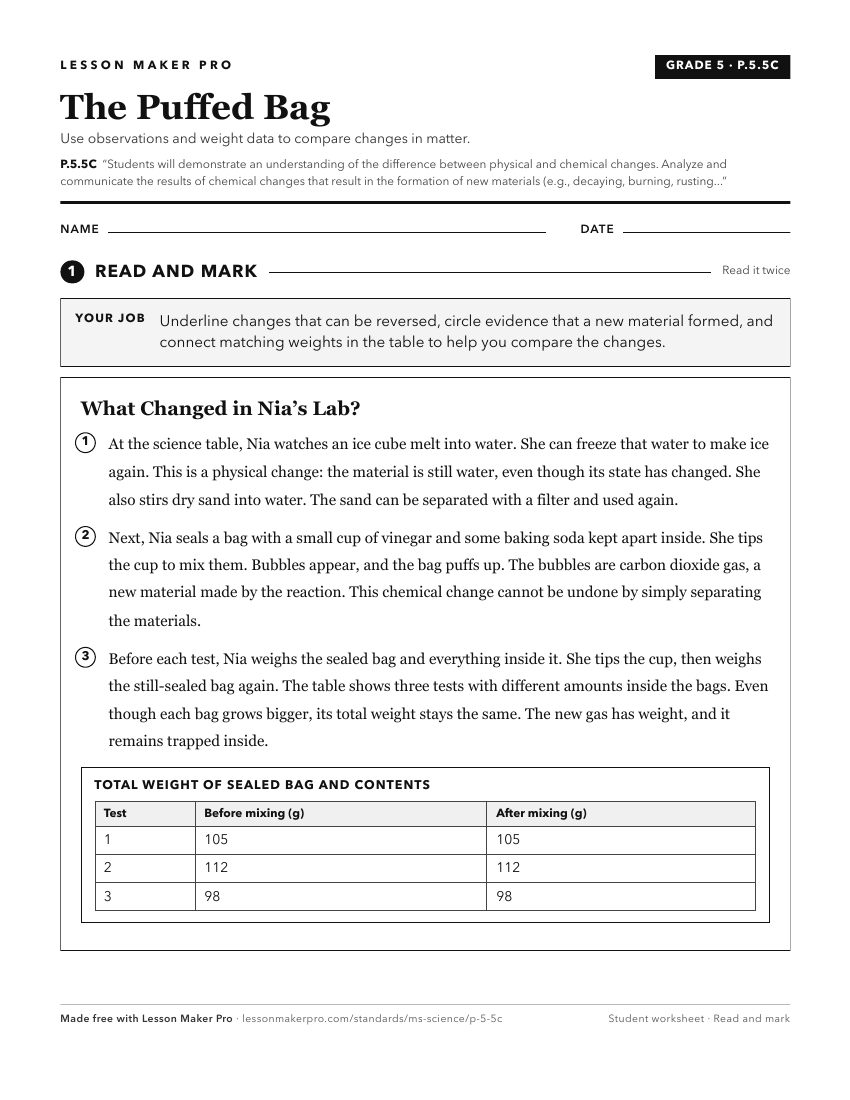
A ready-to-print activity worksheet aligned to P.5.5C, with an answer key for the teacher on its own page. No account needed.
PDF, US Letter, prints cleanly in black and white.
Download the worksheetKeep exploring
Related Standards
- P.7.5A
Students will demonstrate an understanding of the physical and chemical properties of matter.
- P.5.5A
Students will demonstrate an understanding of the physical properties of matter.
- P.2.5
Students will demonstrate an understanding of the properties of matter.
- CHE.6
Students will demonstrate an understanding of the types, causes, and effects of chemical reactions.
Turn this cluster into a lesson
Grade, subject, topic, and the complete cluster are prefilled. Create one free, no account needed.
Also for this cluster:Make a WorksheetMake a QuizMake a Sub Lesson