Mississippi Science P.5.5C.3
The Standard
- P.5.5C
- Students will demonstrate an understanding of the difference between physical and chemical changes.
Analyze and interpret data to support claims that when two substances are mixed, the total weight of matter is conserved.
2026 Mississippi College- and Career-Readiness Standards for Science · Organization of Matter and Chemical Interactions
Teacher's field guide
What This Standard Means
What Students Need to Do
- Students compare the total weight of two substances before mixing with the weight afterward. They use the measurements to support a claim about what happens to matter.
What Mastery Looks Like
- A student cites before-and-after weights as evidence that the total stays the same. They explain that a sealed container keeps all the matter, including any gas that forms, in the measurement.
Common Misconceptions
- Students may think dissolved salt has disappeared or that bubbles have no weight. They may treat a lower reading from an open container as proof that matter was destroyed.
How to Assess It
- Exit ticket: A sealed bag weighs 48 g before salt and water mix and 48 g afterward. Write a claim about the total weight and cite both readings.
Lesson moves
Ways to Teach It
Place separate cups of salt and water inside a sealed zip bag, weigh it, mix without opening it, and weigh it again.
Ask why an open cup of vinegar and baking soda might weigh less after mixing, then have students write where the missing matter went.
Give pairs cards with before-and-after weights for sealed mixtures; have them match equal totals and flag readings that need a recheck.
Weigh a bottle of water and drink powder packet together, mix them, then weigh the capped bottle and empty packet together.
Free download
Printable P.5.5C.3 Worksheet
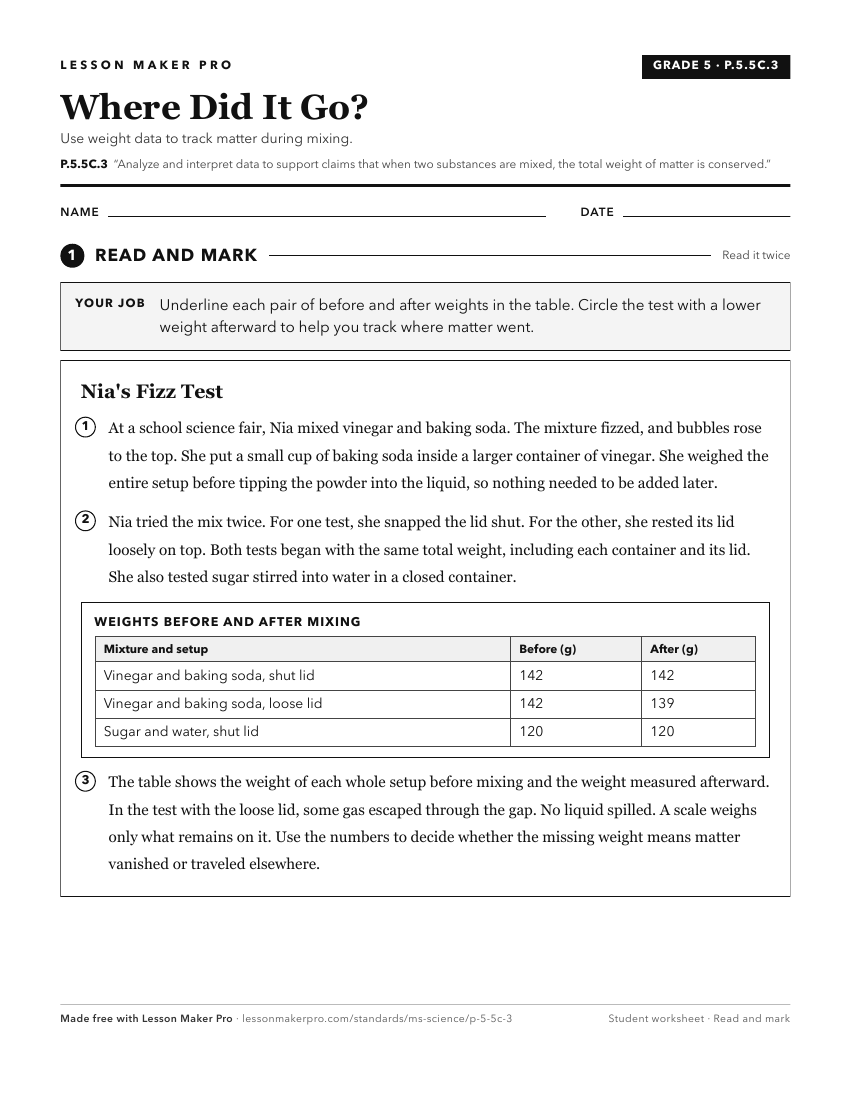
A ready-to-print activity worksheet aligned to P.5.5C.3, with an answer key for the teacher on its own page. No account needed.
PDF, US Letter, prints cleanly in black and white.
Download the worksheetKeep exploring
Related Standards
- PHS.4.4
Use mathematical and computational analysis to examine evidence that mass is conserved in chemical reactions using simple stoichiometry problems (1:1 mole ratio...
- P.5.5B.2
Analyze and interpret data to communicate that the concentration of a solution is determined by the relative amount of solute versus solvent in various mixtures...
- CHE.6.4
Use mathematics and computational analysis to support the claim that atoms, and therefore mass, are conserved during a chemical reaction. Give real-world exampl...
- P.7.5E.1
Conduct simple scientific investigations to show that total mass is not altered during a chemical reaction in a closed system. Compare results of investigations...
Turn this exact standard into a lesson
Grade, subject, topic, and the complete standard are prefilled. Create one free, no account needed.
Also for this standard:Make a WorksheetMake a QuizMake a Sub Lesson