Mississippi Science CHE.6.4
The Standard
- CHE.6
- Students will demonstrate an understanding of the types, causes, and effects of chemical reactions.
Use mathematics and computational analysis to support the claim that atoms, and therefore mass, are conserved during a chemical reaction. Give real-world examples (e.g., burning wood).
2026 Mississippi College- and Career-Readiness Standards for Science · Chemical Reactions
Teacher's field guide
What This Standard Means
What Students Need to Do
- Students count atoms on both sides of a reaction and add up the mass on each side. They use the numbers to explain why burning wood seems to lose mass when gases escape.
What Mastery Looks Like
- A student can make an atom-count table and show that the total mass of the reactants equals the total mass of the products. They can explain why ash weighs less than the original wood by accounting for incoming oxygen and escaping gases.
Common Misconceptions
- Students may think atoms disappear when wood burns because little ash remains. They may compare only the wood and ash, leaving out oxygen from the air and gases that escape.
How to Assess It
- Exit ticket: For C + O2 → CO2, list the atoms on each side and find the product mass if 12 g of carbon reacts with 32 g of oxygen. Explain your answer.
Lesson moves
Ways to Teach It
Place vinegar and baking soda in separate bottle caps inside a zip bag, seal it, weigh it, mix, and weigh again.
Ask pairs: 'Why does a burned log leave so little ash?' Require an answer naming incoming oxygen and escaping gases.
Enter atom counts for 2H2 + O2 → 2H2O in a spreadsheet, then use SUM to compare each element across sides.
Label a campfire photo with incoming oxygen, escaping carbon dioxide and water vapor, and remaining ash.
Free download
Printable CHE.6.4 Worksheet
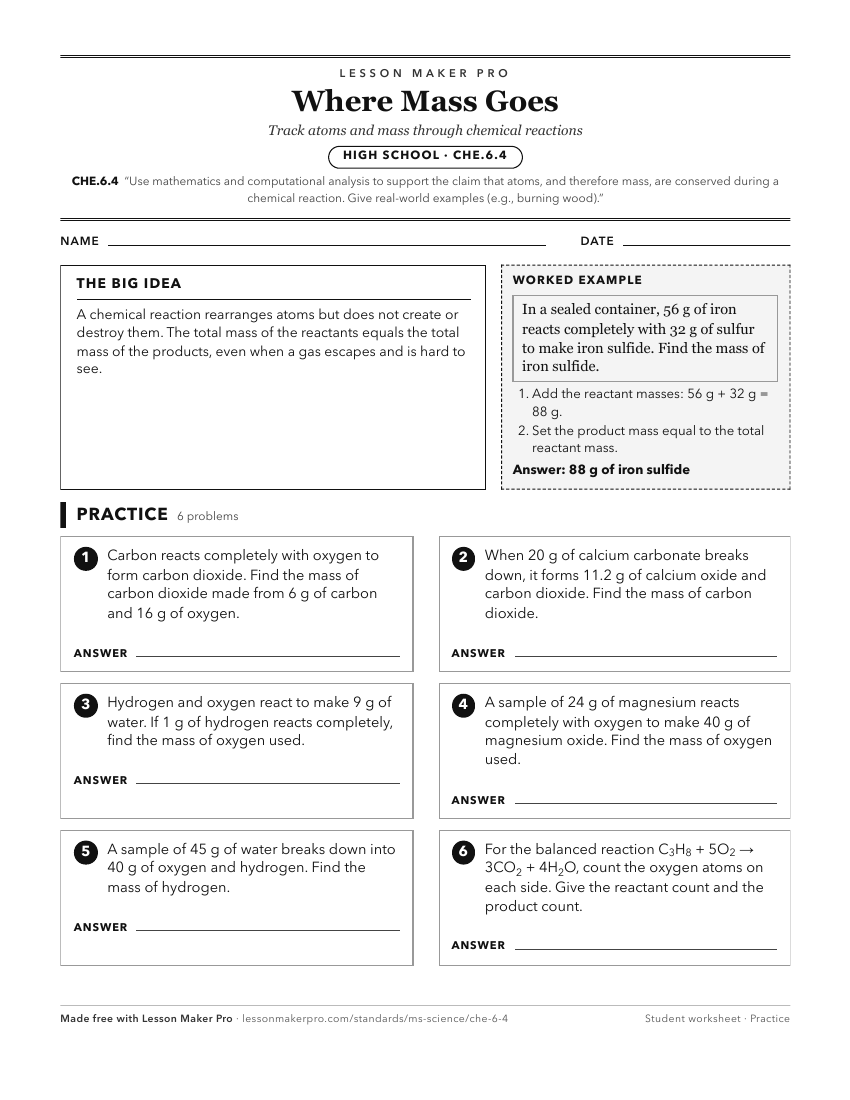
A ready-to-print activity worksheet aligned to CHE.6.4, with an answer key for the teacher on its own page. No account needed.
PDF, US Letter, prints cleanly in black and white.
Download the worksheetKeep exploring
Related Standards
- PHS.4.4
Use mathematical and computational analysis to examine evidence that mass is conserved in chemical reactions using simple stoichiometry problems (1:1 mole ratio...
- P.7.5E.1
Conduct simple scientific investigations to show that total mass is not altered during a chemical reaction in a closed system. Compare results of investigations...
- PHS.4.2
Design and conduct investigations to produce evidence that mass is conserved in chemical reactions (e.g., vinegar and baking soda in a Ziploc© bag).
- P.5.5C.3
Analyze and interpret data to support claims that when two substances are mixed, the total weight of matter is conserved.
Turn this exact standard into a lesson
Grade, subject, topic, and the complete standard are prefilled. Create one free, no account needed.
Also for this standard:Make a WorksheetMake a QuizMake a Sub Lesson