Mississippi Science CHE.6
Standard Cluster
Students will demonstrate an understanding of the types, causes, and effects of chemical reactions. Develop and use models to predict the products of chemical reactions (e.g., synthesis reactions; single replacement; double displacement; and decomposition, including exceptions such as decomposition of hydroxides, chlorates, carbonates, and acids). Discuss and/or compile lists of reactions used in everyday life. Plan, conduct, and communicate the results of investigations to demonstrate different types of simple chemical reactions. Use mathematics and computational analysis to represent the ratio of reactants and products in terms of masses, molecules, and moles (stoichiometry). Use mathematics and computational analysis to support the claim that atoms, and therefore mass, are conserved during a chemical reaction. Give real-world examples (e.g., burning wood). Plan and conduct a controlled scientific investigation to produce mathematical evidence that mass is conserved. Use percent error to analyze the accuracy of results. Use mathematics and computational analysis to support the concept of percent yield and limiting reagent. Plan and conduct a controlled scientific investigation to produce mathematical evidence to predict and confirm the limiting reagent and percent yield in the reaction. Analyze quantitative data, draw conclusions, and communicate findings. Compare and analyze class data for validity.
2026 Mississippi College- and Career-Readiness Standards for Science · Chemical Reactions
Cluster contents
Standards in This Cluster
CHE.6 is a cluster heading. These are the individual standards under it.
- CHE.6.1
Develop and use models to predict the products of chemical reactions (e.g., synthesis reactions; single replacement; double displacement; and decomposition, inc...
- CHE.6.2
Plan, conduct, and communicate the results of investigations to demonstrate different types of simple chemical reactions.
- CHE.6.3
Use mathematics and computational analysis to represent the ratio of reactants and products in terms of masses, molecules, and moles (stoichiometry).
- CHE.6.4
Use mathematics and computational analysis to support the claim that atoms, and therefore mass, are conserved during a chemical reaction. Give real-world exampl...
- CHE.6.5
Plan and conduct a controlled scientific investigation to produce mathematical evidence that mass is conserved. Use percent error to analyze the accuracy of res...
- CHE.6.6
Use mathematics and computational analysis to support the concept of percent yield and limiting reagent.
- CHE.6.7
Plan and conduct a controlled scientific investigation to produce mathematical evidence to predict and confirm the limiting reagent and percent yield in the rea...
Teacher's field guide
What This Cluster Means
What Students Need to Do
- Students draw atom models to predict products of synthesis, single replacement, double displacement, and decomposition reactions. They check special breakdown rules for hydroxides, chlorates, carbonates, and acids. They use balanced equations and lab measurements to calculate mass, limiting reactants, and percent yield.
What Mastery Looks Like
- A student can predict products, balance the equation, and use mole ratios to calculate expected amounts. They can identify the limiting reactant and calculate percent yield. They use percent error and class results to judge whether measurements support mass conservation.
Common Misconceptions
- Students may swap parts of formulas without checking charges or special decomposition rules. They may think mass disappears when a reaction releases gas. They may use gram amounts as mole ratios or divide actual yield by the wrong amount.
How to Assess It
- Exit ticket: CaCl2 + Na2CO3 → CaCO3 + NaCl, with 0.020 mol CaCl2, 0.030 mol Na2CO3, and 1.80 g of CaCO3 collected. Balance the equation, name the limiting reactant, and find percent yield using 100 g/mol for CaCO3.
Lesson moves
Ways to Teach It
Mix measured calcium chloride and sodium carbonate solutions, vary one amount, then filter, dry, and weigh the precipitate against the predicted yield.
Give pairs two sealed-bag mass records; ask them to identify a likely leak and defend their choice using percent error.
Deal reaction cards; teams sketch products for synthesis, single replacement, double displacement, and decomposition, then check exception cards for chlorates and hydroxides.
Show a photo of a burned log and its ash; have students account for wood, oxygen, carbon dioxide, water vapor, and ash.
Free download
Printable CHE.6 Worksheet
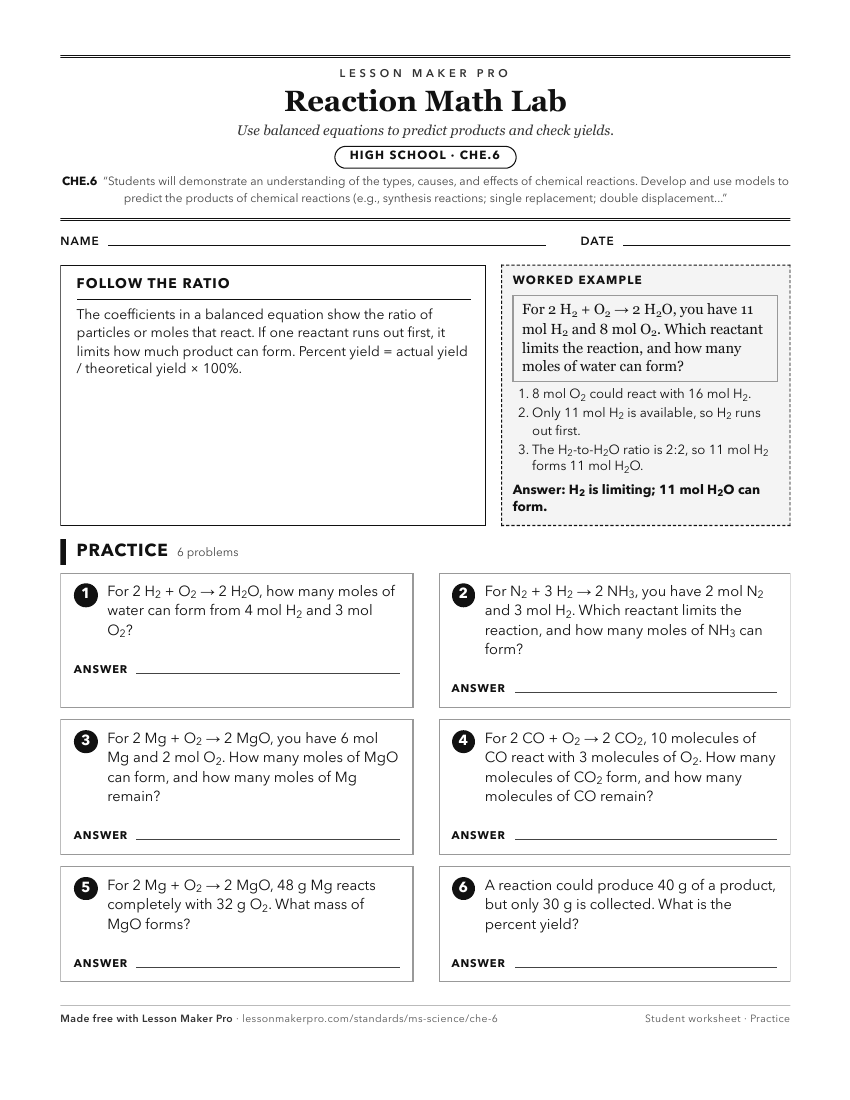
A ready-to-print activity worksheet aligned to CHE.6, with an answer key for the teacher on its own page. No account needed.
PDF, US Letter, prints cleanly in black and white.
Download the worksheetKeep exploring
Related Standards
- P.5.5C
Students will demonstrate an understanding of the difference between physical and chemical changes.
- P.7.5D
Students will demonstrate an understanding of chemical formulas and common chemical substances to predict the types of reactions and possible outcomes of the re...
- P.7.5A
Students will demonstrate an understanding of the physical and chemical properties of matter.
- CHE.8
Students will demonstrate an understanding of the nature of properties of various types of chemical solutions.
Turn this cluster into a lesson
Grade, subject, topic, and the complete cluster are prefilled. Create one free, no account needed.
Also for this cluster:Make a WorksheetMake a QuizMake a Sub Lesson